Form: DRS

Draft Registration Statement

TABLE OF CONTENTS

As confidentially submitted to the Securities and Exchange Commission on January 15, 2026.
This draft registration statement has not been filed publicly with the Securities and Exchange Commission and all
information herein remains strictly confidential.
Registration No. 333-  
UNITED STATES
SECURITIES AND EXCHANGE COMMISSION
Washington, D.C. 20549
FORM S-1
REGISTRATION STATEMENT
UNDER
THE SECURITIES ACT OF 1933
FIRST CAROLINA FINANCIAL SERVICES, INC.
(Exact name of registrant as specified in its charter)
North Carolina
6022
27-2136973
(State or other jurisdiction of
incorporation or organization)
(Primary Standard Industrial
Classification Code Number)
(I.R.S. Employer
Identification Number)
2626 Glenwood Avenue, Suite 200
Raleigh, NC 27608
(252) 937-2152
(Address, including zip code, and telephone number, including area code, of registrant’s principal executive offices)
Ronald A. Day
President and Chief Executive Officer
First Carolina Financial Services, Inc.
2626 Glenwood Avenue, Suite 200
Raleigh, NC 27608
(252) 937-2152
(Name, address, including zip code, and telephone number, including area code, of agent for service)
Copies to:
Michael P. Reed
Dwight S. Yoo
Skadden, Arps, Slate, Meagher & Flom LLP
One Manhattan West
New York, NY 10001
(212) 735-3000
Stuart M. Rigot
General Counsel and Chief Legal
Officer First Carolina Financial Services, Inc.
2626 Glenwood Avenue, Suite 200
Raleigh, NC 27608
(252) 937-2152
Seth A. Winter
Alexander T. Yarbrough
Troutman Pepper Locke LLP
1001 Haxall Point, 15th Floor
Richmond, VA 23219
(804) 697-1200
Approximate date of commencement of proposed sale to public: As soon as practicable after this registration statement is declared effective.
If any of the securities being registered on this Form are to be offered on a delayed or continuous basis pursuant to Rule 415 under the Securities Act of 1933, check the following box.
If this Form is filed to register additional securities for an offering pursuant to Rule 462(b) under the Securities Act, please check the following box and list the Securities Act registration statement number of the earlier effective registration statement for the same offering.
If this Form is a post-effective amendment filed pursuant to Rule 462(c) under the Securities Act, check the following box and list the Securities Act registration statement number of the earlier effective registration statement for the same offering.
If this Form is a post-effective amendment filed pursuant to Rule 462(d) under the Securities Act, check the following box and list the Securities Act registration statement number of the earlier effective registration statement for the same offering.
Indicate by check mark whether the registrant is a large accelerated filer, an accelerated filer, a non-accelerated filer, a smaller reporting company, or an emerging growth company. See the definitions of “large accelerated filer,” “accelerated filer,” “smaller reporting company,” and “emerging growth company” in Rule 12b-2 of the Exchange Act.
Large accelerated filer
Accelerated filer
Non-accelerated filer
Smaller reporting company
 
 
Emerging growth company
If an emerging growth company, indicate by check mark if the registrant has elected not to use the extended transition period for complying with any new or revised financial accounting standards provided to Section 7(a)(2)(B) of the Securities Act.
The registrant hereby amends this registration statement on such date or dates as may be necessary to delay its effective date until the registrant shall file a further amendment which specifically states that this registration statement shall thereafter become effective in accordance with Section 8(a) of the Securities Act, or until the registration statement shall become effective on such date as the Securities and Exchange Commission, acting pursuant to said Section 8(a), may determine.

TABLE OF CONTENTS

The information in this preliminary prospectus is not complete and may be changed. We may not sell these securities or accept your offer to buy any of them until the registration statement filed with the Securities and Exchange Commission is declared effective. This preliminary prospectus is not an offer to sell nor does it seek an offer to buy these securities in any jurisdiction where the offer or sale is not permitted.
SUBJECT TO COMPLETION, DATED JANUARY 15, 2026
PRELIMINARY PROSPECTUS

Shares

Common Stock
This prospectus relates to the initial public offering of shares of common stock of First Carolina Financial Services, Inc., a North Carolina corporation and the bank holding company for First Carolina Bank, our principal subsidiary and a North Carolina state-chartered bank.
We are offering    shares of our common stock. Prior to this offering, there has been no public market for our common stock. We currently expect the initial public offering price per share of our common stock to be between $   and $  . We have applied to list our common stock on the    under the symbol “FCBM.”
We are an “emerging growth company” as defined in the Jumpstart Our Business Startups Act of 2012 and, as a result, are subject to reduced public company disclosure standards. See the section entitled “Implications of Being an Emerging Growth Company.”
Investing in our common stock involves risks. See the section entitled “Risk Factors,” beginning on page 26 to read about factors you should consider before investing in our common stock.
None of the United States Securities and Exchange Commission, any state securities commission, the Federal Deposit Insurance Corporation, the Board of Governors of the Federal Reserve System nor any other regulatory body has approved or disapproved of these securities or passed upon the accuracy or adequacy of this prospectus. Any representation to the contrary is a criminal offense.
 
Per Share
Total
Initial public offering price
$   
$   
Underwriting discount(1)
$
$
Proceeds before expenses, to us
$
$
(1)
See the section entitled “Underwriting” for additional information regarding underwriting compensation.
We have granted the underwriters an option for a period of 30 days from the date of this prospectus to purchase up to an additional    shares of our common stock at the initial public offering price, less underwriting discounts and commissions.
These securities are not deposits, savings accounts or other obligations of any bank or savings association and are not insured or guaranteed by the Federal Deposit Insurance Corporation or any other governmental agency and are subject to investment risks, including the possible loss of the entire amount you invest.
The underwriters expect to deliver the shares of our common stock to purchasers on or about    , 2026, subject to customary closing conditions.


Keefe, Bruyette & Woods
 
 
A Stifel Company
 
Prospectus dated   , 2026.

TABLE OF CONTENTS

TABLE OF CONTENTS
 
Page
Through and including   , 2026 (the 25th day after the date of this prospectus), all dealers effecting transactions in these securities, whether or not participating in this offering, may be required to deliver a prospectus. This is in addition to a dealer’s obligation to deliver a prospectus when acting as an underwriter and with respect to an unsold allotment or subscription.
We and the underwriters have not authorized anyone to provide any information or to make any representations other than those contained in this prospectus or in any free writing prospectus we have prepared or that has been prepared on our behalf or to which we have referred you. We and the underwriters take no responsibility for, and can provide no assurance as to the reliability of, any other information that others may give you. This prospectus is an offer to sell only the shares of common stock offered by this prospectus, and only under circumstances and in jurisdictions where it is lawful to do so. The information contained in this prospectus is current only as of the date of this prospectus. Our business, financial condition, and results of operations may have changed since that date.
For investors outside the United States: neither we nor the underwriters have done anything that would permit this offering or possession or distribution of this prospectus or any free writing prospectus in connection with this offering in any jurisdiction where action for that purpose is required, other than in the United States. Persons outside of the United States who come into possession of this prospectus must inform themselves about, and observe any restrictions relating to, the offering of the shares of common stock and the distribution of this prospectus outside of the United States. See the section entitled “Underwriting.”
i

TABLE OF CONTENTS

CERTAIN DEFINED TERMS
Unless we state otherwise or the context otherwise requires, references in this prospectus to:
ACH
Automated Clearing House
AMLA
Anti-Money Laundering Act of 2020
Articles
Our Articles of Incorporation and all amendments thereto
Bank
First Carolina Bank
BHCA
U.S. Bank Holding Company Act of 1956, as amended
Bylaws
Our Amended and Restated Bylaws
CAC
Customer acquisition cost
CAGR
Compound annual growth rate
CFPB
Consumer Financial Protection Bureau
Code
Internal Revenue Code of 1986, as amended
Common stock
Our common stock, par value $1.00 per share
CRA
Community Reinvestment Act of 1977, as amended
DIF
Deposit Insurance Fund
DOE
U.S. Department of Education
Exchange Act
Securities Exchange Act of 1934, as amended
FDIC
Federal Deposit Insurance Corporation
FHLB
Federal Home Loan Bank
FASB
Financial Accounting Standard Board
FOMC
Federal Open Market Committee
FRB
Federal Reserve Bank of Richmond, acting under delegated authority from the Federal Reserve, the primary federal regulator of the Company
FDI Act
Federal Deposit Insurance Act, as amended
GAAP
U.S. Generally Accepted Accounting Principles
IRS
Internal Revenue Service
Federal Reserve
Board of Governors of the Federal Reserve System
JOBS Act
Jumpstart Our Business Startups Act of 2012, as amended
NCBCA
North Carolina Business Corporation Act
NCCOB
North Carolina Commissioner of Banks
OCC
Office of the Comptroller of the Currency
Sarbanes-Oxley Act
Sarbanes-Oxley Act of 2002, as amended
SEC
U.S. Securities and Exchange Commission
Securities Act
Securities Act of 1933, as amended
USA PATRIOT Act
USA PATRIOT Act of 2001, as amended
ii

TABLE OF CONTENTS

ABOUT THIS PROSPECTUS
In this prospectus, “we,” “our,” “us,” “First Carolina,” our “Company,” the “Company,” and the “Registrant” refer to First Carolina Financial Services, Inc., a North Carolina corporation, and its direct and indirect consolidated subsidiaries. The Bank is a North Carolina-chartered bank and wholly owned subsidiary of First Carolina Financial Services, Inc. BM Technologies, Inc., a Delaware corporation, is a wholly owned subsidiary of the Bank and the parent company of BMTX, Inc. We refer to BM Technologies, Inc. and its subsidiary, BMTX, Inc., collectively, as our “Payments business” or “BM Tech.”
Certain amounts, percentages, and other figures presented in this prospectus have been subject to rounding adjustments. Accordingly, figures shown as totals, dollars or percentage amounts of changes may not represent the arithmetic summation or calculation of the figures that precede them.
INDUSTRY AND MARKET DATA
This prospectus includes statistical and other industry and market data that we obtained from government reports and other third-party sources. Our internal data, estimates and forecasts are based on information obtained from government reports, trade and business organizations and other contacts in the markets in which we operate and our management’s understanding of industry conditions. Although we believe that this information (including the industry publications and third-party research, surveys and studies) is accurate and reliable, we have not independently verified such information. In addition, estimates, forecasts and assumptions are necessarily subject to a high degree of uncertainty and risk due to a variety of factors, including those described in the section entitled “Risk Factors” and elsewhere in this prospectus. Finally, forward-looking information obtained from these sources is subject to the same qualifications and the additional uncertainties regarding the other forward-looking statements in this prospectus.
TRADEMARKS, SERVICE MARKS, AND TRADENAMES
We own or otherwise have rights to the trademarks, service marks, and tradenames, including those mentioned in this prospectus, used in conjunction with the operation of our business. This prospectus includes our own trademarks, service marks and tradenames which are protected under applicable intellectual property laws, as well as trademarks, service marks and tradenames of other companies, which are the property of their respective owners. We do not intend our use or display of other companies’ trademarks, service marks or tradenames to imply a relationship with, or endorsement or sponsorship of us by, any other companies. Solely for convenience, our trademarks, service marks and tradenames referred to in this prospectus may appear without the ®, ™, or SM symbols, but such references are not intended to indicate, in any way, that we will not assert, to the fullest extent under applicable law, our rights, or the rights of the applicable licensor to these trademarks, service marks and tradenames.
iii

TABLE OF CONTENTS

PROSPECTUS SUMMARY
This summary highlights selected information contained in this prospectus. This summary does not contain all the information that you should consider before investing in our common stock. You should read the entire prospectus carefully, including the sections entitled “Risk Factors,” “Cautionary Note Regarding Forward-Looking Statements” and “Management’s Discussion and Analysis of Financial Condition and Results of Operations,” and our historical financial statements and the accompanying notes included in this prospectus.
Company Overview
First Carolina is a high-performing, opportunistically driven financial services company with a focused banking footprint and a national financial services business. We are dedicated to providing innovative banking solutions and financial services to a diverse client base that totals over 531,000 customer deposit accounts (as of December 31, 2025), including small and medium-sized businesses, individuals, professionals, as well as institutions of higher education. Our core values: being enterprising, intentional, responsive and considerate, underpin both how we operate and serve our customers and communities.
Our history of profitability and prudent expense management is matched by our commitment to innovation. Through 2024 and 2025 we made strategic investments to build a platform capable of supporting long-term scale that we believe are essential to achieving increased future operating leverage. We remain confident in our ability to return to and exceed historical levels of profitability as these investments mature. We have a technology-forward platform that we believe augments our sophisticated commercial and consumer banking divisions and enhances our enterprise risk management operations while improving and expanding the suite of offerings we can provide to our customers. We manage and curate data as a corporate asset and are deploying scalable, data-driven marketing and risk mitigation initiatives based upon proven methodologies of automated portfolio screening, advanced diagnostic evaluations, defined outcome protocols, and applied treatments.
As of December 31, 2025, we had total assets of $    billion, total loans of $    billion, total deposits of $    billion, and total shareholders’ equity of $    million. First Carolina owns 100% of the issued and outstanding capital stock of the Bank. Our deposit accounts are insured to the maximum extent permitted by applicable law.
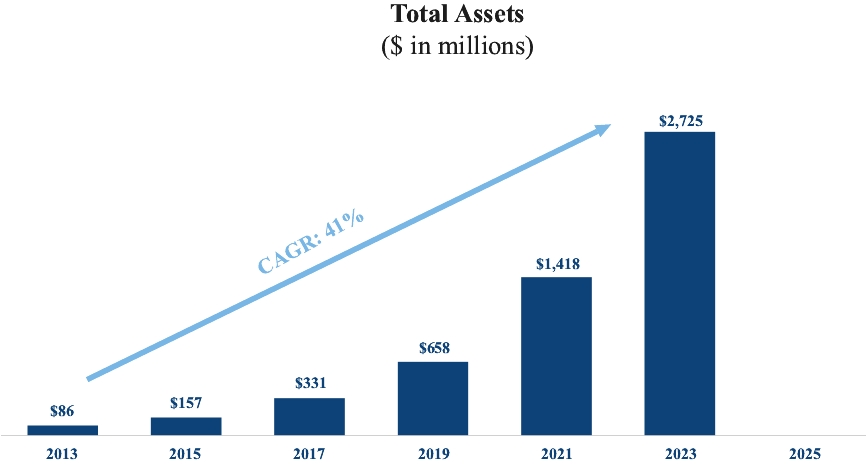
Since our inception in 2012, we have successfully raised approximately $313.9 million in capital across eleven private placements—a testament to our robust access to command capital outside the public markets, on our own terms. We believe this repeated success underscores our deep network of committed stakeholders, our strong relationships within the investor community and our successful ability to grow while delivering great financial performance for our shareholders.

Our Diversified Business Model
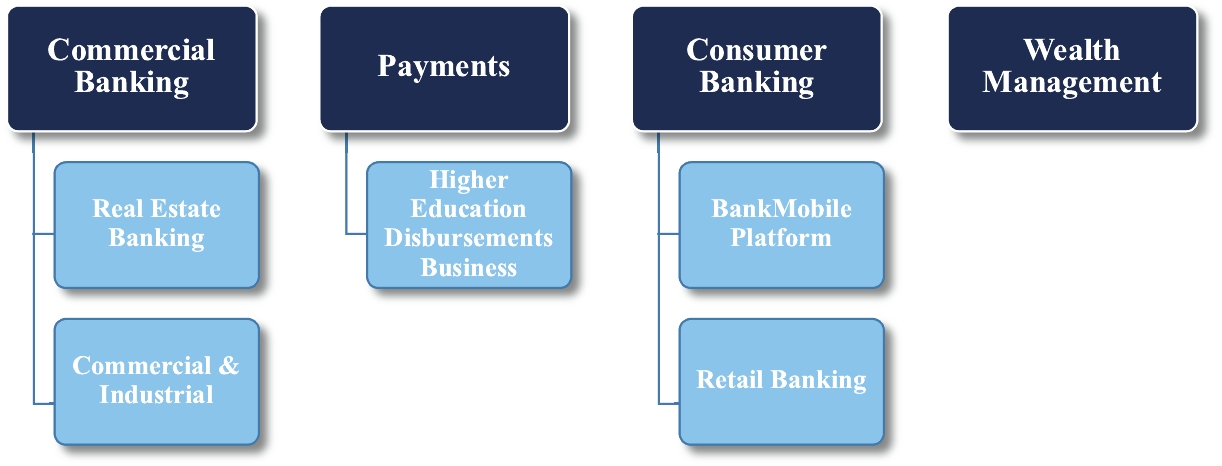
We have four primary lines of business: Commercial Banking, Payments, Consumer Banking and Wealth Management. Consistent across these lines of business is our steadfast focus on personalized, relationship-driven service underpinned by market and product expertise. Each business has experienced leadership that partners with market and industry executives for execution tailored to the respective business and geography.
1

TABLE OF CONTENTS

We aim to drive financial performance through this diversified business model and believe that our business lines will enable us to capitalize on a wide range of strategic opportunities. Our Commercial Banking business has significant headroom for growth and margin expansion, as older fixed-rate loans originated during lower rate environments pay off and we make new variable-rate loans in today’s comparatively higher rate environment. Parallel to our lending growth, we are aggressively expanding our treasury management and commercial deposit platform. By providing mission-critical liquidity management and automated payment solutions to our corporate clients, we are securing low-cost, ‘sticky’ operating deposits that serve as a foundational funding source. We aim to attract additional deposits through our Payments relationships with higher education institutions, and we expect that such additional deposits will help us manage wholesale borrowings and improve our overall cost of funds. We believe our Consumer Banking business and technological capabilities give us a unique opportunity to graduate student deposit accounts into long-term, franchise banking relationships.


Commercial Banking Operations
Primarily serving our core Southeast markets, our Commercial Banking line of business is made up of our Real Estate Banking and Commercial & Industrial Banking divisions.
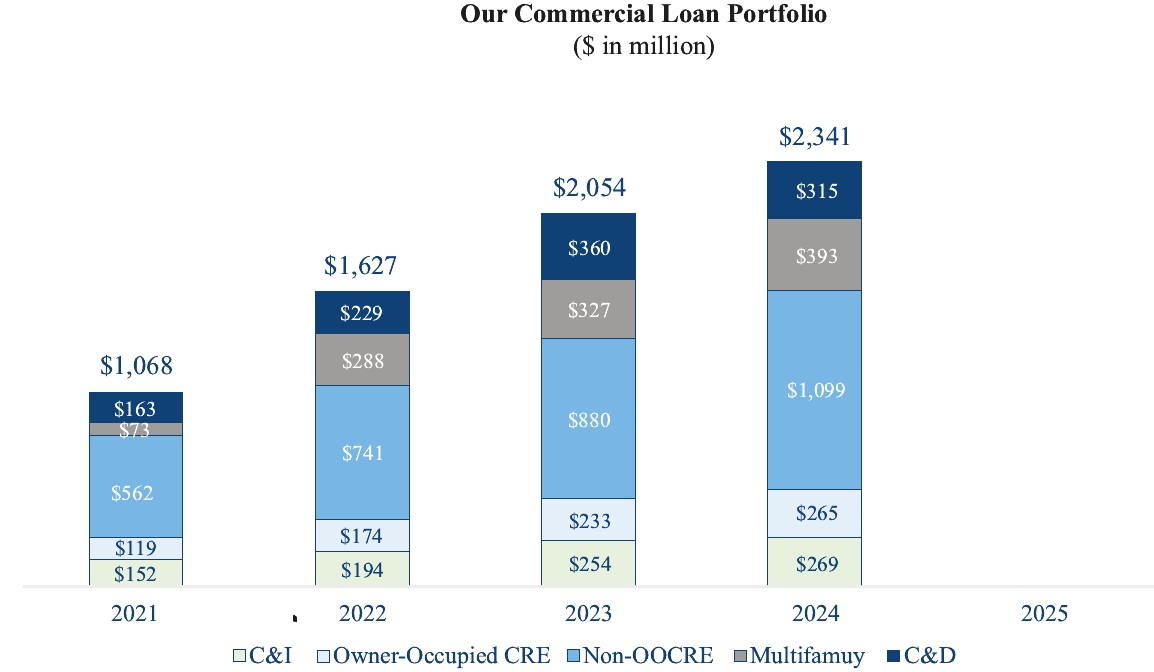
Real Estate Banking. Our Real Estate Banking division delivers term and construction financing solutions for commercial real estate (“CRE”) properties. Our team of CRE lending experts provides financing for CRE purchases, rehabilitation/repositioning and refinancings by deploying local market expertise and building strong relationships to understand the needs of our customers. The success of this relationship-driven model is evidenced by our high level of borrower loyalty, with      of our new originations consistently sourced from existing clients. Our streamlined and centralized loan origination process leverages regional underwriting support and in-house risk committee oversight, thus effectively managing risks associated with our CRE lending activities while making efficient and well-informed credit decisions. Our CRE loan portfolio is substantially diverse across asset classes and geographic regions, with over 290 CRE loan relationships and no significant asset class concentrations as of December 31, 2025. We intentionally limit our credit risk to borrowers and CRE properties in the hospitality and quick service restaurant industries. Our primary source of repayment is cash flow generated by the property that secures our CRE loans. We prioritize “velocity” lending, favoring facilities with terms of five years or less and floating-rate structures to optimize yield and capital efficiency.
Our centralized real estate banking group (housed in Raleigh, NC) also provides business line leadership, underwriting, fulfillment, closing and processing program management, and origination support for our portfolio consumer real estate loan product. This product is a relationship-based home mortgage loan to prime borrowers that follows the same philosophy of our real estate lending business in general which is to prioritize “velocity” lending, favoring facilities with terms of five years or less and capital efficiency given the majority of this portfolio currently is first-lien loans. The loans are originated by private and commercial bankers across our traditional bank footprint, and the consumer real estate portfolio exceeded $   million as of December 31, 2025.
Commercial & Industrial. Our commercial and industrial (“C&I”) banking division specializes in delivering C&I banking solutions, including loans on owner-occupied CRE properties and lines of credit to closely held companies. These loans most commonly support working capital needs, equipment financing, or the purchase or
2

TABLE OF CONTENTS

refinance of real estate owned by the operating business or a related entity. We target a “Standard C&I Profile” consisting of firms with a minimum annual revenue of $10 million that demonstrate consistent profitability and an appropriately deep management team. Our primary source of repayment is cash flow generated by the operating business, and we often require personal guarantees of the business owners.
Among our key strengths in our Commercial Banking operations is the fact that as of December 31, 2025,  % of our CRE and C&I clients maintain deposit relationships with the Bank, and a significant majority thereof conduct their primary deposit banking activities and maintain the majority of their deposit balances with us. Further, our commercial banking strategy opts for loan origination in place of pursuing participation or passive syndication strategies. We are focused on inculcating relationships that foremostly serve the commercial banking needs of our clients in this space, and on providing further deposit and related banking support to attend to the holistic needs of our clients. The result is an integrated, responsive and full-service approach to our clients’ commercial banking and related needs.

Payments
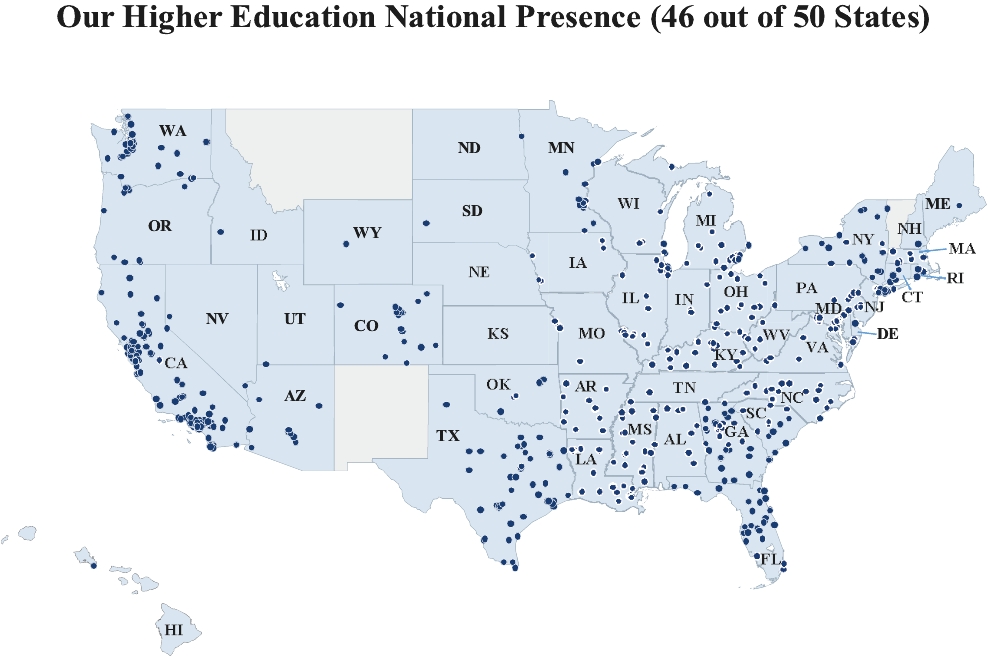
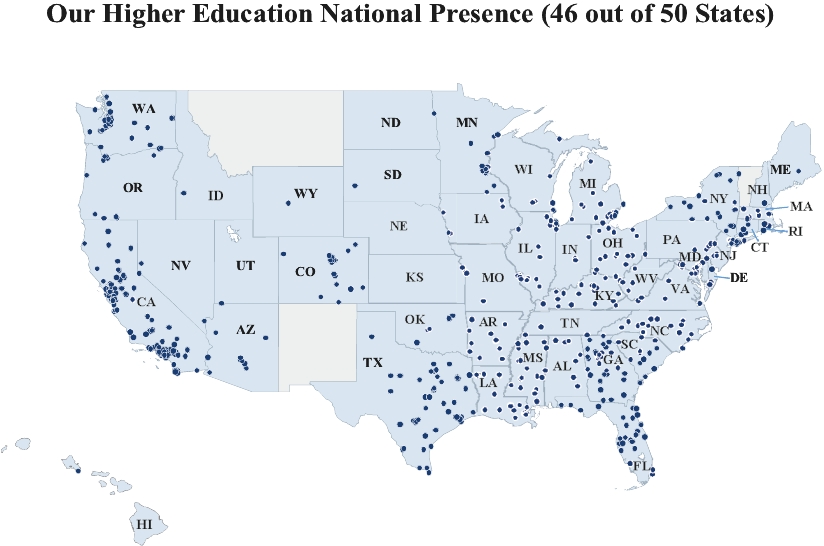
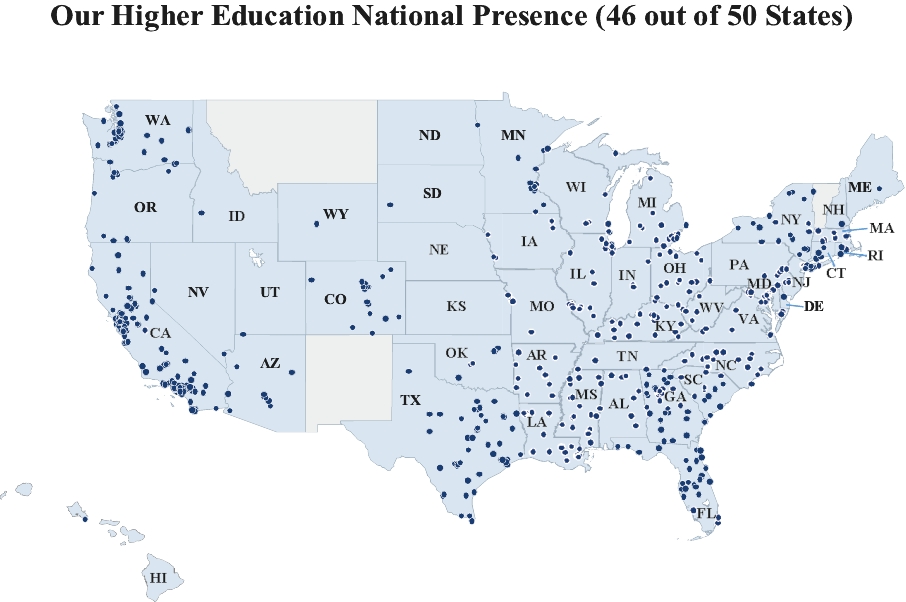
Our Payments business is an industry leader in the higher education funds disbursement sector offering higher education institutions the ability to process financial aid disbursements and refunds to students. In this role, we offer students flexible options to receive federal grants and scholarships through our refund management disbursement platform. As a competitive differentiator, we also offer students the option to deposit funds into our BankMobile Platform deposit account offering for accelerated access to their funds. We monetize our Payments business services in three primary ways: (1) institutional fees (both transactional and subscriptions) in exchange for us providing financial aid and other student refund disbursement services, (2) interchange and account fees generated by our BankMobile Platform deposit account offering and associated debit cards, which are utilized by both current and former students, and (3) as a significant source of low-cost deposits derivative of moving over      annually. Our higher education customers are located nationwide, with a significant presence outside our core Southeast markets. We believe that our Payments business provides us with a transformational opportunity and a nationwide platform for deposit-gathering and establishing new customer relationships.
3

TABLE OF CONTENTS


Consumer Banking
Our Consumer Banking business is primarily driven by our BankMobile Platform and online presence, serving our more than 520,000 customers across the nation as of December 31, 2025, and supplemented by our retail banking division serving the personal day-to-day banking needs of our commercial clients, business owners and other professionals of high net worth, in our core Southeast markets.
BankMobile Platform. Our BankMobile Platform provides digital-first checking and savings accounts through our BankMobile Platform app with market-competitive features, such as peer-to-peer transfers, and reward programs along with the traditional features such as a physical debit card. All students that receive disbursements through our Payments business can apply to receive their disbursements to a BankMobile Platform account (issued by the Bank). Our BankMobile Platform provides an evergreen pipeline for new accounts (with a near zero CAC) with an inherent opportunity of graduating these accounts into long-term, franchise relationships. As noted, we monetize these accounts from interchange and account fees, in addition to being a source of durable, low-cost deposits.
Retail Banking. Our retail banking division serves the personal day-to-day banking needs of our commercial clients, business owners and other professionals of high net worth. We aim to provide our customers with a single view of their financial relationship with us with easy navigation, high-touch, personalized service delivered primarily through our nine full-service offices that cover: in North Carolina, the Raleigh, Rocky Mount, Wilmington and Greensboro market areas; in Georgia, the Atlanta metro area; in Virginia, the Virginia Beach market area; and in South Carolina, the Columbia and Greenville market areas. Our banking franchise is focused on personalized, relationship-driven service combined with local market management and expertise.
Wealth Management
We deliver a full suite of wealth management services through First Carolina Wealth. We build strong partnership relationships with our wealth management clients, which we believe differentiates us from our peers, to offer a superior menu of wealth management and financial planning solutions that serve clients’ needs throughout their respective life cycles. We personalize our services based upon each client’s resources, needs and goals to best achieve their priorities in pursuit of an abundant and fulfilled life.
4

TABLE OF CONTENTS

Strategic Focus and Growth Strategies
We have demonstrated a strong trajectory of growth, expanding our physical footprint and balance sheet while maintaining profitability. Our strategic focus is to drive sustainable growth by leveraging our established banking platform, capitalizing on market disruption, leveraging our market leadership position with our Payments business, and adapting to an evolving banking landscape. We believe that we deliver an excellent customer experience by building strong client relationships, providing personalized service and delivering market-leading products. In doing so we can deliver profitable growth through enhanced revenue generation and disciplined expense management. We believe that we will be able to continue to successfully leverage our strengths to sustain our growth trajectory:

Expand High-Quality Loan Portfolio. Our consistent organic loan growth is originated by a high-quality team of knowledgeable bankers with deep market and commercial real estate expertise. We support this organic loan growth with a deposit strategy that prioritizes relationship-driven banking with tailored treasury management services. We fund our loan growth primarily through low-cost core customer deposits. The strength of our commercial loan and deposit franchise results from our development and maintenance of long-standing customer relationships. Our relationship managers and branch managers actively seek lending relationships with our existing depositors.
Deepen and Expand Higher Education Client Relationships and Services. We intend to leverage our established relationships with colleges and universities (across over 700 campuses as of December 31, 2025) via our Payments business services to build profitable, full-service banking relationships with these institutions. We are a trusted partner to these institutions who are reluctant to leave as switching costs are comparatively high and the operational risk of non-performance would be material to them. This stable customer base ensures predictable, high-margin noninterest income streams and continued access to low-cost core deposits that support our balance sheet growth. We also intend to strategically target additional higher education institutions that we believe could benefit from our Payments services and other integrated offerings such as our identity verification tool to assist higher education institutions in mitigating student admissions and financial aid fraud.
Expand Deposit Base. We fund our loan growth primarily through low-cost core customer deposits. Our ratio of core deposits (total deposits less time deposits, greater than $250,000) was     % of total deposits and our loan to deposit ratio was     %, as of December 31, 2025. The strength of our deposit franchise results from our development and maintenance of long-standing customer relationships as well the customers through our BankMobile Platform digital consumer checking accounts and higher education business. As of December 31, 2025,    % of our CRE borrowers have deposits with the Bank, and often our new originations come from existing customers. Additionally, we attract deposits from our commercial customers by providing them with personal service, a broad suite of commercial banking and treasury management products. The relationships we establish with students through our Payments business provides us a unique opportunity to capitalize and convert these accounts into long-term client relationships. As we are the platform through which students receive their disbursements, we have the unique opportunity to create durable and long-lasting relationships with high engagement with them. With minimal CAC of student deposits accounts, converting these students to long-term, everyday banking customers is a key objective in expanding our deposit base.
5

TABLE OF CONTENTS


Maintain Strong Credit Quality and Enterprise Risk Management Culture. We believe that our ability to maintain exceptional credit quality and conservative underwriting standards throughout our significant organic loan growth is a key differentiator for us. We do not and will not compromise our conservative credit culture. We believe we can originate high-quality loans that fit our customers’ needs and that minimize our future loss exposure. Our credit administration and risk management teams work together with our disciplined loan origination teams, and we have a proven track record of strong asset quality. Through our management loan and Board Risk Oversight committees, we maintain a multi-faceted loan monitoring process that regularly evaluates our loans, our monitoring systems and our loan grading. We believe our enterprise risk management framework and compliance management system (“CMS”) infrastructure strongly supports our Payments business to appropriately manage its risks. In addition, we believe our enterprise risk management and CMS are highly scalable to support the growth of our BankMobile Platform deposit franchise and Payments business, as well as other strategic opportunities we may identify in the future.
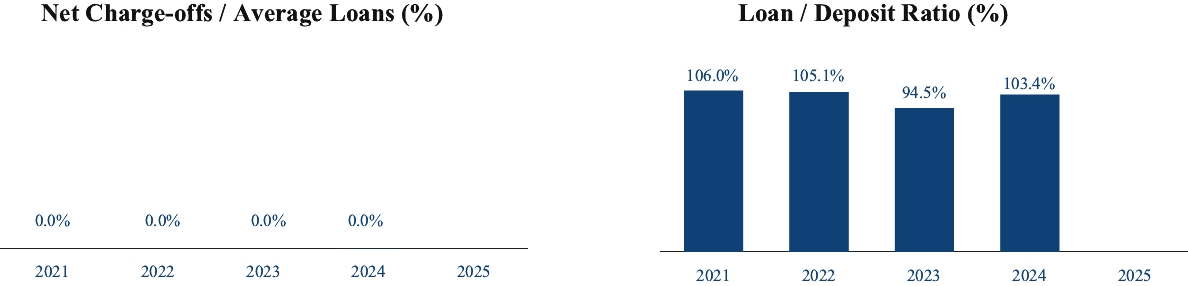
We proactively manage our liquidity position with a low to moderate risk appetite by optimizing the diversity of our funding sources and maintaining a stable size and mix on our balance sheet. In line with our goal of securing long-term profitability and independence, we have focused on decreasing our reliance on less stable brokered and wholesale funding, prioritizing core deposits instead. Our loan-to-deposit ratio trends below peer levels, which reflects a deliberate and conservative posture intended to maximize liquidity before deploying capital into high-quality organic growth opportunities.
Additionally, the Bank has a robust periodic review process in place covering the majority of the portfolio to detect deterioration in credit quality. In support of this, most commercial credits are subject to more frequent financial reporting and covenant requirements that are proactively managed. This credit risk monitoring includes monthly or quarterly reporting on all criticized, classified, and nonaccrual asset relationships, individually analyzed loans with proper supporting third-party values, and the identification of loans modified to borrowers experiencing financial difficulties. Regular impairment analyses are supported by current appraisals, which indicate adequate collateral coverage on all individually reviewed loans.
6

TABLE OF CONTENTS


Identify Revenue and Efficiency Opportunities through Data Analytics. We are deploying scalable, data-driven marketing and risk mitigation initiatives. They operate using proven methodologies of automated portfolio screening, advanced diagnostic evaluations, defined outcome protocols, and applied treatments. For example, we have an identity verification service that we offer to our higher-education institution customers to help them: verify student identities, reduce fraudulent enrollments, and secure account onboarding. This strengthens compliance, reduces fraud risk and supports trusted program enrollment and account access, as our higher education institution customers continue to encounter significant activity in student impersonation and fraudulent ACH activity, among other fraud schemes. To achieve our goal of reducing fraudulent activity we are developing a collaborative fraud prevention and education program, which we believe could represent an important noninterest income source in future periods.
7

TABLE OF CONTENTS

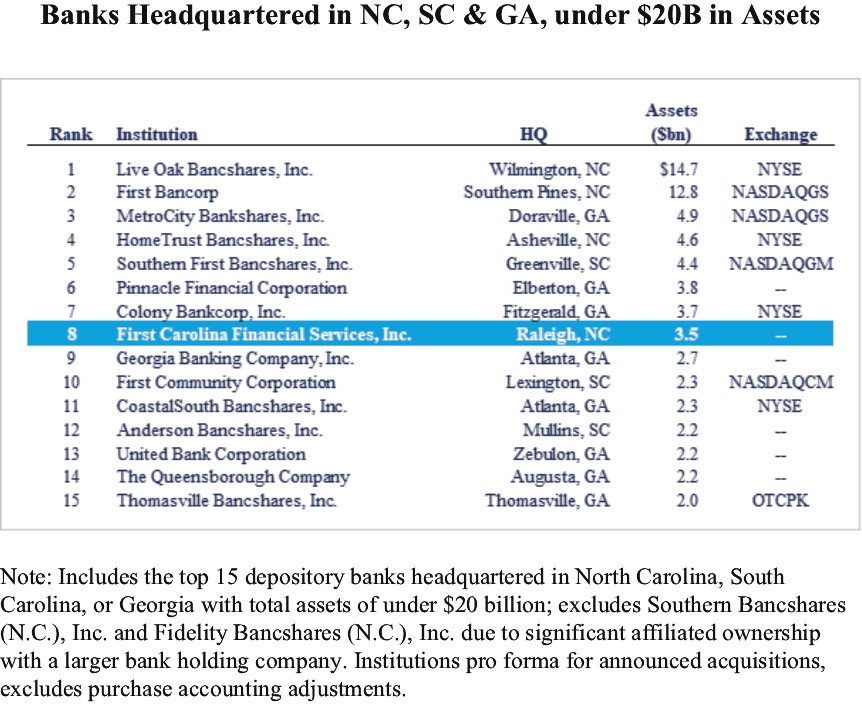
Strategic Expansion and Scarcity Value. Organic loan growth and deposit growth have been primary tenets since our inception, and we believe this growth is paramount in driving long-term shareholder value. We grow by recruiting seasoned, entrepreneurial bankers in our attractive Southeast metropolitan markets and empowering them to build deep, holistic customer relationships. We regularly evaluate opportunities to add additional experienced banking professionals within our current footprint and may seek to expand our operations in attractive and adjacent markets with experienced banking teams that are a cultural fit and knowledgeable of our target client base. In our recruiting efforts, we capitalize on customers and employees displaced by bank merger and acquisition activity in our markets. Recent elevated bank merger and acquisition activity has created high levels of disruption, particularly in our core Raleigh-Cary and Atlanta markets. This dislocation allows us to grow as our bankers act as advocates for their customers, with access to all levels of management to meet our customer needs with speed and decisiveness. While organic growth has historically been our main strategic goal, we may selectively pursue future acquisitions and new market expansions to supplement organic growth in our core markets. We may also make acquisitions or open additional offices in our existing markets. We will only pursue opportunities that we believe could provide meaningful financial benefits, long-term organic growth opportunities and economies of scale without compromising asset quality or our broader enterprise risk management framework. We believe we have significant scarcity value as we maintain our status as: (i) the second-largest bank holding company headquartered in Raleigh, (ii) the second-largest bank with less than $10 billion in assets and the fourth-largest with under $100 billion in assets (excluding affiliated banks) and (iii) a top ten bank in our primary markets under $20 billion in assets, each as of December 31, 2025.


Proprietary Data and Technology Platform
We are data-driven company, focused on accelerating revenue growth and achieving high operational performance through information-based decisioning. We manage and curate data as a corporate asset, while democratizing access for team members for improved decision-making, better forecasting, and faster detection of market shifts and behavioral changes. We believe all of this is especially important in the dynamic financial services space.
Our Payments business and our BankMobile Platform provide us with significant information scale, allowing us to be ahead of the curve to know what’s coming. These learnings come from handling over      in annual student disbursements volume in 2025. We possess data at both the account level and the transaction/instrument level (merchant name, location, merchant category code, dollar value, etc.) with over seven years of history. Leveraging this information, we are deploying scalable, data-driven marketing initiatives based upon proven methodologies of automated portfolio screening, advanced diagnostic evaluations, defined outcome protocols, and applied treatments. For example, we are targeting other cohorts of likely graduates with incentives to make our BankMobile Platform their choice for payroll direct deposit.
8

TABLE OF CONTENTS

We embrace opportunities for artificial intelligence (“AI”) and automation for enhanced outcomes and to reimagine how “work gets done.” As an organization, we have a culture focused on continuous learning.
Our Competitive Strengths
We believe that the following strengths will help us execute our strategic and growth plans:
Experienced and Invested Leadership. Our board of directors and executive leadership team are founders and have decades of combined business experience from a variety of backgrounds. Our directors actively participate in and support community activities, which we believe significantly benefits our business development efforts and have expanded our expansive referral network. Led by Ronald Day, our President and Chief Executive Officer (CEO), our executive leadership team is comprised of established industry veterans with a track record of profitable growth, operating efficiencies and strong risk management. Collectively, our directors and senior executives beneficially own approximately    % of the total common stock outstanding as of December 31, 2025. In addition to our executive leadership team, we are supported by a deep and talented bench of market leaders, many of whom have been with us for much of our existence.
Culture of Excellence. The culture we have developed, which permeates all our customer interactions and operational functions, provides continuity of purpose and a deeply ingrained winning mentality. Our executive leadership team, many of whom have been with us since our early days, champion a set of core values: being enterprising, intentional, responsive and considerate. This ethos promotes a collaborative workplace and an environment of transparency and shared purpose. As of December 31, 2025, over    % of our employees are shareholders, underscoring a collective commitment to First Carolina’s long-term success.
Diversified Business with Unique Expertise in Higher Education Offerings. Our diversified loan portfolio is structured to support growth while effectively managing risk across various sectors and geographic markets. Based on the location of customers and the location for collateral for real estate loans, approximately   % of our total loans are based in North Carolina,  % based in Virginia, South Carolina or Georgia, our other core Southeastern markets, and the remaining   % distributed nationally, as of December 31, 2025. Our highest industry concentration is loans to nursing facilities, representing    % of our C&I loan portfolio at December 31, 2025. We believe this geographic and sector diversification strengthens our ability to manage risk among our banking divisions.
Additionally, we have developed unique expertise in providing banking products and services to higher education institution customers. Many institutions of higher education are customers of larger national banks and report significantly lower levels of client service and satisfaction from those national banks, as compared to the levels that we provide. We believe our expertise in the student disbursements ecosystem coupled with our high-touch service level allows us to build lasting relationships with these higher education institutions as they continue to see the tangible benefits from our offerings.
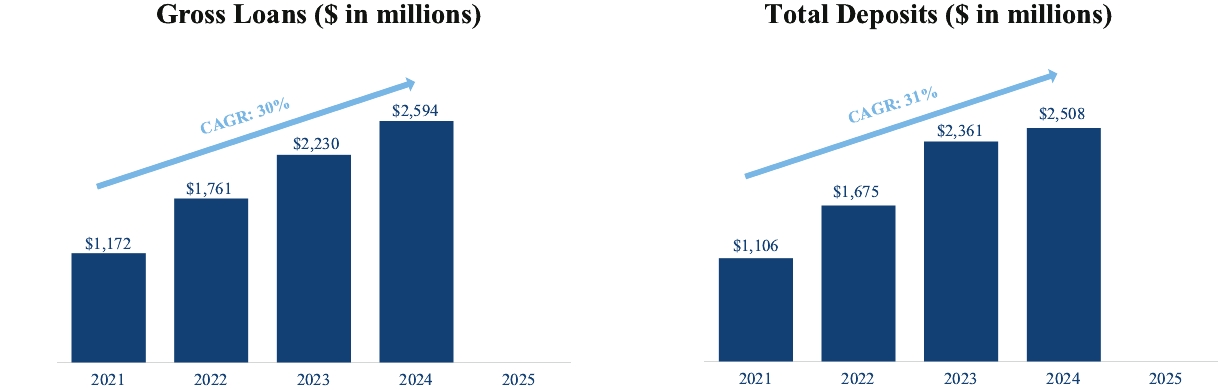
Proven Organic Growth Capabilities Through Strong Relationships in Core Markets. We have demonstrated an ability to grow our loans and deposits organically. Our team of professionals has been an important driver of our organic growth by developing banking relationships with current and potential clients. We believe the strength of our culture and brand has been the core of our success in attracting talented professionals and banking relationships. Our focus is on being the premier commercial bank for small and medium-sized businesses, their owners, and their employees in our core high-growth Southeastern metropolitan markets. We win by delivering a superior level of responsiveness and sophisticated banking solutions, competing aggressively in our larger metropolitan areas while aiming for market dominance where we have a long-standing presence. We operate on the core belief that our success is a direct result of the success of the customers and communities we serve. We dedicate significant effort and resources to developing and maintaining relationships with entrepreneurs, business leaders and talented bankers in our markets. We believe that our focus on leveraging local talent and market knowledge has made us one of the fastest-growing banks in North Carolina and the Southeast since 2015.
Proprietary Technology Platforms. Our internally developed disbursements platform seamlessly connects to over 700 higher education campuses as of December 31, 2025, to provide a reliable and secure mechanism to transfer over $   billion annually to    of eligible secondary student recipients. This platform is key to our competitive and technological advantage and has been optimized with risk management capabilities to promote safe and secure disbursement services. Similarly, our internally developed BankMobile Platform provides complete “neo-bank” functionality to customers. In conjunction with our entire array of technology-enabled banking, disbursement and deposit services, our technology gives us access to a plethora of data that we believe will help us drive future customer
9

TABLE OF CONTENTS

and deposit growth and boost profitability in the payments business. In summary, our technological capabilities are robust and scalable for future growth, targeting high operating leverage yields.
Advanced and Scalable Enterprise Risk Management. We have a culture of well-developed risk management procedures at all levels of our organization. Our loan portfolio is primarily originated from borrowers within our footprint and is subject to a rigorous credit evaluation process that seeks to balance responsiveness with prudent underwriting and pricing practices. We have established processes to monitor our loan portfolio on a regular basis. Our management team and board of directors have established concentration limits by loan type, industry, and related borrowers, which are regularly reviewed in light of current conditions in our core market areas to mitigate developing risk areas within our loan portfolio and to provide for strong asset quality in our loan portfolio. Our CRE and construction and development (“C&D”) loans as a percentage of total capital on December 31, 2025, was    % and     % respectively. When credit issues arise, our management team takes an active approach in handling the problem. We monitor our loan loss reserve and seek to maintain an adequate reserve for future losses. We have also strongly managed our loan portfolio for interest rate risks, with   % of loans fixed rate and   % variable rate as of December 31, 2025, compared to   % fixed and   % variable as of December 31, 2021. As of December 31, 2025, our balance sheet was       sensitive with  % of our variable rate loans having rate floors with a weighted average floor of  %.
Diversified Core Deposit Base. We have a valuable deposit franchise supported by a substantial level of core deposits including those generated from our Commercial Banking and Consumer Banking divisions. We believe our deposit generation is driven by our strong personal service with an emphasis on developing the total client relationship. Our bankers are skilled deposit gatherers and are incentivized to hit deposit goals. Our BankMobile Platform and Payments business generate significant core deposits, that have created long-term deposit relationships for the Bank. As of December 31, 2025, we had total customer deposit balances of approximately $    billion across more than      open accounts. The average account size for our deposit accounts is approximately $   , and the cost of deposits was approximately    %, for the year ended December 31, 2025, reflecting a low-cost funding profile. Approximately    % of deposits are uninsured, underscoring the stability of the deposit base.
Significant Total Addressable Market: The Bank aims to capitalize on significant market opportunities across its primary geographic footprint in North Carolina, Georgia, Virginia, and South Carolina, which collectively represent a population of over 10 million people and host more than 200,000 businesses. In these dynamic, high-growth metropolitan areas like Raleigh and Atlanta, we serve a diverse customer base of small and medium-sized businesses, professionals, and individuals by deploying a high-touch, relationship-focused banking model that provides a distinct competitive advantage over larger, money-center institutions. To this end, our markets are served by numerous larger regional and money-center financial institutions, which provides us with an outsized opportunity for future growth in CRE and C&I lending, as well as deposit gathering. Our market opportunity expanded exponentially with the acquisition of BM Tech, which acquisition transformed the Bank with a national franchise and a proprietary digital platform serving higher education institutions across over 700 campuses as of December 31, 2025, and reaching over    million student refund recipients annually. We believe there is still significant opportunity to expand as almost 10 million students at approximately 5,500 schools received over $111 billion of federal financial aid in fiscal year 2022, according to a 2023 CFPB report.
10

TABLE OF CONTENTS

Our Core Markets
We provide banking services from nine full-service offices in eight separate metropolitan statistical areas (“MSA”): in North Carolina, the Raleigh, Rocky Mount, Wilmington and Greensboro service areas; in Georgia, the Atlanta service area; in Virginia, the Virginia Beach service area; and in South Carolina, the Columbia and Greenville service areas. These four states, which comprise our core markets for our Commercial Banking line of business, are all top 10 in net domestic migration, which has accounted for their significant population expansion in recent years. Of community banks in our MSAs, we have a top five deposit market share in four of our markets of operation. Our markets are a mix of higher-growth areas and stable markets with strong core deposits. We believe that we are well positioned to capture value in some of the fastest growing and most valuable markets in the country. Below is market information in the MSAs and selected counties in which we operate, as well as deposit information:
Market Area
Total
Population
2026
(Estimated)
Projected
Population
Change
2026-2031
(%)
Projected
Median
Household
Income
2031
($)
Projected
Household
Income
Change
2026-2031
(%)
Unemployment
Rate
(%)
Raleigh-Cary MSA
1,611,719
8.3
121,727
13.3
3.2
Rocky Mount MSA
148,258
2.8
77,992
14.5
5.1
Wilmington MSA
498,333
9.0
96,508
13.0
3.6
Atlanta-Sandy Springs-Alpharetta MSA
6,500,242
4.2
103,823
11.4
3.5
Virginia Beach-Chesapeake-Norfolk MSA
1,795,848
0.7
98,678
11.2
3.5
Greensboro-High Point MSA
808,012
3.3
78,811
12.2
4.1
Columbia MSA
882,398
4.8
81,377
11.9
4.3
Greenville-Anderson-Greer MSA
1,018,490
6.6
87,836
14.3
4.2
Market Area
Year
Entered
Market
Deposits
($bn)
Market
Rank
Deposit
Market
Share
(%)
Branches
First
Carolina
Deposits
($mm)
Deposits
Per
Branch
($mm)
YoY
Deposit
Growth
(%)
Raleigh-Cary MSA
2017
$102
15
0.80
2


Rocky Mount MSA
2000
$3
1
37.76
1


Wilmington MSA
2020
$26
13
0.53
1


Atlanta-Sandy Springs-Alpharetta MSA
2022
$246
56
0.04
1


Virginia Beach-Chesapeake-Norfolk MSA
2021
$30
14
0.38
1


Greensboro-High Point MSA
2009
$16
19
0.43
1


Columbia MSA
2022
$27
25
0.09
1


Greenville-Anderson-Greer MSA
2023
$26
39
0.01
1


Source: S&P Global Market Intelligence and U.S. Bureau of Labor Statistics
Note: Unemployment data as of 9/25; deposit data as of 6/30/25; total market deposit data as of 9/30/25
11

TABLE OF CONTENTS

Our Performance
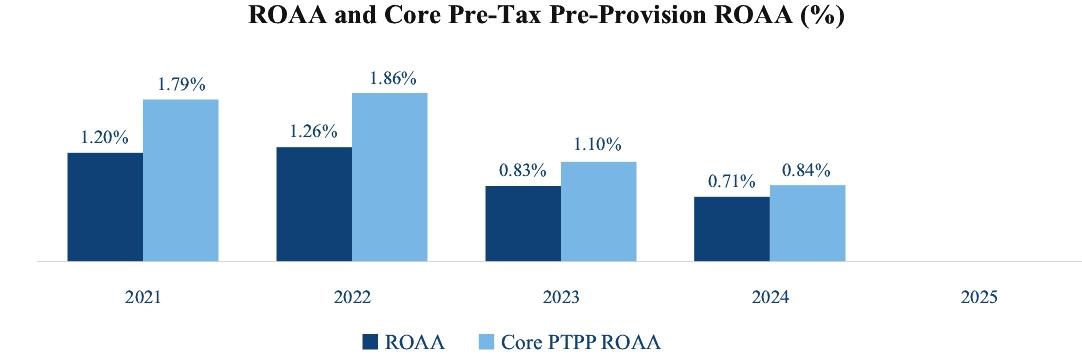
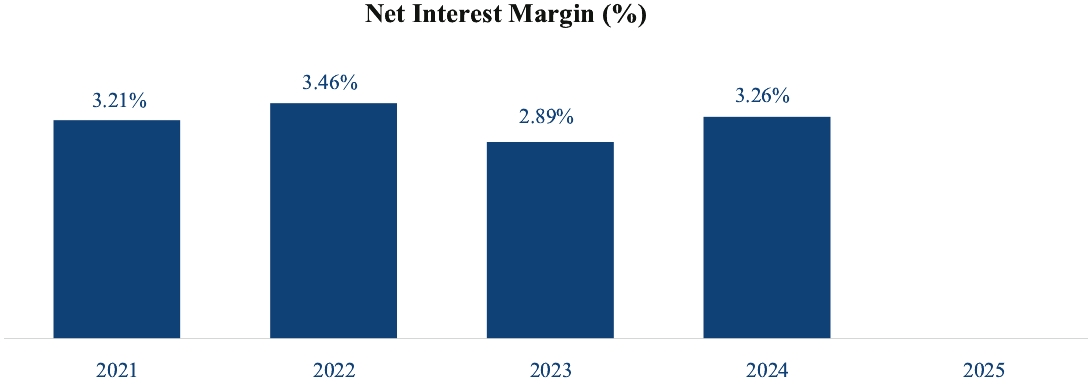
Over the course of our history, we have operated our business at high levels of performance, as seen in our return on average assets (“ROAA”) of 1.20% in 2021 and 1.26% in 2022, while maintaining peer-leading balance sheet growth, strong levels of capital and solid credit quality metrics. These elevated performance metrics were primarily driven by our strong revenue growth coupled with disciplined loan and deposit pricing and an efficient, branch light operating model. However, our net interest margin began to decline in 2023 as a result of the Federal Reserve increasing the target range for the federal funds rate by 525 basis points between March 2022 and July 2023 and a significantly more competitive deposit environment for all depository institutions. Additionally, the recent moderation in our profitability has reflected a deliberate strategic choice to prioritize our deposit portfolio and long-term infrastructure scalability over short-term earnings. Since 2023, we have purposefully invested in technology and human capital to support our pivot towards our Payments business and building a more sophisticated enterprise risk management framework for further growth in all lines of business. As we continue to grow our balance sheet and customer base, we will further leverage this expense base, which we believe will drive higher profitability metrics.


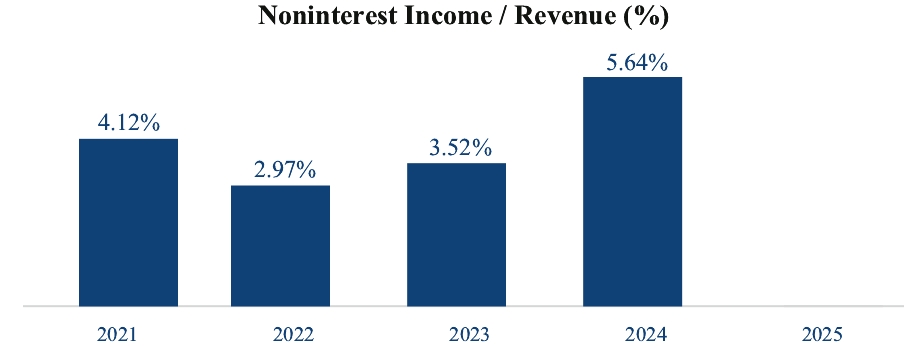
To bridge this transformation, we successfully raised proceeds of $45.4 million (before offering expenses) in common equity capital in the fourth quarter of 2024, allowing us to invest in our Payments business without compromising our balance sheet strength. During the first quarter of 2025 we acquired our Payments business, which is a nationwide low-cost deposit platform, which we believe directly improved our balance sheet, addressed our elevated deposit interest expense and drove net interest margin expansion, which has already improved to     %, for the year ended December 31, 2025. Additionally, our Payment business added significant non-interest income to the Bank, and we believe there will be additional opportunities to generate incremental fee income as we integrate and season the Payment business. We believe that these investments have built a scalable platform, positioning us to transition from a period of investment back to a high-profitability and high-growth business.
12

TABLE OF CONTENTS


Operating Leverage
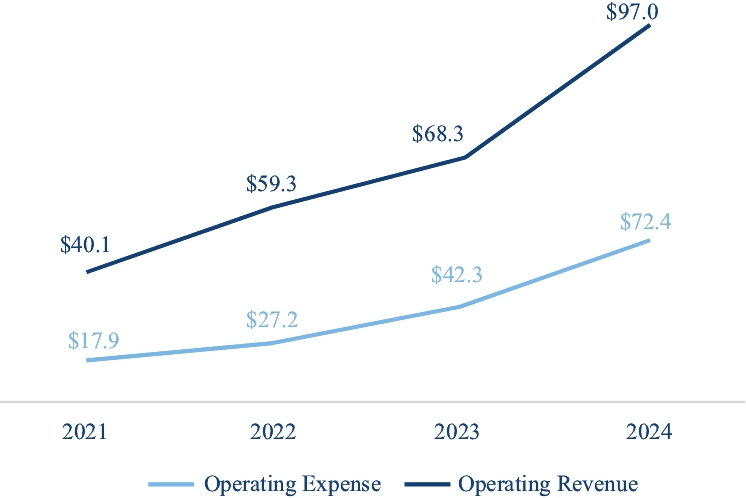
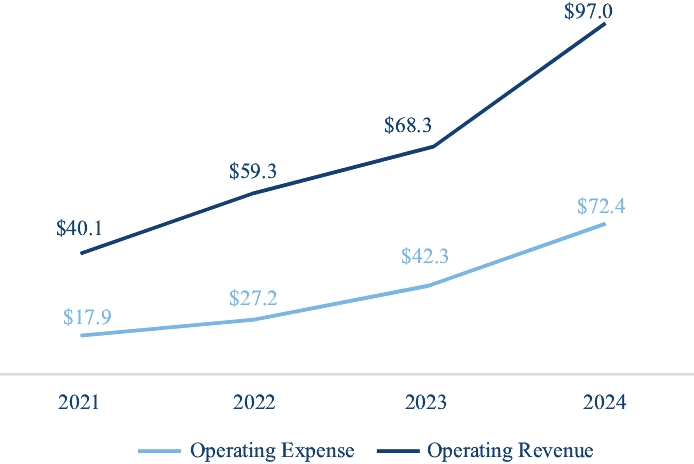
We have built a culture focused on strong revenue growth and prudent expense management, balanced with strategic investments in talent and technology to drive long-term operating leverage. We believe that superior operating performance and profitability in the future will be the result of a disciplined growth strategy, an efficient branch-light operating model, a focus on sophisticated commercial, real estate, higher education institutions and consumer clients, and the ability of our seasoned professionals to manage significant assets. This capacity is increasingly amplified by our national footprint, strategic technology enhancements, newly redesigned enterprise risk management platform and investment in human capital designed to create a scalable, efficient, and secure banking platform.
13

TABLE OF CONTENTS

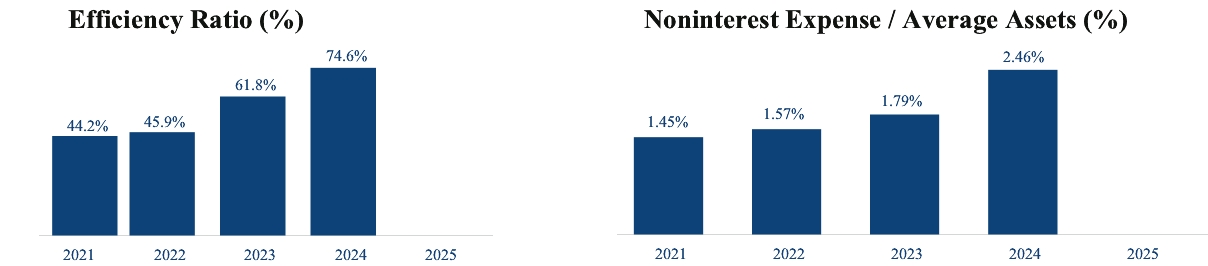
We remain focused on key efficiency metrics and believe that our results for the fourth quarter of 2025 begin to demonstrate our potential for significantly improved efficiency and financial performance. We believe that our higher efficiency ratio and noninterest expense to average assets ratio during 2024 and 2025 highlight the investments we have made throughout our organization for the growth opportunities in front of us. During 2025, we began to realize significant noninterest expense savings following the acquisition of BM Tech, including as a result of two reductions in force and implementing a data analytics platform to significantly reduce fraud in our Payments business and BankMobile Platform and to help identify additional operational synergies. Additionally, we believe there will be strong revenue growth capabilities through incremental loan and deposit growth opportunities in our core Southeast markets and in our Payments business and BankMobile Platform businesses as well as incremental fee income growth identified through our data analytics platform via interchange income, account fees and payments. In summary, through incremental customer loan and deposit growth, improving expense management and increases in fee income, we believe our performance metrics will return to historical levels.


14

TABLE OF CONTENTS

Summary Risk Factors
Our business is subject to a number of risks and uncertainties, as more fully described under “Risk Factors” in this prospectus. These risks could materially and adversely impact our business, financial condition, and results of operations, which could cause the trading price of our common stock to decline and could result in a loss of all or part of your investment. Some of these risks include:
We may be adversely affected by economic conditions in our market area.
Our future success is dependent on our ability to compete effectively in our markets and in a highly competitive industry.
There can be no assurance that we will be successful in fully integrating BM Tech. into our business.
Accounting for business combinations may expose us to intangible asset impairment risk, which could affect our results of operations.
Our business is significantly dependent on conditions in our real estate markets, which could increase our credit losses and negatively affect our financial results.
The small to medium-sized businesses which we target may have fewer resources to weather adverse business developments, which may impair a borrower’s ability to repay a loan.
We have a concentration of credit exposure in commercial real estate, and loans with this type of collateral are viewed as having more risk of default.
Our construction and development loans involve a higher degree of risk than other segments of our loan portfolio.
We engage in lending secured by real estate and may be forced to foreclose on the collateral and own the underlying real estate, subjecting us to the costs and potential risks, including environmental liabilities, associated with the ownership of real property, or consumer protection initiatives or changes in state or federal law may substantially raise the cost of foreclosure or prevent us from foreclosing at all.
Our recovery on commercial real estate loans could be further reduced by a lack of a liquid secondary market for such loans.
The appraisals and other valuation techniques we use in evaluating and monitoring loans secured by real property, other real estate owned (“OREO”) and repossessed personal property may not accurately describe the net value of the asset.
Our allowance for credit losses may prove to be insufficient to cover actual loan losses, which could have a material adverse effect on our financial condition, results of operations and the value of our common stock.
We are subject to interest rate risk, which could adversely affect our profitability.
We may not be able to measure and manage our credit risk adequately, which could adversely affect our profitability.
Our risk management framework may not be effective in mitigating risks and/or losses to us.
Liquidity needs could adversely affect our financial condition, results of operations and the value of our common stock.
Regulatory requirements affecting our loans secured by commercial real estate could limit our ability to leverage our capital and adversely affect our growth and profitability.
We depend on the accuracy and completeness of information about clients and counterparties, which, if incorrect or incomplete, could harm our earnings.
We may be adversely affected by changes in the actual or perceived soundness or condition of other financial institutions.
We could recognize losses on investment securities held in our securities portfolio, particularly if interest rates increase or economic and market conditions deteriorate.
15

TABLE OF CONTENTS

Our largest loan relationships make up a material percentage of our total loan portfolio and credit risks relating to these loans would have a disproportionate impact
Our accounting estimates and risk management processes rely on analytical and forecasting techniques and models.
Our largest deposit relationships currently make up a material percentage of our deposits and the withdrawal of deposits by our largest depositors could force us to fund our business through more expensive and less stable sources.
Part of our expansion strategy involves targeting select acquisitions of parts or all of other financial institutions, nonbanking companies or financial services companies, which exposes us to acquisition risks.
We may be liable to or we may lose customers if any agreements that we maintain with colleges and universities are terminated, or if other performance triggers, performance conditions, or financial obligations are triggered.
A change in the availability of student loans or financial aid, as well as budget constraints, could materially and adversely affect our financial performance by reducing demand for our Payments business or our BankMobile Platform.
Our disbursement business depends in part on the current government financial aid regime that relies on the outsourcing of financial aid disbursements through higher education institutions.
If we are unable to protect or enforce our intellectual property rights, we may lose a competitive advantage and incur significant expenses.
We may incorporate open source software (“OSS”) into our products and we anticipate continuing to incorporate OSS in our business in the future.
We may be subject to claims that our services or solutions violate the patents or other intellectual property of others, which would be costly and time-consuming to defend.
Changes in interest rates and monetary policy may adversely affect our results of operations.
Federal and state regulators periodically examine our business and may require us to remediate adverse examination findings or may take enforcement action against us.
We are subject to capital adequacy standards and, if we fail to meet these standards, or more stringent standards in the future, we will be subject to restrictions on our ability to make capital distributions and other restrictions.
As a result of our Payments business and BankMobile Platform, we operate a nationwide business and are required to comply with significantly more state laws and regulations.
We are subject to various laws and regulations related to higher education and disbursements.
Our liquidity is dependent on dividends from the Bank.
The Federal Reserve may require us to commit capital resources to support the Bank.
Our operations may require us to raise additional capital, which may result in dilution to our then-existing shareholders and may not be available when it is needed, on terms that are acceptable to us, or at all.
We are subject to numerous “fair and responsible banking” laws and other laws and regulations designed to protect consumers, and failure to comply with these laws could lead to a wide variety of sanctions.
Investors in this offering will experience immediate and substantial dilution.
16

TABLE OF CONTENTS

Implications of Being an Emerging Growth Company
We qualify as an “emerging growth company” as defined in the JOBS Act. An emerging growth company may take advantage of specified reduced reporting and other requirements that are otherwise applicable generally to public companies. These provisions include:
we are only required to include two years of audited consolidated financial statements in this prospectus, in addition to any required interim financial statements, and are only required to provide reduced disclosure in “Management’s Discussion and Analysis of Financial Condition and Results of Operations”;
we are not required to engage an auditor to report on our internal controls over financial reporting pursuant to Section 404(b) of the Sarbanes-Oxley Act;
we are not required to submit certain executive compensation matters to shareholders for advisory votes, such as “say-on-pay,” “say-on-frequency,” and “say-on-golden parachutes”; and
we are not required to disclose certain executive compensation related items, such as the correlation between executive compensation and performance (so called “pay versus performance disclosure”) and comparisons of the chief executive officer’s compensation to our median employee compensation (so called “CEO pay ratio disclosure”).
We may take advantage of these provisions until the last day of the fiscal year following the fifth anniversary of the completion of this offering or such earlier time that we are no longer an emerging growth company. We would cease to be an emerging growth company upon the earliest of (a) the last day of the first fiscal year in which our annual gross revenue is $1.235 billion or more, (b) the date on which we have, during the previous rolling three-year period, issued more than $1.0 billion in non-convertible debt securities, and (c) the last day of the fiscal year in which the market value of our common stock held by non-affiliates exceeded $700 million as of the last business day of the second fiscal quarter of such fiscal year.
Under the JOBS Act, emerging growth companies also can delay adopting new or revised accounting standards until such time as those standards would otherwise apply to private companies. We currently intend to take advantage of this exemption.
For risks related to our status as an emerging growth company, see the section entitled “Risk Factors—Risks Related to an Investment in Our Common Stock and the Offering—We are an “emerging growth company,” as defined in the JOBS Act, and will be able to avail ourselves of reduced disclosure requirements applicable to emerging growth companies, which could make our common stock less attractive to investors and adversely affect the market price of our common stock.”
Corporate Information
Our principal executive office is located at 2626 Glenwood Avenue, Suite 200, Raleigh, NC 27608, and our telephone number is (252) 937-2152. We maintain a website at www.firstcarolinabank.com. This reference to our website is included for the convenience of investors only and our website and the information contained therein or limited thereto is not incorporated into this prospectus or the registration statement of which it forms a part.
Channels for Disclosure of Information
Following the closing of this offering, we intend to announce material information to the public through filings with the SEC, the investor relations page on our website (www.firstcarolinabank.com), press releases, public conference calls, and public webcasts.
Any updates to the list of disclosure channels through which we will announce information will be posted on the investor relations page on our website.
17

TABLE OF CONTENTS

THE OFFERING
The following summary contains basic information about the offering of our common stock and is not intended to be complete. It does not contain all the information that may be important to you in connection with an investment in our common stock. For a more complete description of our common stock, see the section entitled “Description of Capital Stock.”
Issuer
First Carolina Financial Services, Inc.
Common Stock Offered
   shares (or    shares including the underwriters’ option to purchase additional shares in full)
Shares Outstanding After the Offering
    shares (or shares if the underwriters’ option to purchase additional shares is exercised in full)
Price Per Share
We currently expect the initial public offering price per share of our common stock to be between $    and $   .
Use of Proceeds
Assuming an initial public offering price of $    per share (the midpoint of the price range set forth on the cover page of this prospectus), we estimate that the net proceeds to us from this offering, after deducting underwriting discounts and commissions and the estimated offering expenses payable by us, will be approximately $    , or approximately $    if the underwriters’ option to purchase additional shares is exercised in full.
We intend to use the net proceeds to us from this offering for general corporate purposes, which may include, without limitation, enhancing our capital ratios and those of the Bank, organic growth, refinancing or repurchase of outstanding indebtedness, funding the potential acquisition of other banks or other complementary businesses to the extent such opportunities arise, for capital expenditures, and as working capital.
Our management will have broad discretion in the application of the net proceeds from this offering to us, and investors will be relying on the judgment of our management regarding the application of the proceeds. See the section entitled “Use of Proceeds.”
Dividend Policy
The declaration of all future dividends, if any, will be at the discretion of our board of directors and will depend on many factors, including the financial condition, earnings and liquidity requirements applicable to us and the Bank, regulatory constraints, and any other factors that our board of directors deems relevant in making such a determination. Our ability to pay dividends is subject to restrictions under applicable banking laws and regulations. In addition, dividends from the Bank are the principal source of funds for the payment of dividends on our stock. The Bank is subject to certain restrictions under banking laws and regulations that may limit its ability to pay dividends to us. Therefore, there can be no assurance that we will pay any dividends to holders of our common stock, or as to the amount of any such dividends.
18

TABLE OF CONTENTS

Exchange Listing
We have applied to list our common stock on the      under the symbol “FCBM.”
Directed Share Program
At our request, the underwriters have reserved up to    % of the shares of our common stock offered by this prospectus for sale, at the initial public offering price, to our directors, officers, principal shareholders, employees, business associates, and related persons who have expressed an interest in purchasing our common stock in this offering. We will offer these shares to the extent permitted under applicable regulations in the United States through a directed share program. See the section entitled “Underwriting—Directed Share Program.”
Risk Factors
Investing in our common stock involves risks. See the sections entitled “Risk Factors,” “Summary of Risk Factors” and “Cautionary Note Regarding Forward-Looking Statements” for a discussion of factors that you should carefully consider before making an investment decision.
Unless otherwise noted, references in this prospectus to the number of shares of our common stock outstanding after this offering are based on     shares of our common stock issued and outstanding as of December 31, 2025. Except as otherwise indicated, the information in this prospectus:
excludes     shares of our common stock reserved for issuance under the Company’s 2025 Equity Incentive Plan (the “2025 Plan”);
assumes no exercise of the underwriters’ option to purchase additional shares of our common stock;
assumes an initial public offering price of $    per share, which is the midpoint of the price range set forth on the cover page of this prospectus; and
does not attribute to any director, officer, principal shareholder or related person any purchases of shares of our common stock in this offering, including through the directed share program described in the section entitled “Underwriting—Directed Share Program.”
19

TABLE OF CONTENTS

SUMMARY HISTORICAL CONSOLIDATED FINANCIAL DATA AND OTHER INFORMATION
The following tables summarize our historical consolidated financial and operating information. We have derived the consolidated statement of operations information for the years ended December 31, 2025 and 2024 and the consolidated balance sheet information as of December 31, 2025, from our audited annual consolidated financial statements included elsewhere in this prospectus. The selected historical financial information as of and for the years ended December 31, 2023, 2022 and 2021, except for the selected ratios, is derived from our audited financial statements not included in this prospectus.
Our historical results are not necessarily indicative of the results that may be expected in the future. You should read the following financial information together with the information under “Capitalization,” “Management’s Discussion and Analysis of Financial Condition and Results of Operations,” and our consolidated financial statements and related notes included elsewhere in this prospectus.
 
As of and for the Year Ended
 
2021
2022
2023
2024
2025
(Dollars in thousands, except performance metrics)


Statement of Operations Data


Interest Income
$46,918
$77,166
$135,567
$176,086
$   
Interest Expense
$8,487
$19,604
$69,689
$84,526
$
Net Interest Income
$38,431
$57,562
$65,878
$91,560
$
Provision (Benefit) for Credit Losses
$2,747
$4,186
$1,300
$(1,766)
$
Noninterest Income
$1,650
$1,761
$2,406
$5,475
$
Merger Related Expenses
$
$
$
$
$
Other Noninterest Expense
$17,937
$27,203
$42,287
$72,362
$
Income before Income Taxes
$19,397
$27,934
$24,697
$26,439
$
Income tax expense
$4,516
$6,297
$5,069
$5,527
$
Net Income
$14,881
$21,637
$19,628
$20,912
$
Less net income (loss) allocable to noncontrolling interest
$(46)
$160
$
$
$
Net income allocable to First Carolina Services, Inc.
$14,835
$21,797
$19,628
$20,912
$
Core Net Income(1)
$14,452
$21,797
$19,541
$20,912
$
Pretax Pre-provision Net Income
$​22,144
$​32,120
$25,997
$24,673
$
Pretax Pre-provision Core Net Income(1)
$21,659
$32,120
$25,887
$24,673
$


Balance Sheet Data (Period End)


Cash and Cash Equivalents
$68,177
$130,040
$160,970
$168,055
$
Securities, available for sale
$41,968
$65,684
$119,985
$116,863
$
Securities, held to maturity
$94,502
$84,590
$82,208
$51,761
$
Federal Home Loan Bank stock,
at cost
$5,033
$4,967
$1,487
$4,298
$
Loans, net of unearned income(2)
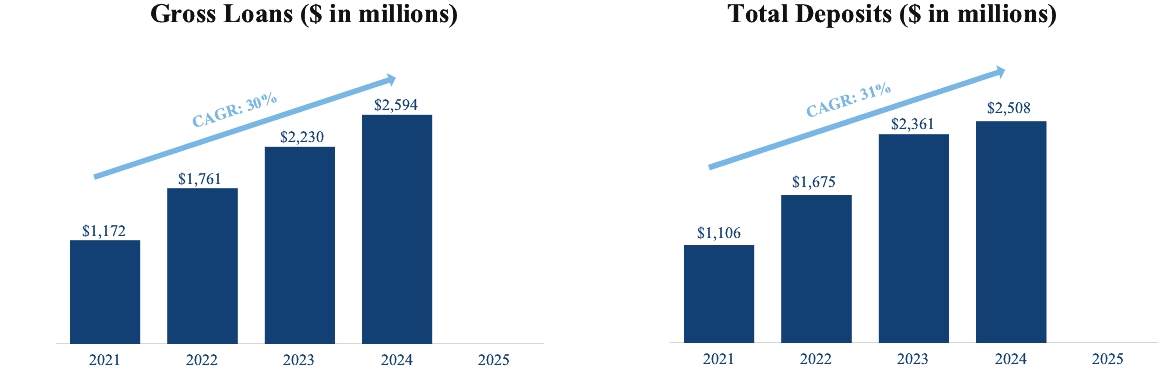
$1,172,159
$1,760,834
$2,230,443
$2,593,820
$
Allowance for Credit Losses
($​7,490)
($​11,669)
($​18,897)
($​20,402)
$
Goodwill
$1,792
$1,792
$1,792
$1,792
$
Other Intangible
$
$
$
$
$
Deferred tax asset, net
$2,593
$4,965
$8,549
$7,268
$
Bank owned life insurance
$12,518
$27,113
$27,898
$39,340
$
Other Assets
$26,768
$44,116
$110,940
$76,544
$
Deposits
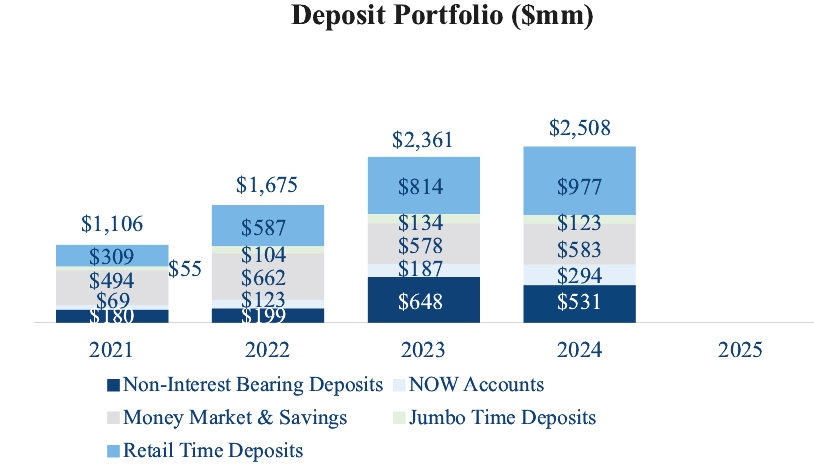
$1,106,271
$1,674,913
$2,360,739
$2,508,421
$
Borrowings
$152,000
$100,000
$
$100,000
$
Subordinated debt, net
$50,203
$63,116
$63,223
$63,329
$
Total Liabilities
$1,313,098
$1,856,011
$2,457,002
$2,702,021
$
Total Shareholders’ Equity
$104,922
$256,421
$268,373
$337,317
$
Tangible Common Equity(1)
$103,130
$254,629
$266,581
$335,525
$
20

TABLE OF CONTENTS

 
As of and for the Year Ended
 
2021
2022
2023
2024
2025
Select Per Share Data


Book Value Per Share
$20.06
$23.96
$24.80
$27.41
$
Tangible book value per share(1)
$19.72
$23.79
$24.63
$27.26
$
Diluted Earnings per Share
$2.84
$2.04
$1.81
$1.90
$
Diluted Core Earnings Per Share(1)
$2.76
$2.04
$1.81
$1.90
$


Performance Metrics


Return on Average Assets(3)
1.20%
1.26%
0.83%
0.71%
 
Core Return on Average
Assets(1)(3)
1.17%
1.26%
0.83%
0.71%
 
Pretax Pre-Provision Core Return on Average Assets(1)(3)
1.79%
1.86%
1.10%
0.84%
 
Return on Average Stockholders’ Equity(4)
15.36%
10.11%
7.63%
7.43%
 
Return on Average Tangible Stockholders’ Equity(1)(8)
15.25%
10.20%
7.65%
7.48%
 
Net Interest Margin
3.21%
3.46%
2.89%
3.26%
 
Yield on Loans
4.63%
4.95%
5.98%
6.32%
 
Cost of Deposits (including non-interest demand)
0.47%
1.14%
3.24%
3.13%
 
Noninterest Income / Average Assets(3)
0.13%
0.10%
0.10%
0.19%
 
Noninterest Expense / Average Assets(3)
1.45%
1.57%
1.79%
2.46%
 
Efficiency Ratio
44.2%
45.9%
61.8%
74.6%
 
Core Efficiency Ratio (excludes merger expenses)(1)
44.2%
45.9%
61.8%
74.6%
 
Loans to Deposits
105.9%
105.1%
94.5%
103.4%
 
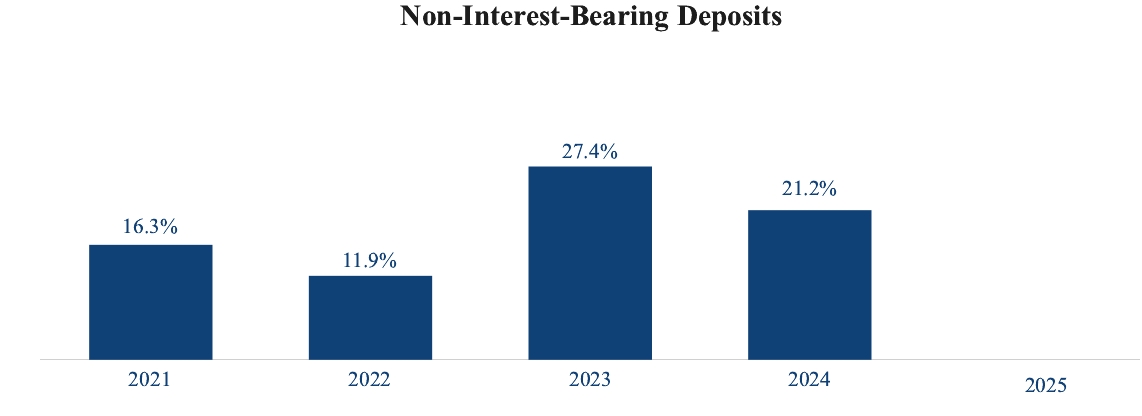
Non-Interest Bearing Deposits / Total Deposits
16.3%
11.9%
27.4%
21.2%


Credit Quality Ratios


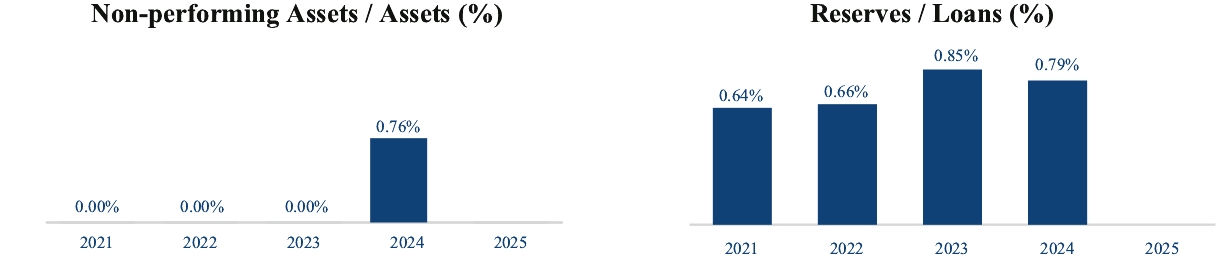
Nonperforming Assets to Total Assets(5)
0.00%
0.00%
0.00%
0.76%
 
Nonperforming Assets to Total Loans and OREO(5)
0.00%
0.00%
0.00%
0.89%
 
Nonperforming Loans to Total Loans(2)
0.00%
0.00%
0.00%
0.67%
 
Allowance for Credit Losses to Total Loans
0.64%
0.66%
0.85%
0.79%
 
Allowance for Credit Losses to Nonperforming Loans(2)
0.0%
0.0%
0.0%
117.1%
 
Net Loan Charge-offs to Average Loans(6)
0.00%
0.00%
0.00%
0.00%


Consolidated Capital Ratios (Unless otherwise noted)


Common Equity to Assets
7.40%
12.14%
9.85%
11.10%
 
Tangible Common Equity to Tangible Assets(1)
7.27%
12.05%
9.78%
11.04%
 
Tier 1 Leverage Ratio
7.63%
12.49%
10.30%
11.08%
 
Common Equity Tier 1 Capital Ratio
7.76%
12.20%
9.43%
11.28%
 
Tier 1 Risk-based Ratio
7.76%
12.20%
9.43%
11.28%
 
Total Risk-based Capital Ratio
12.09%
15.75%
12.58%
14.23%
 
C&D Concentration Ratio (Bank)
85.4%
71.1%
102.4%
75.7%
 
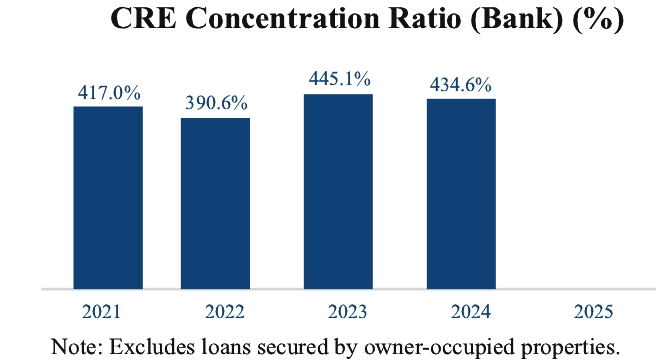
CRE Concentration Ratio (Bank)
417.0%
390.6%
445.1%
434.6%


21

TABLE OF CONTENTS

 
As of and for the Year Ended
 
2021
2022
2023
2024
2025
Composition of Loan Portfolio


Owner-occupied Commercial Real Estate
$118,619
$174,047
$232,917
$264,670
$
Nonowner-occupied Commercial Real Estate
$559,193
$740,548
$878,384
$1,097,775
$
Commercial and Industrial
$152,085
$194,130
$253,991
$268,860
$   
Construction and Development
$162,812
$228,911
$360,024
$314,687
$
1-4 Family
$102,752
$133,532
$175,283
$251,308
$
Multi-Family
$73,039
$288,043
$326,936
$393,370
$
Consumer and other loans
$1,297
$729
$1,538
$1,850
$
Agriculture
$2,362
$894
$1,370
$1,299
$


Composition of Deposits


Noninterest-bearing Demand
$179,851
$199,427
$647,856
$530,923
$
NOW Accounts
$68,658
$122,946
$186,940
$294,360
$
Savings
$8,395
$9,702
$64,679
$31,116
$
Money Market Accounts
$485,423
$652,614
$513,316
$552,101
$
Certificates of Deposit- $250,000 and Less(7)
$309,260
$586,593
$813,551
$976,933
$
Certificates of Deposit- More than $250,000(7)
$54,684
$103,631
$134,397
$122,988
$
 
$1,106,271
$1,674,913
$2,360,739
$2,508,421
$   
(1)
See definitions of our non-GAAP measures and reconciliations to their most comparable GAAP metrics in “Summary Historical Consolidated Financial Data and Other Information—Non-GAAP Financial Measures.”
(2)
Includes non-accrual loans and loans 90 days and more past due.
(3)
Calculated based upon the average daily balance of total assets.
(4)
Calculated based upon the average daily balance of total stockholders’ equity.
(5)
Non-performing assets include all non-performing loans and other real estate owned, or OREO, properties acquired through or in lieu of foreclosure.
(6)
Calculated based upon the average daily balance of the outstanding loan principal balance.
(7)
Includes Qwickrate and Brokered Deposits.
(8)
Calculated based upon the average daily balance of tangible common equity.
22

TABLE OF CONTENTS

NON-GAAP FINANCIAL MEASURES
Some of the financial measures discussed herein, including in our summary historical consolidated financial data, are non-GAAP financial measures. In accordance with SEC rules, we classify a financial measure as being a non-GAAP financial measure if that financial measure excludes or includes amounts, or is subject to adjustments that have the effect of excluding or including amounts, that are included or excluded, as the case may be, in the most directly comparable measure calculated and presented in accordance with GAAP in our statements of income, balance sheets or statements of cash flows.
Our accounting and reporting policies conform to GAAP and the prevailing practices in the banking industry. However, we also evaluate our performance based on certain additional non-GAAP metrics. Management uses these non-GAAP measures because it believes they may provide useful supplemental information for evaluating our operations and performance over periods of time, as well as in managing and evaluating our business and in discussions about our operations and performance. Management believes these non-GAAP measures may also provide users of our financial information with a meaningful measure for assessing our financial results and credit trends, as well as a comparison to financial results for prior periods. These non-GAAP measures should be viewed in addition to, and not as an alternative to or substitute for, measures determined in accordance with GAAP and are not necessarily comparable to other similarly titled measures used by other companies.
We present net interest income, noninterest income, noninterest expense, net income, earnings per share and certain related ratios described below on an “adjusted”, or “core”, basis, each a non-GAAP financial measure. Core measures exclude from the corresponding GAAP measure the impact of certain items that we do not believe are representative of our financial results or our ongoing business.
Core net income excludes, as applicable, merger-related costs, amortization of intangibles, and gains (losses) on sale of securities. Management excludes such expenses from our analysis of our “core” financial metrics, including core net income, core noninterest expense, core return on average assets, pretax pre-provision core return on average assets, core return on average tangible common equity, and core efficiency ratio and core earnings per share to better illustrate and understand our operating performance.
Pretax pre-provision return is defined as net interest income plus noninterest income less noninterest expense.
Operating revenue is defined as net interest income plus noninterest income less gain (loss) on sale of securities.
Tangible common equity is defined as total shareholders’ equity less goodwill and other intangible assets.
Tangible book value per share is defined as tangible common equity divided by total common shares outstanding. We believe this measure is important because it shows changes from period to period in book value per share exclusive of changes in intangible assets.
Tangible common equity to tangible assets is defined as the ratio of tangible common equity divided by total tangible assets. We believe this measure is important because it shows relative changes from period to period in equity and total assets, each exclusive of changes in intangible assets.
Return on average tangible common equity, core return on average tangible common equity, tangible common equity to tangible assets, core return on average assets, and pretax pre-provision core return on average assets and tangible book value per share are non-GAAP financial measures. We compute our return on average tangible common equity as the ratio of net income to average tangible common equity, which is calculated by subtracting (and thereby effectively excluding) amounts related to the effect of goodwill from our average total stockholders' equity. We compute our core return on average tangible common equity as the ratio of core net income to average tangible common equity, which is calculated by subtracting (and thereby effectively excluding) amounts related to the effect of goodwill from our average total stockholders' equity. We compute our tangible common equity to tangible assets as the ratio of tangible common equity to tangible assets, each of which we calculate by subtracting (and thereby effectively excluding) the value of our goodwill. We compute our core return on average assets as the ratio of core net income to average assets. We compute pretax pre-provision core return on average assets as the ratio of pretax pre-provision core return to average assets. We compute our tangible book value per share as the ratio of tangible common equity to outstanding shares.
Efficiency ratio is defined as total noninterest expense divided by the sum of net interest income and noninterest income, excluding only gains from securities transactions. We believe this measure is important as an indicator of productivity because it shows the amount of revenue generated for each dollar spent.
23

TABLE OF CONTENTS

We compute our core efficiency ratio as the ratio of core noninterest expense, before the amortization of intangibles and merger expenses, to the sum of core net interest income and core noninterest income, excluding only gains from securities transactions.
We compute our core return on average total assets as the ratio of core net income to average total assets.
We define core adjusted earnings per share as core net income divided by the weighted average common shares outstanding for the period, reflecting the dilution that may occur if equity-based awards are converted into common stock equivalents as calculated using the treasury stock method. We use diluted core earnings per share as an internal performance measure in the management of our operations because we believe it gives our management and other users of our financial information useful insight into our results of operations and our underlying business performance.
We believe that these non-GAAP financial measures provide useful information to management and investors that is supplementary to our financial condition, results of operations and cash flows computed in accordance with GAAP. However, we acknowledge that our non-GAAP financial measures have a number of limitations. As such, you should not view these disclosures as a substitute for results determined in accordance with GAAP, and they are not necessarily comparable to non-GAAP financial measures that other banking companies use. Other banking companies may use names similar to those we use for the non-GAAP financial measures we disclose, but may calculate them differently. You should understand how we and other companies each calculate their non-GAAP financial measures when making comparisons.
The following reconciliation table provides a more detailed analysis of the non-GAAP financial measures discussed herein along with their most directly comparable financial measures calculated in accordance with GAAP.
 
As of and for the Year Ended
 
2021
2022
2023
2024
2025
(Dollars in thousands, except per share information)


Net income to common shareholders
$14,835
$21,797
$19,628
$20,912
$    
Add: merger costs, net of tax
$
$
$
$
$
Add: Amortization of intangibles, net of tax
$
$
$
$
$
Less: Gain (loss) of securities, net of tax
$383
$
$87
$
$
Core Net Income
$14,452
$21,797
$19,541
$20,912
$
Average assets
$1,235,893
$1,735,976
$2,367,346
$2,939,701
$
Core return on average assets
1.17%
1.26%
0.83%
0.71%
 
Net Interest Income
$38,431
$57,562
$65,878
$91,560
$
Noninterest Income
$1,650
$1,761
$2,406
$5,475
$
Noninterest Expense
$17,937
$27,203
$42,287
$72,362
$
Pretax Pre-Provision Return
$22,144
$32,120
$25,997
$24,673
$
Add: merger costs
$
$
$
$
$
Add: Amortization of intangibles
$
$
$
$​—
$
Less: Gain (loss) of securities
$485
$
$110
$
$
Pretax Pre-Provision Core Return
$22,629
$31,120
$26,107
$24,673
$
Average assets
$1,235,893
$1,735,976
$2,367,346
$2,939,701
$
Pretax Pre-Provision Core Return on Average Assets
1.79%
1.86%
1.10%
0.84%
 
Total shareholders equity
$104,922
$256,421
$268,373
$337,317
$
Less: intangible assets
$1,792
$1,792
$1,792
$1,792
$
Tangible common equity
$103,130
$254,629
$266,581
$335,525
$
Common shares outstanding at period end
5,230
10,704
10,823
12,307
 
Tangible book value per share
$19.72
$23.79
$24.63
$27.26
$
Total assets at end of period
$1,418,021
$2,112,433
$2,725,376
$3,039,338
$
Less: intangible assets
$1,792
$1,792
$1,792
$1,792
$
Adjusted total assets at end of period
$1,416,229
$2,110,641
$2,723,584
$3,037,546
$
24

TABLE OF CONTENTS

 
As of and for the Year Ended
 
2021
2022
2023
2024
2025
(Dollars in thousands, except per share information)


Tangible common equity to tangible assets
7.28%
12.06%
9.79%
11.05%
 
Total average shareholders equity
$ 96,588
$ 215,590
$ 257,260
$ 281,282
$    
Less: average intangible assets
$1,792
$1,792
$1,792
$1,792
$
Average tangible common equity
$94,796
$213,798
$255,468
$279,490
$
Net income to common shareholders
$14,835
$21,797
$19,541
$20,912
$
Return on average tangible common equity
15.65%
10.20%
7.65%
7.48%
 
Average tangible common equity
$94,796
$213,798
$255,468
$279,490
$
Core Net Income
$14,452
$21,797
$19,541
$20,912
$
Core return on average tangible common equity
15.25%
10.20%
7.65%
7.48%
 
Expenses:


Total noninterest expenses
$17,937
$27,203
$42,287
$72,362
$
Net interest income
$38,431
$57,562
$65,878
$91,560
$
Total noninterest income
$1,650
$1,761
$2,406
$5,475
$
Less: gain (loss) on sale of securities
$485
$
$110
$
$
Operating revenue
$40,566
$59,323
$68,394
$97,035
$
Efficiency Ratio
44.2%
45.9%
61.8%
74.6%
 
Expenses:


Total noninterest expenses
$17,937
$27,203
$42,287
$72,362
$
Less: merger expenses
$
$
$
$
$
Less: Amortization of intangibles
$
$
$
$
$
Core noninterest expenses
$17,937
$27,203
$42,287
$72,362
$
Net interest income
$38,431
$57,562
$65,878
$91,560
$
Total noninterest income
$1,650
$1,761
$2,406
$5,475
$
Less: gain (loss) on sale of securities
$485
$
$110
$
$
Operating revenue
$40,566
$59,323
$68,394
$97,035
$
Core efficiency ratio
44.2%
45.9%
61.8%
74.6%
 
Diluted Weighted Average Shares Outstanding
5,230
10,704
10,823
12,307
 
Diluted Core Earnings: Per Share
$2.76
$2.04
$1.81
$1.90
$
25

TABLE OF CONTENTS

RISK FACTORS
An investment in our common stock involves a significant degree of risk. The material risks and uncertainties that management believes affect us are described below. Before you decide to invest in our common stock, you should carefully read and consider the risk factors described below as well as the other information included in this prospectus, including our consolidated financial statements and the related notes included elsewhere in this prospectus. Any of these risks, if they are realized, could have an adverse effect on our business, financial condition and results of operations, and consequently, the value of our common stock. In any such case, you could lose all or a portion of your original investment. Further, additional risks and uncertainties not currently known to us or that we currently believe to be immaterial may also adversely affect us. This prospectus also contains forward-looking statements that involve risks and uncertainties. See the section entitled “Cautionary Note Regarding Forward-Looking Statements.”
Risks Related to Our Business
We may be adversely affected by economic conditions in our market area.
Our financial performance generally, and in particular the ability of our borrowers to pay interest on and repay principal of outstanding loans and the value of collateral securing those loans, as well as demand for loans and other products and services we offer, is highly dependent upon the business environment in the markets in which we operate and in the United States as a whole. Unlike many of our larger competitors that maintain significant operations located outside our market, many of our borrowers are individuals and businesses located and doing business in the state of North Carolina, where we are headquartered, and to a lesser extent, the surrounding region as a result of our branches in South Carolina, Virginia, and Georgia (such region, the “Southeast”).
While we may continue to expand our operations beyond North Carolina and the Southeast, a significant portion of our borrowers are, and will be, individuals and businesses located and doing business in the state of North Carolina, particularly in the eastern half of the state. As a result, our success depends to a large degree on the general economic conditions in the Southeast. Changes in the local or regional economy may influence the growth rate of our loans and deposits, the quality of our loan portfolio and our loan and deposit pricing. A significant decline in general economic conditions caused by inflation, recession, unemployment or other factors beyond our control, would impact these local or regional economic conditions and the demand for banking products and services generally, which could negatively affect our financial condition and results of operations.
A weakening or worsening of the real estate or employment market in our market areas could result in an increase in the number of borrowers who default on their loans and a reduction in the value of the collateral securing their loans, which in turn could have an adverse effect on our profitability. Although we might not have significant exposure to all the businesses in the areas in which we primarily operate, the downturn in any of these businesses could have a negative impact on local economic conditions, real estate collateral values generally and the ability of our borrowers to repay loans, which could negatively affect our financial condition, results of operations and the value of our common stock.
Our future success is dependent on our ability to compete effectively in our markets and in a highly competitive industry.
We have many competitors. Our principal competitors are commercial banks, credit unions, and savings and loan associations, including large national financial institutions that operate in our markets. To a lesser extent, we also compete with financial technology companies, mortgage companies, consumer financial companies, and other non-bank providers of financial services. Many of our competitors are larger than us, have significantly more resources, greater brand recognition and more extensive and established branch networks or geographic footprints than we do, and may be able to attract customers more effectively than we can. Because of their scale, many of these competitors can be more aggressive than we can on loan and deposit pricing, and may better afford and make broader use of media advertising, support services and electronic technology than we do. Also, many of our non-bank competitors have fewer regulatory constraints and may have lower cost structures. We compete with these other financial institutions both in attracting deposits and making loans. We expect competition to continue to increase as a result of legislative, regulatory and technological changes, the continuing trend of consolidation in the financial services industry and the emergence of alternative providers of traditional banking products and services. Our profitability in large part depends upon our continued ability to compete successfully with traditional and new financial services providers, some of which maintain a physical presence in our market and others of which maintain only a virtual presence. Increased competition could require us to increase the rates we pay on deposits or lower the rates that we offer on loans, which could reduce our profitability.
26

TABLE OF CONTENTS

Additionally, like many of our competitors, we rely on customer deposits as our primary source of funding for our lending activities, and we continue to seek and compete for customer deposits to maintain this funding base. Our future growth will largely depend on our ability to retain and grow our deposit base. As of December 31, 2025, we had $    billion in deposits and a loan to deposit ratio of    %. As of the same date, using deposit account related information such as tax identification numbers, account vesting and account size, we estimated that $    of our deposits, or    % of our total deposits, exceeded the insurance limits established by the FDIC. Additionally, we have $    million of governmental deposits secured by collateral.
We have expanded our deposit gathering capabilities through our Payments business, which partners with colleges, universities, and other organizations to provide financial disbursement services and deposit account offerings to their constituents. Disbursements made into our BankMobile Platform deposit account offerings are a significant source of deposits for us. While our Payments business provides us with access to a broader and more geographically diverse deposit base, it also introduces additional risks and uncertainties. For example, a significant portion of these deposits are sourced through relationships with higher education institutions, and the loss or deterioration of any such relationship could result in a substantial reduction on our deposits. In addition, deposit customers originated through our Payments business may exhibit different behaviors and sensitivities compared to our traditional branch-based customers, which could increase the volatility of our deposit base. Furthermore, the digital nature of our BankMobile Platform may make it easier for customers to move funds quickly in response to market or company-specific developments, potentially resulting in more rapid deposit outflows than we have historically experienced. These factors could require us to adjust our pricing or product offerings, or to seek alternative funding sources, any of which could adversely affect our business, financial condition and results of operations.
Although we have historically maintained a high deposit customer retention rate, customer deposits, including those sourced through our Payments business, are subject to potentially dramatic fluctuations in availability or price due to certain factors outside of our control, such as increasing competitive pressures for deposits, changes in interest rates and returns on other investment classes, customer perceptions of our financial health and general reputation, or a loss of confidence by customers in us or the banking sector generally, particularly with respect to regional banks, which could result in significant outflows of deposits within short periods of time or significant changes in pricing necessary to maintain current customer deposits or attract additional deposits. Additionally, any such loss of funds could result in lower loan originations, which could have an adverse effect on our business, financial condition and results of operations.
Our failure to compete effectively in our market could restrain our growth or cause us to lose market share, which could have an adverse effect on our business, financial condition and results of operations.
Additionally, consumers can maintain funds that would have historically been held as bank deposits in brokerage accounts or mutual funds. Consumers can also complete transactions such as paying bills and/or transferring funds directly without the assistance of banks. In addition, the emergence, adoption and evolution of new technologies that do not require intermediation, including distributed ledgers such as digital assets and blockchains, as well as advances in robotic process automation, could significantly affect the competition for financial services. The process of eliminating banks as intermediaries, known as “disintermediation,” could result in the loss of fee income, as well as the loss of customer deposits and the related income generated from those deposits.
We operate in a highly competitive financial services industry that could become even more competitive as a result of continued industry consolidation. This consolidation may produce larger, better capitalized and more geographically diverse companies that are capable of offering a wider array of financial products and services at more competitive prices. For example, certain financial institutions within the markets in which we operate have recently announced or completed mergers or acquisitions. These transactions may allow those financial institutions to benefit from cost savings and shared resources.
Our ability to compete successfully depends on a number of factors, including, among other things: (i) the ability to develop, maintain and build long-term customer relationships based on top quality service, high ethical standards and safe, sound assets; (ii) the ability to expand within our marketplace and with our market position; (iii) the scope, relevance and pricing of products and services offered to meet customer needs and demands; (iv) the rate at which we introduce new products and services relative to our competitors; and (v) customer satisfaction with our level of service. Failure to perform in any of these areas could significantly weaken our competitive position, which could adversely affect our growth and profitability, which, in turn, could have a material adverse effect on our business, financial condition and results of operations.
27

TABLE OF CONTENTS

There can be no assurance that we will be successful in fully integrating BM Tech into our business.
In January 2025 we completed our acquisition of BM Tech. The success of this acquisition will depend, in large part, on the ability of our combined company to realize anticipated benefits from such acquisition. The failure to successfully integrate and to successfully manage the challenges presented by the integration process may result in the failure to achieve some or all of the anticipated benefits of the acquisition, which could have a material adverse effect on our future results, operations and financial condition.
Accounting for business combinations may expose us to intangible asset impairment risk, which could affect our results of operations.
In connection with accounting for the acquisition of BM Tech, we recorded assets acquired and liabilities assumed at their fair value, which resulted in the recognition of certain intangible assets, including goodwill. Adverse conditions in our business climate, such as a significant decline in future operating cash flows, changes in our Payments business, a significant decrease in the valuation or stock price of the Company or other bank holding companies, or a deviation from our expected growth rate and performance, may trigger impairment losses on goodwill. Any such impairment could have a material adverse effect on our business, financial condition and results of operations.
Our business is significantly dependent on conditions in our real estate markets, which could increase our credit losses and negatively affect our financial results.
We offer a variety of secured loans, including commercial lines of credit, commercial term loans, real estate, construction, home equity, consumer and other loans. In addition to the financial strength and cash flow characteristics of the borrower in each case, we often secure loans with real estate collateral, and as of December 31, 2025, approximately   % of our loan portfolio was comprised of loans with real estate as a primary or secondary component of collateral, with   % of these real estate loans concentrated in North Carolina, Georgia, South Carolina, and Virginia. Real property values in our markets may be different from, and in some instances worse than, real property values in other markets or in the United States as a whole and may be affected by a variety of factors outside of our control and the control of our borrowers, including national, regional and local economic conditions, generally. Consequently, a decline in regional or local economic conditions may have a greater effect on our earnings and capital than on the earnings and capital of larger financial institutions whose real estate loan portfolios are more geographically diverse. Specifically, a decline in local or regional economic conditions may adversely affect the ability of borrowers to repay loans and the value of the collateral securing those loans.
Further, the real estate collateral in each case provides an alternate source of repayment in the event of default by the borrower and may deteriorate in value during the time the credit is extended. As a result, declines in real property values in our markets could reduce the value of any collateral we realize following a default on these loans and could adversely affect our ability to continue to grow our loan portfolio consistent with our underwriting standards. If borrowers default on their loans, we may have to foreclose on real estate assets, in which case we are required to record the related asset to the then fair market value of the collateral, which may ultimately result in a loss. An increase in the level of non-performing assets increases our risk profile and may affect the capital levels regulators believe are appropriate in light of the ensuing risk profile. Our failure to effectively mitigate these risks could have a material adverse effect on our business, financial condition and results of operations.
The small to medium-sized businesses which we target may have fewer resources to weather adverse business developments, which may impair a borrower’s ability to repay a loan.
We target our business development and marketing strategy primarily to serve the banking and financial services needs of small to medium-sized businesses. These businesses generally have fewer financial resources in terms of capital or borrowing capacity than larger entities, frequently have smaller market shares than their competition, may be more vulnerable to economic downturns, often need substantial additional capital to expand or compete, and may experience substantial volatility in operating results, any of which may impair their ability as a borrower to repay a loan.
In addition, the success of small and medium-sized businesses often depends on the management skills, talents and efforts of one or two people or a small group of key individuals, and the death, disability or resignation of one or more of these people could have an adverse impact on the business and its ability to repay its loan. If general economic conditions negatively impact the markets in which we operate or any of our borrowers otherwise are affected by adverse business developments, our small to medium-sized borrowers may be disproportionately affected and their ability to repay outstanding loans may be negatively affected, resulting in an adverse effect on our business, financial condition and results of operations.
28

TABLE OF CONTENTS

We have a concentration of credit exposure in commercial real estate, and loans with this type of collateral are viewed as having more risk of default.
As of December 31, 2025, we had approximately $   billion in loans secured by commercial real estate. These loans represented approximately   % of our total loans outstanding at that date. The real estate consists primarily of owner-operated properties and other commercial properties. These types of loans are generally viewed as having more risk of default than residential real estate loans. They are also typically larger than residential real estate loans and consumer loans and depend on cash flows from the owner’s business or the property to service the debt. Cash flows may be affected significantly by general economic conditions, and a downturn in the local economy or occupancy rates in the local economy where the property is located could increase the likelihood of default. Because our loan portfolio contains a number of commercial real estate loans with relatively large balances, the deterioration of one or a few of these loans could cause a significant increase in our percentage of non-performing loans. An increase in non-performing loans could result in a loss of earnings from these loans, an increase in the provision for credit losses and an increase in charge-offs, all of which could have a material adverse effect on our financial condition, the value of our common stock and corresponding impact on capital ratios.
Banking regulators generally give commercial real estate lending greater scrutiny and may require banks with higher levels of commercial real estate loans to implement improved underwriting, internal controls, risk management and policies and portfolio stress testing, as well as possibly higher levels of allowances for losses and capital levels as a result of commercial real estate lending growth and exposures, which could have a material adverse effect on our results of operations.
Our construction and development loans involve a higher degree of risk than other segments of our loan portfolio.
As of December 31, 2025, approximately   % of the total dollar value of our loan portfolio, or $   million, consisted of construction and development loans. Construction financing typically involves a higher degree of credit risk than commercial real estate lending. Risk of loss on a construction loan is largely dependent upon the accuracy of the initial estimate of the property’s value at completion of construction and the bid price and estimated cost (including interest) of construction. If the estimate of construction costs proves to be inaccurate, we may be required to advance funds beyond the amount originally committed to permit completion of the project. If the estimate of the value proves to be inaccurate, we may be confronted, at or prior to the maturity of the loan, with a project whose value is insufficient to assure full repayment. In addition, if we foreclose on a property during construction, we may face additional difficulty realizing the value of the collateral. When lending to builders, the cost of construction breakdown is provided by the builder, as well as supported by the appraisal. Although our underwriting criteria are designed to evaluate and minimize the risks of each construction loan, there can be no guarantee that these practices will safeguard against material delinquencies and losses to our operations.
We engage in lending secured by real estate and may be forced to foreclose on the collateral and own the underlying real estate, subjecting us to the costs and potential risks, including environmental liabilities, associated with the ownership of real property, or consumer protection initiatives or changes in state or federal law may substantially raise the cost of foreclosure or prevent us from foreclosing at all.
Since we originate loans secured by real estate, we may have to foreclose on the collateral property to protect our investment and may thereafter own and operate such property, in which case we would be exposed to the risks inherent in the ownership of real estate, including environmental liabilities. We may be liable for remediation costs, as well as for personal injury and property damage, civil fines and criminal penalties regardless of when the hazardous conditions or toxic substances first affected the property. Environmental laws may require us to incur substantial expenses to address unknown liabilities and may materially reduce the affected property’s value or limit our ability to use or sell the affected property. In addition, future laws or more stringent interpretations or enforcement policies with respect to existing laws may increase our exposure to environmental liability, and we may not have adequate remedies against the prior owner or other responsible parties and could find it difficult or impossible to sell the affected properties. The amount that we, as a mortgagee, may realize after a foreclosure depends on factors outside of our control, including, but not limited to, general or local economic conditions, environmental clean-up liabilities, assessments, interest rates, real estate tax rates, operating expenses of the mortgaged properties, our ability to obtain and maintain adequate occupancy of the properties, zoning laws, governmental and regulatory rules and natural disasters. Our inability to manage the amount of costs or size of the risks associated with the ownership of real estate, or write-downs in the value of real estate, could have a material adverse effect on our business, financial condition and results of operations.
Additionally, consumer protection initiatives or changes in state or federal law may substantially increase the time and expenses associated with the foreclosure process or prevent us from foreclosing at all. A number of states in recent
29

TABLE OF CONTENTS

years have either considered or adopted foreclosure reform laws that make it substantially more difficult and expensive for lenders to foreclose on properties in default. Additionally, federal and state regulators have prosecuted or pursued enforcement action against a number of mortgage servicing companies for alleged consumer law violations. If new federal or state laws or regulations are ultimately enacted that significantly raise the cost of foreclosure or raise outright barriers to foreclosure, they could have a material adverse effect on our business, financial condition and results of operations.
Our recovery on commercial real estate loans could be further reduced by a lack of a liquid secondary market for such loans.
Our current business strategy includes commercial real estate lending. A secondary market for most types of commercial real estate loans is not readily liquid, so we have less opportunity to mitigate credit risk by selling part or all of our interest in these loans. As a result of these characteristics, if we foreclose on a commercial real estate loan, our holding period for the collateral typically is longer than for residential mortgage loans because there are fewer potential purchasers of the collateral. Accordingly, charge-offs on commercial real estate loans may be larger as a percentage of the total principal outstanding than those incurred with our residential or consumer loan portfolios.
The appraisals and other valuation techniques we use in evaluating and monitoring loans secured by real property, OREO and repossessed personal property may not accurately describe the net value of the asset.
In considering whether to make a loan secured by real property, we generally require an appraisal of the property, and in determining the value of real estate collateral, we rely on external appraisals and assessment of property values by our internal staff. However, an appraisal is only an estimate of the value of the property at the time the appraisal is made, and, as real estate values may change significantly in value in relatively short periods of time (especially in periods of heightened economic uncertainty), this estimate may not accurately describe the net value of the real property collateral after the loan is made. In the case of non-real estate collateral, we rely on a variety of sources, including external estimates of value and judgments based on the experience and expertise of our internal staff. As a result, we may not be able to realize the full amount of any remaining indebtedness when we foreclose on and sell the relevant property.
In addition, we rely on appraisals and other valuation techniques, such as third-party price opinions or internally developed pricing models, to establish the value of our OREO and personal property that we acquire through foreclosure proceedings and to determine certain loan impairments. If any of these valuations are inaccurate, our consolidated financial statements may not accurately reflect the value of assets we acquire through foreclosure, and our allowance for loan and lease losses may not accurately reflect loan impairments. This could have a material adverse effect on our business, financial condition and results of operations.
Our allowance for credit losses may prove to be insufficient to cover actual loan losses, which could have a material adverse effect on our financial condition, results of operations and the value of our common stock.
Our future success depends to a significant extent upon the quality of our assets, particularly loans. In originating loans, there is a substantial likelihood that we will experience credit losses. The risk of loss will vary with, among other things, general economic conditions, including the current economic environment and real estate market, the type of loan, the creditworthiness of the borrower over the term of the loan, and, in the case of a collateralized loan, the quality of the collateral for the loan.
Our loan customers may not repay their loans according to the terms of these loans, and the collateral securing the payment of these loans may be insufficient to assure repayment. As a result, we may experience significant loan losses, which could have a material adverse effect on our operating results. We maintain an allowance for credit losses in an attempt to cover any loan losses that may occur. In calculating our allowance for credit losses, our management makes various assumptions and judgments about the collectability of our loan portfolio, including the creditworthiness of our borrowers and the value of the real estate and other assets serving as collateral for the repayment of many of our loans.
If our assumptions are wrong, our current allowance for credit losses may not be sufficient to cover future loan losses, and we may need to make adjustments to allow for different economic conditions or adverse developments in our loan portfolio. Material additions to our allowance for credit losses in the form of provisions for credit losses would materially decrease our net income.
In addition, the FDIC and NCCOB periodically review our allowance for credit losses and may require us to increase our provision for credit losses or recognize further loan charge-offs, based on judgments different than those
30

TABLE OF CONTENTS

of our management. Any increase in our allowance for credit losses or loan charge-offs as required by these regulators could have a material adverse effect on our financial condition, results of operations and the value of our common stock.
We are subject to interest rate risk, which could adversely affect our profitability.
Our profitability, like that of most financial institutions of our type, depends to a large extent on our net interest income, which is the difference between our interest income on interest-earning assets, such as loans and investment securities, and our interest expense on interest-bearing liabilities, such as deposits and borrowings. Changes in interest rates can increase or decrease our net interest income, because different types of assets and liabilities may react differently, and at different times, to market interest rate changes. While we intend to manage the effects of changes in interest rates by adjusting the terms, maturities and pricing of our assets and liabilities, our efforts may not be effective, which could have a material effect on our financial condition, results of operations and the value of our common stock. Specifically, changes in interest rates or interest rate spreads may:
Affect the difference between the interest that we earn on assets and the interest that we pay on liabilities, which impacts our overall net interest income and profitability;
Adversely affect the ability of borrowers to meet obligations under variable or adjustable-rate loans and other debt instruments (including due to an inability to refinance loans), which, in turn, affects our loss rates on those assets;
Decrease the demand for interest-rate based products and services, including loans and deposits;
Affect our ability to hedge various forms of market and interest rate risk and may decrease the profitability or protection or increase the risk or cost associated with such hedges;
Increase the unrealized losses on our available-for-sale investment portfolio; and
Affect mortgage prepayment speeds and result in the impairment of capitalized mortgage servicing assets, reduce the value of loans held for sale and increase the volatility of mortgage banking revenues, potentially adversely affecting our results of operations.
Interest rates are highly sensitive to many factors that are beyond our control, including general economic conditions and policies of various governmental and regulatory agencies and, in particular, the Federal Reserve. Changes in monetary policy, including changes in interest rates, could influence not only the interest we receive on loans and securities and the interest we pay on deposits and borrowings, but such changes could affect our ability to originate loans and obtain deposits, the fair value of our assets and liabilities and the average duration of our assets and liabilities. Any substantial, unexpected or prolonged change in market interest rates could have an adverse effect on our business, financial condition and results of operations. As of December 31, 2025,    % of our earning assets and    % of our interest-bearing liabilities were variable-rate, where our variable rate liabilities reprice at a slower rate than our variable rate assets. Our interest sensitivity profile was       sensitive as of December 31, 2025.
Because of the differences in maturities and repricing characteristics of our interest-earning assets and interest-bearing liabilities, changes in interest rates do not produce equivalent changes in interest income earned on interest-earning assets and interest paid on interest-bearing liabilities. Accordingly, fluctuations in interest rates could adversely affect our net interest income and, in turn, our profitability. In addition, loan volumes are affected by market interest rates on loans. Rising interest rates generally are associated with a lower volume of loan originations while lower interest rates are usually associated with higher loan originations. Conversely, in rising interest rate environments, loan repayment rates will decline and in falling interest rate environments, loan repayment rates will increase. Accordingly, changes in market interest rates could materially and adversely affect our net interest income, asset quality, loan origination volume and the value of our common stock.
We may not be able to measure and manage our credit risk adequately, which could adversely affect our profitability.
Our business depends on our ability to successfully measure and manage credit risk. As a lender, we are exposed to the risk that the principal of, or interest on, a loan will not be paid timely or at all or that the value of any collateral supporting a loan will be insufficient to cover our outstanding exposure. In addition, we are exposed to risks with respect to the period of time over which the loan may be repaid, risks relating to proper loan underwriting, risks resulting from changes in economic and industry conditions and risks inherent in dealing with individual loans and borrowers. The creditworthiness of a borrower is affected by many factors, including local market conditions and general economic conditions. Additional factors related to the credit quality of residential real estate loans, construction and land real estate loans and commercial real estate loans include the quality of management of the business and tenant vacancy rates.
31

TABLE OF CONTENTS

Our risk management practices, such as monitoring the concentration of our loans within specific markets and our credit approval, review and administrative practices, may not adequately manage credit risk, and our credit administration personnel, policies and procedures may not adequately adapt to changes in economic or any other conditions affecting customers and the quality of the loan and lease portfolio. A failure to effectively measure and limit the credit risk associated with our loan and lease portfolio may result in loan defaults, foreclosures and additional charge-offs, and may necessitate that we significantly increase our allowance for credit losses, each of which could adversely affect our net income. As a result, our inability to successfully manage credit risk could have a material adverse effect on our business, financial condition and results of operations.
Our risk management framework may not be effective in mitigating risks and/or losses to us.
In order to manage the significant risks inherent in our business, we must maintain effective policies, procedures and systems that enable us to identify, monitor and control our exposure to material risks, such as credit, operational, legal and reputational risks. Our risk management methods may prove to be ineffective due to their design, their implementation or the degree to which we adhere to them, or as a result of the lack of adequate, accurate or timely information, changes in methods pursued by external bad actors or otherwise.
If our risk management efforts are ineffective, we could suffer losses that could have a material adverse effect on our business, financial condition and results of operations. In addition, we could be subject to litigation, particularly from our customers, and sanctions or fines from regulators. Our techniques for managing the risks we face may not fully mitigate the risk exposure in all economic or market environments, including exposure to risks that we might fail to identify or anticipate, which could have a material adverse effect on our business, financial position and results of operations.
Liquidity needs could adversely affect our financial condition, results of operations and the value of our common stock.
Liquidity is essential to our business, and we monitor our liquidity and manage our liquidity risk at the holding company and Bank level. We require sufficient liquidity to fund asset growth, meet customer loan requests, customer deposit maturities and withdrawals, payments on our debt obligations as they come due and other cash commitments under both normal operating conditions and other unpredictable circumstances, including events causing industry or general financial market stress. Liquidity risk can increase due to a number of factors, which include, but are not limited to, an over-reliance on a particular source of funding, changes in the liquidity needs of our depositors, borrowers’ inability to make loan repayments, adverse regulatory actions against us, or a downturn in the markets in which our loans are concentrated.
Market conditions or other events could also negatively affect the level or cost of funding, affecting our ongoing ability to accommodate liability maturities and deposit withdrawals, meet contractual obligations, and fund asset growth and new business transactions at a reasonable cost, in a timely manner, and without adverse consequences. Our inability to raise funds through deposits, borrowings, the sale of loans, and other sources could have an adverse effect on our business, financial condition and results of operations, and could result in the closure of the Bank.
The Bank’s primary funding sources are client deposits and loan repayments. While scheduled loan repayments are a relatively stable source of funds, they are subject to the ability of borrowers to repay the loans. The ability of borrowers to repay loans can be adversely affected by a number of factors, including changes in economic conditions, adverse trends or events affecting business industry groups, reductions in real estate values or markets, business closings or lay-offs, inclement weather, natural disasters and international instability. Additionally, deposit levels may be affected by a number of factors, including rates paid by competitors, general interest rate levels, regulatory capital requirements, returns available to clients on alternative investments, general economic conditions, and, particularly with respect to our deposits sourced through our Payments business, the seasonality of the financial aid disbursement process. Accordingly, we may be required from time to time to rely on secondary sources of liquidity to meet withdrawal demands or otherwise fund operations. Such sources include FHLB advances, sales of securities and loans, and federal funds lines of credit from correspondent banks, as well as out-of-market time deposits. While we believe that these sources are adequate for our current needs, there can be no assurance they will be sufficient to meet future liquidity demands, particularly if we continue to grow and experience increasing loan demand. Any substantial, unexpected, and/or prolonged change in the level or cost of liquidity could impair our ability to fund operations and meet our obligations as they become due and could have an adverse effect on our business, financial condition and results of operations. Although we have historically been able to replace maturing deposits and advances if desired, we may not
32

TABLE OF CONTENTS

be able to replace such funds in the future if our financial condition, the financial condition of the FHLB or market conditions change. FHLB borrowings and other current sources of liquidity may not be available or, if available, sufficient to provide adequate funding for operations and to support our continued growth. The unavailability of a sufficient funding could have an adverse effect on our business, financial condition and results of operations. Further, the expense of borrowing funds to meet liquidity needs may adversely affect our results of operations. We may be required to slow or discontinue loan growth, capital expenditures or other investments or liquidate assets should such sources not be adequate, which could have a material adverse effect on our financial condition, results of operations and the value of our common stock.
We are exposed to environmental liabilities and other risks associated with foreclosing on and taking title to real property, and changes in foreclosure laws may substantially raise the cost of foreclosure or prevent us from foreclosing at all.
Our loan portfolio is frequently secured by real property. In the ordinary course of our business, we may foreclose and take title to real estate, potentially becoming subject to environmental liabilities associated with the properties. We may be held liable to a governmental entity or to third parties for property damage, personal injury, investigation and clean-up costs, or we may be required to investigate or clean up hazardous or toxic substances or chemical releases at a property. Costs associated with investigation or remediation activities can be substantial. If we are the owner or former owner of a contaminated site, we may be subject to common law claims by third parties based on damages and costs resulting from environmental contamination emanating from the property. These costs and claims could adversely affect our financial condition, results of operations, and the value of our common stock.
In addition, environmental laws may require us to incur substantial expenses to address unknown liabilities and may materially reduce the affected property’s value or limit our ability to use or sell the affected property. In addition, future laws or more stringent interpretations or enforcement policies with respect to existing laws may increase our exposure to environmental liability, and we may not have adequate remedies against the prior owner or other responsible parties and could find it difficult or impossible to sell the affected properties. The amount that we, as a mortgagee, may realize after a foreclosure depends on factors outside of our control, including, but not limited to, general or local economic conditions, environmental clean-up liabilities, assessments, interest rates, real estate tax rates, operating expenses of the mortgaged properties, our ability to obtain and maintain adequate occupancy of the properties, zoning laws, governmental and regulatory rules and natural disasters. Our inability to manage the amount of costs or size of the risks associated with the ownership of real estate, or write-downs in the value of real estate, could have a material adverse effect on our business, financial condition and results of operations.
Additionally, consumer protection initiatives or changes in state or federal law may substantially increase the time and expenses associated with the foreclosure process or prevent us from foreclosing at all. A number of states in recent years have either considered or adopted foreclosure reform laws that make it substantially more difficult and expensive for lenders to foreclose on properties in default. Additionally, federal and state regulators have prosecuted or pursued enforcement action against a number of mortgage servicing companies for alleged consumer law violations. If new federal or state laws or regulations are ultimately enacted that significantly raise the cost of foreclosure or raise outright barriers to foreclosure, they could have a material adverse effect on our business, financial condition and results of operations.
Regulatory requirements affecting our loans secured by commercial real estate could limit our ability to leverage our capital and adversely affect our growth and profitability.
The federal banking agencies have issued guidance regarding concentrations in commercial real estate lending for institutions that are deemed to have particularly high concentrations of commercial real estate loans within their lending portfolios. Under this guidance, an institution that has (i) total reported loans for construction, land development, and other land which represent 100% or more of the institution’s total risk-based capital; or (ii) total commercial real estate loans (excluding loans secured by owner-occupied properties) representing 300% or more of the institution’s total risk-based capital, where the outstanding balance of the institution’s commercial real estate loan portfolio has increased 50% or more during the prior 36 months, is identified as having potential commercial real estate concentration risk. An institution that is deemed to have concentrations in commercial real estate lending is expected to employ heightened levels of risk management with respect to its commercial real estate portfolios, and may be required to maintain higher levels of capital.
We have a concentration in commercial real estate loans and we have experienced significant growth in our commercial real estate portfolio in recent years. From December 31, 2021, through December 31, 2025, our commercial
33

TABLE OF CONTENTS

real estate loan balances have increased by $    million. As of December 31, 2025, commercial real estate loans represent    % of our total risk-based capital. We cannot guarantee that any risk management practices we implement will be effective to prevent losses relating to our commercial real estate portfolio. In addition, we may be required to maintain higher levels of capital as a result of our commercial real estate concentration, which could limit our growth, require us to obtain additional capital, and have an adverse effect on our business, financial condition and results of operations.
Technological advances impact our business and our ability to successfully adopt and implement new technologies that our customers desire will affect our competitive position.
The financial services industry is continually undergoing rapid technological change with frequent introductions of new, technology-driven products and services. The effective use of technology increases efficiency and enables financial institutions to better serve customers and to reduce costs. For instance, we recently acquired BM Tech, one of the largest digital banking platforms in the United States for students and schools of higher education. Our future success depends, in part, upon our ability to address the needs of our customers by using technology to provide products and services that will satisfy customer demands, as well as to create additional efficiencies in our operations. Certain of our competitors have substantially greater resources to invest in technological improvements than we do.
Despite our focus into the financial technology space, we may nonetheless not be able to effectively implement new, technology-driven products and services, implement them as quickly as our competitors do or be successful in marketing these products and services to our customers. In addition, the implementation of technological changes, such as AI technologies, and upgrades to maintain current systems and integrate new systems may also cause service interruptions, transaction processing errors and system conversion delays, and may cause us to fail to comply with applicable laws or may otherwise result in an increase, potentially a material increase, in our expenses, or otherwise distract management from our core banking and lending business. Failure to successfully keep pace with technological change affecting the financial services industry and failure to avoid interruptions, errors and delays could cause us to lose customers or have a material adverse effect on our business, financial condition and results of operations.
We expect that new technologies and business processes applicable to the financial services industry will continue to emerge, and these new technologies and business processes may be better than those we currently use. As these technologies improve in the future, we may be required to make significant capital expenditures in order to remain competitive, which may increase our overall expenses and have a material adverse effect on our business, financial condition and results of operations. And because the pace of technological change is high and our industry is intensely competitive, we may not be able to sustain our investment in new technology as critical systems and applications become obsolete or as better ones become available. A failure to maintain current technology and business processes and optimize the opportunities deriving from our strategic initiatives could cause disruptions in our operations or cause our products and services to be less competitive, all of which could have a material adverse effect on our business, financial condition and results of operations.
System failures, breaches and interruptions in the availability of our platforms may adversely affect our business, results of operations, and financial condition.
Our business depends on the confidentiality, integrity, and availability of our technology platform, that comprises both third-party and proprietary systems. Any system outage, service interruption, data loss, security breach, malware attack or performance issue could negatively impact operations and financial results. We may experience disruptions caused by infrastructure failures, software errors, capacity constraints, natural disasters, cyberattacks, or third-party service failures.
Identifying and resolving these issues promptly can be challenging, and remediation often requires significant resources. As our customer base and transaction volume grow, maintaining sufficient processing capacity and uptime becomes increasingly critical. Performance issues or downtime—whether from internal systems or third-party providers—may prevent customers from disbursing funds, accessing funds or completing transactions, harming our brand, reducing customer satisfaction, and exposing us to contractual penalties under service-level agreements.
Additionally, reliance on third-party infrastructure, such as data centers and cloud services, introduces further risk. Insurance coverage may not fully mitigate financial exposure from these events. Extended outages or security incidents could lead to customer attrition and reputational damage or have a material adverse effect on our business, financial condition and results of operations.
34

TABLE OF CONTENTS

We depend on the accuracy and completeness of information about clients and counterparties, which, if incorrect or incomplete, could harm our earnings.
In deciding whether to extend credit or enter into other transactions with clients and counterparties, we may rely on information furnished to us by or on behalf of clients and counterparties, including financial statements and other financial information. We also may rely on representations of customers, counterparties or other third parties, such as independent auditors as to the accuracy and completeness of that information and, with respect to financial statements, on reports of independent auditors. For example, in deciding whether to extend credit to customers, we may assume that a customer’s audited financial statements conform to GAAP and present fairly, in all material respects, the financial condition, results of operations and cash flows of the customer. Our earnings are significantly affected by our ability to properly originate, underwrite, and service loans. Our financial condition, results of operations and the value of our common stock could be negatively impacted to the extent we incorrectly assess the creditworthiness of our borrowers, fail to detect or respond to deterioration in asset quality in a timely manner, or rely on information provided to us, such as financial statements that do not comply with GAAP, that is materially misleading.
We may be adversely affected by changes in the actual or perceived soundness or condition of other financial institutions.
Financial services institutions may be interconnected as a result of trading, investment, liquidity management, clearing, counterparty and other relationships. Within the financial services industry, loss of public confidence, including through default by any one institution, could lead to liquidity challenges or to defaults by other institutions. Concerns about, or a default by, one institution could lead to significant liquidity problems and losses or defaults by other institutions, as the commercial and financial soundness of many financial institutions is closely related as a result of these credit, trading, clearing and other relationships. Even the perceived lack of creditworthiness of, or questions about, a counterparty may lead to market-wide liquidity problems and losses or defaults by various institutions. This systemic risk may adversely affect financial intermediaries, such as clearing agencies, banks and exchanges with which we interact on a daily basis or key funding providers such as the FHLB, any of which could have a material adverse effect on our access to liquidity or otherwise have a material adverse effect on our business, financial condition and results of operations.
We could recognize losses on investment securities held in our securities portfolio, particularly if interest rates increase or economic and market conditions deteriorate.
As of December 31, 2025, the book value of our investment securities portfolio was approximately $    million. As of the same date,    % of our investments were commercial mortgage-backed securities. Factors beyond our control can significantly influence the fair value of securities in our portfolio and can cause potential adverse changes to the fair value of these securities. These factors include, but are not limited to, rating agency actions in respect of the securities, defaults by the issuer or with respect to the underlying securities, and changes in market interest rates and instability in the capital markets. A security is considered impaired if its fair value is less than its amortized cost. When a security is impaired, a valuation is used to determine whether the impairment is other than temporary. The valuation of securities may involve a significant degree of judgment and assumptions that are inherently uncertain and may result in material adjustments, which in turn may materially and adversely affect our results of operation. Any of these factors, among others, could cause other-than-temporary impairments (“OTTI”) and realized and/or unrealized losses in future periods and declines in other comprehensive income, which could have an adverse effect on our business, financial condition and results of operations. The process for determining whether impairment of a security is OTTI usually requires complex, subjective judgments about the future financial performance and liquidity of the issuer, any collateral underlying the security and our intent and ability to hold the security for a sufficient period of time to allow for any anticipated recovery in fair value, in order to assess the probability of receiving all contractual principal and interest payments on the security. Our failure to correctly and timely assess any impairments or losses with respect to our securities could have an adverse effect on our financial condition, results of operations and the value of our common stock.
Our largest loan relationships make up a material percentage of our total loan portfolio and credit risks relating to these loans would have a disproportionate impact
As of December 31, 2025, our      largest borrowing relationships ranged from approximately $    million to $    million (including unfunded commitments) and totaled approximately $     million in total commitments (representing, in the aggregate,   % of our total outstanding commitments as of December 31, 2025). Each of the loans associated with these relationships has been underwritten in accordance with our underwriting policies and limits. Along with
35

TABLE OF CONTENTS

other risks inherent in these loans, such as the deterioration of the underlying businesses or property securing these loans, this concentration of borrowers presents a risk that, if one or more of these relationships were to become delinquent or suffer default, we could be exposed to material losses. The allowance for credit losses may not be adequate to cover losses associated with any of these relationships, and any loss or increase in the allowance would negatively affect our earnings and capital. Even if these loans are adequately collateralized, an increase in classified assets could harm our reputation with our regulators and inhibit our ability to execute our business plan.
Our accounting estimates and risk management processes rely on analytical and forecasting techniques and models.
Our accounting policies and methods are fundamental to how we record and report our financial condition and results of operations. Our management must exercise judgment in selecting and applying many of these accounting policies and methods so they comply with GAAP and reflect management’s judgment of the most appropriate manner to report our financial condition and results. In some cases, management must select the accounting policy or method to apply from two or more alternatives, any of which may be reasonable under the circumstances, yet which may result in our reporting materially different results than would have been reported under a different alternative.
Our critical accounting policies, which are included in the section captioned “Management’s Discussion and Analysis of Financial Condition and Results of Operations” in this prospectus, describe those significant accounting policies and methods used in the preparation of our consolidated financial statements that we consider “critical” because they require judgments, assumptions and estimates that materially affect our consolidated financial statements and related disclosures. As a result, if future events or regulatory views concerning such analysis differ significantly from the judgments, assumptions and estimates in our critical accounting policies, those events or assumptions could have a material impact on our consolidated financial statements and related disclosures, in each case resulting in our possible need to revise or, if in error, restate prior period financial statements, cause damage to our reputation and the price of our common stock and adversely affect our business, financial condition and results of operations.
As noted above, our critical accounting policies require management to make difficult, subjective or complex judgments about matters that are uncertain. Materially different amounts could be reported under different conditions or using different assumptions or estimates. These critical accounting policies include credit risk management, troubled debt restructurings, the allowance for credit losses, fair value measurements, goodwill impairment, and income taxes. Because of the uncertainty of estimates involved in these matters, we may be required to do one or more of the following: significantly increase the allowance for credit losses or sustain loan losses that are significantly higher than the reserve provided; recognize significant impairment on goodwill and other intangible asset balances; reduce the carrying value of an asset measured at fair value; or significantly increase our accrued tax liability. Any of these could have a material adverse effect on our financial condition, results of operations, and the value of our common stock.
Our largest deposit relationships currently make up a material percentage of our deposits and the withdrawal of deposits by our largest depositors could force us to fund our business through more expensive and less stable sources.
As of December 31, 2025, our      largest deposit relationships, each accounting for more than $    million, accounted for $    million, or    % of our total deposits. Withdrawals of deposits by any one of our largest depositors or by one of our related customer groups could force us to rely more heavily on borrowings and other sources of funding for our business and withdrawal demands, adversely affecting our net interest margin and results of operations. If a significant amount of these deposits were withdrawn within a short period of time, it could have a negative impact on our short -term liquidity and have an adverse impact on our earnings. We may also be forced, as a result of withdrawals of deposits, to rely more heavily on other, potentially more expensive and less stable funding sources. Additionally, such circumstances could require us to raise deposit rates in an attempt to attract new deposits, which would adversely affect our results of operations. Under applicable regulations, if the Bank were no longer “well capitalized,” the Bank would not be able to accept brokered deposits without the approval of the FDIC.
Part of our expansion strategy involves targeting select acquisitions of parts or all of other financial institutions, nonbanking companies or financial services companies, which exposes us to acquisition risks.
Historically, our growth strategy has focused on organic growth in which we have sought to grow our business through increased loan production, market penetration, and the development of new products or services. When entering new geographic markets, we have historically focused on hiring key revenue generating employees, establishing a physical market presence through de novo entry, and then providing the necessary resources and capital
36

TABLE OF CONTENTS

to grow organically. We do, however, from time to time evaluate opportunities to potentially expand our business through mergers, acquisitions, or other business combination activity, such as our recently consummated acquisition of BM Tech.
we may incur substantial costs in identifying and evaluating potential acquisitions and merger partners, including related to due diligence activities, financial modeling, and the negotiation of definitive agreements;
our estimates and judgments used to evaluate credit, operations, management, compliance, risk management, and market risks relating to target businesses may not be accurate;
any institutions or businesses we acquire may have distressed assets and there can be no assurance that we will be able to realize the value we predict from those assets or that we will make sufficient provisions or have sufficient capital for future losses;
we may be required to take write-downs or write-offs, restructuring and impairment, or other charges related to any institutions or businesses we acquire that could have a significant negative effect on our financial condition and results of operations;
there may be substantial lag-time between completing an acquisition and generating sufficient revenue, assets and/or deposits to support costs of the expansion;
our management’s attention in negotiating a transaction and integrating the operations and personnel of the combining businesses may be diverted from our existing business and we may not be able to successfully integrate such operations and personnel;
we may not be able to obtain regulatory approval for an acquisition target on the timeline we expect or at all;
we may enter new markets where we lack local experience or that introduce new risks to our operations, or that otherwise result in adverse effects on our results of operations;
we may introduce new products and services we are not equipped to manage or that introduce new risks to our operations, or that otherwise result in adverse effects on our results of operations;
we may obtain intangible assets in connection with an acquisition, or the intangible assets we obtain may become impaired, which could result in adverse short-term effects on our results of operations;
we may assume liabilities in connection with an acquisition, including both unrecorded liabilities that are not discovered at the time of the transaction and known potential liabilities that are not properly evaluated or quantified, and the repayment of such liabilities may have an adverse effect on our results of operations, financial condition and the value of our common stock; or
we may lose key employees and customers that were part of the reason we pursued an acquisition.
If we seek to expand our business through merger and acquisition activity, we cannot assure you that we will be able to identify and successfully consummate any acquisitions or successfully integrate any banks, nonbanking companies, or financial services companies that we acquire into our operations or retain the customers that we acquire in any acquisition. If any of these risks occur in connection with our expansion efforts, it may have a material adverse effect on our results of operations, financial condition, and the value of our common stock.
We depend on a strong brand and a failure to maintain and develop that brand in a cost-effective manner may hurt our ability to expand our customer base.
Maintaining and developing our brands, including the Bank and our BankMobile Platform, are critical to expanding and maintaining our customer base. We believe the importance of brand recognition will increase as competition in our market further intensifies. Maintaining and developing our brand will depend largely on our ability to continue to provide high quality products and services at cost effective and competitive prices, as well as after-sale customer service. While we intend to continue investing in our brand, no assurance can be given as to the success of these investments. If we fail to maintain and enhance our brand, incur excessive expenses in this effort, or our reputation is otherwise tainted, including by association with the wider financial services industry or because of data security breaches or negative press, we may be unable to maintain loyalty among our existing customers or attract new customers, which could materially and adversely affect our business, financial condition, and results of operations.
37

TABLE OF CONTENTS

We may be liable to or we may lose customers if any agreements that we maintain with colleges and universities are terminated, or if other performance triggers, performance conditions, or financial obligations are triggered.
We enter into contractual arrangements with colleges and universities, or higher education institutions, that govern the terms and conditions pursuant to which we provides services to such institutions. Our agreements with colleges and universities contain and will contain certain termination rights, performance triggers, and other conditions, including indemnity obligations, which, if exercised or triggered, may result in penalties, financial obligations, and/or early termination of such agreements, which could cause us to be liable to customers or lose customers, thereby materially impacting our business, financial condition, and results of operations. Additionally, while we customarily include contractual provisions that attempt to limit our financial exposure, such as limitation of liability provisions or indemnification obligations on the part of our higher education clients, such provisions may be ineffective. For example, colleges and universities that are public or state agencies or instrumentalities may be prohibited from providing indemnification or may have their legal liability limited by applicable state law. To the extent our contractual provisions are ineffective, it could adversely affect our business and results of operations.
A change in the availability of student loans or financial aid, as well as budget constraints, could materially and adversely affect our financial performance by reducing demand for our Payments business or our BankMobile Platform.
The higher education industry depends heavily upon the ability of students to obtain student loans and financial aid. As part of the disbursement services we offer to our higher education institutional clients, students’ financial aid credit balances and other refunds are sent to us for disbursement. The fees that we charge most of our higher education clients will be based, in part, on the number of financial aid disbursements made to students. In addition, our relationships with higher education institutional clients provides us with a market for BankMobile Platform deposit accounts, including interchange income from students’ use of debit cards associated with such accounts. If the availability of student loans and financial aid were to decrease, the number of enrolled students could decrease, and our BankMobile Platform’s addressable market for student disbursement services would shrink. Future legislative and executive branch efforts to reduce the U.S. federal budget deficit or worsening economic conditions may require the government to severely curtail its financial aid spending, which could adversely affect our disbursement business and, in turn, could materially and adversely affect our business, financial condition, and results of operations.
Our disbursement business depends in part on the current government financial aid regime that relies on the outsourcing of financial aid disbursements through higher education institutions.
In general, the U.S. federal government distributes financial aid to students through higher education institutions as intermediaries. Following the receipt of financial aid funds and the payment of tuition and other expenses, higher education institutions have typically processed refund disbursements to students by preparing and distributing paper checks and/or electronically disbursing such funds. Our disbursements service provides higher education institutional clients with a turn-key, proprietary electronic system for improving the administrative efficiency of this refund disbursement process, alleviating the internal administrative burden on our client institutions. If the federal government, through legislation, executive branch action or initiatives or regulatory action, restructured the existing financial aid regime in such a way that reduces or eliminates the intermediary role played by higher education institutions or limited or materially changes the role played by service providers like us, through our Payments business, including use of, and the addressable market for, our BankMobile Platform, would be negatively affected, which could materially and adversely affect our financial condition, results of operations and the prospects for future growth of our Payments business and other service offerings.
If we are unable to protect or enforce our intellectual property rights, we may lose a competitive advantage and incur significant expenses.
Our business and product and service offerings depend on certain registered and unregistered intellectual property rights and proprietary information. We rely on, and expect to continue to rely on, a combination of patent, copyright, trademark, service mark and trade secret laws, as well as nondisclosure agreements with employees, consultants and third parties with whom we have relationships, and technical measures (such as the password protection and encryption of our data and systems) to protect our brand, technology and intellectual property rights, including our proprietary software. Existing laws afford only limited protection for our intellectual property rights. Intellectual property rights or registrations granted to us may provide an inadequate competitive advantage or be too narrow to protect our products and services in the relevant jurisdictions. Similarly, there is no guarantee that our pending applications for intellectual
38

TABLE OF CONTENTS

property protection will result in registrations or sufficiently protect our rights. The protections may not be sufficient to prevent unauthorized use, misappropriation or disclosure of our intellectual property or technology, and may not prevent competitors from copying, infringing, or misappropriating our products and services. Various events outside of our control may pose a threat to our intellectual property rights, as well as to our products and services. We cannot be certain that others will not independently develop, design around, or otherwise acquire equivalent or superior technology or intellectual property rights to ours. Effective protection of intellectual property rights is expensive and difficult to maintain, both in terms of application and maintenance costs, as well as the costs of defending and enforcing those rights. The efforts we have taken to protect our intellectual property rights may not be sufficient or effective in protecting our intellectual property rights; intellectual property laws may change and certain agreements may not be fully enforceable, which could restrict our ability to protect our intellectual property rights. If we are unable to adequately protect our intellectual property rights, our business and growth prospects could be materially and adversely affected.
One or more patents we own may be categorized as so-called “business method” patents. The general validity of software patents and business method patents has been challenged in a number of jurisdictions, including the United States. Such patents may become less valuable or unenforceable if software or business methods are found to be a non-patentable subject matter or if additional requirements are imposed that such patents do not meet. Moreover, a patent we own may cover only certain aspects of our products and processes, and competitors and other third parties may be able to circumvent or design around the patent. There can be no assurance that third parties will not create new designs, processes or other technologies that achieve similar or better results without infringing upon any patent we own. If these developments were to occur, it could have an adverse effect on our sales or market position.
We also rely on numerous marks, trademarks, and service marks, including “First Carolina Bank,” “BankMobile,” “BankMobile Disbursements,” and “First Carolina Wealth.” We may be unable to adequately obtain or maintain trademark protection in the relevant jurisdictions, such that we may not be able to distinguish our products and services from those of our competitors. Further, we may not timely or successfully register our trademarks. If the validity of these marks were challenged, our brand may be damaged or we may be required to face considerable expense defending or changing our marks.
We also have chosen not to register any copyrights, and instead rely primarily on trade secret protection to protect our proprietary software, information and technology. Because we have chosen not to register our copyrights, the remedies and damages available to us for unauthorized use of software under copyright laws may be limited. Despite our efforts to maintain our source code and certain other technologies as trade secrets, it may still be possible for unauthorized third parties to copy our technologies, and use information that we regard as proprietary to create products and services that compete with ours.
We may incorporate open source software (“OSS”) into our products and we anticipate continuing to incorporate OSS in our business in the future.
Certain OSS licenses may give rise to requirements to disclose or license our proprietary source code or make available any derivative works or modifications of the OSS on unfavorable terms or at no cost, and we may be subject to such terms if we combine, link or otherwise integrate our proprietary software with OSS in certain ways. The terms of many OSS licenses to which we are subject have not been interpreted by U.S. or foreign courts, and there is a risk that some source software licenses could be construed in a manner that imposes unanticipated conditions or restrictions on our ability to provide or distribute our products or services. In such event, we could be required to make any open source code utilized in certain of our proprietary software available to third parties (including competitors) to seek licenses from third-parties, to re-engineer, or to discontinue the offering of our products or services, or we could become subject to other consequences, any of which could adversely affect our business, financial condition, and results of operations.
We may be subject to claims that our services or solutions violate the patents or other intellectual property of others, which would be costly and time-consuming to defend. If our services and solutions are found to infringe the patents or other intellectual property rights of others, we may be required to change our business practices or pay significant costs and monetary penalties.
The services and solutions that our Payment business and BankMobile Platform provides may infringe upon the patents or other intellectual property rights of others. In recent years, there has been considerable patent, copyright, trademark, domain name, trade secret and other intellectual property development activity in the financial services industry. There has also been a corresponding increase in litigation based on allegations of infringement or other
39

TABLE OF CONTENTS

violations of intellectual property, including by or against financial service companies. We cannot be sure that our services and solutions, or the products of others that we use or offer to our clients, do not and will not infringe upon the patents or other intellectual property rights of third-parties, and we may have infringement claims asserted against us or our clients. If others claim that we have infringed upon their patents or other intellectual property rights, we could be liable for significant damages and incur significant legal fees and expenses. In addition, we have agreed to indemnify many of our clients against claims that our services and solutions infringe upon the proprietary rights of others. In some instances, the potential amount of these indemnities may be greater than the revenues received from the client.
Regardless of merit, any claims or litigation could cause us to incur significant expenses and, if successfully asserted against us, could require that we pay substantial costs or damages, obtain a license, which may not be available on commercially reasonable terms or at all, pay significant ongoing royalty payments, settlements or licensing fees, satisfy indemnification obligations, prevent us from offering our products or services or using certain technologies, force us to implement expensive and time-consuming work-arounds, distract management from our business or impose other unfavorable terms. Such results could limit our ability to provide a solution or service to clients and have a material adverse effect on our business, results of operations, or financial condition.
Risks Related to Our Industry and Regulation
Changes in interest rates and monetary policy may adversely affect our results of operations.
As a result of the high percentage of our assets and liabilities that are in the form of interest-bearing or interest-related instruments, changes in interest rates, including in the shape of the yield curve or in spreads between different market interest rates, as well as changes linked to inflation, can have a material effect on our business and profitability and the value of our assets and liabilities. For example, changes in interest rates or interest rate spreads may:
affect the difference between the interest that we earn on assets and the interest that we pay on liabilities, which impacts our overall net interest income and profitability;
adversely affect the ability of borrowers to meet obligations under variable or adjustable-rate loans and other debt instruments (including due to an inability to refinance loans), which, in turn, affects our loss rates on those assets;
decrease the demand for interest rate-based products and services, including loans and deposits;
affect our ability to hedge various forms of market and interest rate risk and may decrease the profitability or protection or increase the risk or cost associated with such hedges;
increase the unrealized losses on our available-for-sale investment portfolio; and
affect mortgage prepayment speeds and result in the impairment of capitalized mortgage servicing assets, reduce the value of loans held for sale and increase the volatility of mortgage banking revenues, potentially adversely affecting our results of operations.
Interest rates and the yield curve are highly sensitive to many factors that are beyond our control, including general economic conditions and the policies of various governmental and regulatory agencies and, in particular, the Federal Reserve which, through the FOMC, may raise or lower interest rates in response to economic conditions. The FOMC increased the federal funds target range to 5.25% to 5.5% through several hikes during 2022 and 2023 and held that interest rate at the elevated level until it decreased the federal funds target interest range to 4.25% to 4.5% between September 2024 and December 2024. The federal funds target range remained steady until September 2025, when the FOMC decreased the federal funds target range to 4.00% to 4.25%, decreased it again to a range of 3.75% to 4.00% in October 2025, and decreased it again to a range of 3.50% to 3.75% in December 2025. The timing, pace and direction of additional interest rate changes remains uncertain, and will largely depend on trends in inflation, employment and other macroeconomic factors that are outside of our control.
Any of the foregoing effects from interest rate changes could have a material adverse effect on our business, financial condition, liquidity, and results of operations.
We are subject to extensive regulation and supervision, which could limit or restrict our activities and negatively impact our financial performance.
We operate in a highly regulated industry and are subject to extensive federal and state regulation and supervision, which vests a significant amount of discretion in the various regulatory authorities who supervise us, including, at the bank level, the NCCOB and the FDIC and, at the holding company level, the Federal Reserve. Banking regulations are
40

TABLE OF CONTENTS

primarily intended to protect depositors’ funds, federal deposit insurance funds and the banking system as a whole, not shareholders. Our compliance with these regulations is costly and restricts certain of our activities and lines of business, our payment of dividends, mergers and acquisitions, investments, loans and interest rates charged, interest rates paid on deposits, and locations of banking offices. The cost of regulatory compliance is particularly burdensome on smaller institutions such as the Bank, which has a smaller earning asset base than our larger competitors to offset these compliance costs. If we are unsuccessful in managing our compliance costs or such costs continue to increase, it could have a material adverse effect on our financial condition, results of operations, and the value of our common stock.
Congress and federal regulatory agencies continually review banking laws, regulations and policies for possible changes. Changes to statutes, regulations or regulatory policies or supervisory guidance or expectations, including changes in interpretation or implementation of statutes, regulations, policies or supervisory guidance, have and could continue to affect us in substantial and unpredictable ways. Such changes have subjected us to, and could continue to subject us to, additional costs, limit the types of financial services and products we may offer, limit our ability to return capital to shareholders or conduct certain activities, or increase the ability of non-banks to offer competing financial services and products, among other things.
Failure to comply with laws, regulations, policies or supervisory guidance could result in enforcement and other legal actions by federal or state authorities, including criminal and civil penalties, the loss of FDIC insurance, the revocation of a banking charter, enforcement actions or sanctions by regulatory agencies, significant fines and civil money penalties and/or reputational damage. In this regard, government authorities, including the bank regulatory agencies, are pursuing and have pursued aggressive enforcement actions with respect to compliance and other legal matters involving financial activities, which heightens the risks associated with actual and perceived compliance failures. Directives issued to enforce such actions may be confidential and thus, in some instances, we are not permitted to publicly disclose these actions. Litigation challenging actions or regulations by federal or state authorities could, depending on the outcome, significantly affect the regulatory and supervisory framework affecting our operations, and could in turn have a material adverse effect on our business, financial condition and results of operations.
Additionally, consumer protection initiatives or changes in state or federal law, may substantially increase our compliance expenses including with respect our student disbursement business. In addition, a number of states in recent years have either considered or adopted foreclosure reform laws that make it substantially more difficult and expensive for lenders to foreclose on properties in default, and we cannot be certain that any state in which we operate will not adopt similar legislation in the future. Additionally, federal regulators have prosecuted or pursued enforcement actions against a number of mortgage servicing companies for alleged consumer law violations. If new state or federal laws or regulations are ultimately enacted that significantly raise the cost of foreclosure or raise outright barriers to foreclosure, such laws or regulations could have an adverse effect on our business, financial condition and results of operations.
In addition, new regulations or increased regulatory scrutiny often occur in response to negative developments in the banking industry, which may increase our cost of doing business and reduce our profitability. Among other things, there may be increased focus by both regulators and investors on deposit composition, the level of uninsured deposits, brokered deposits, unrealized losses in securities portfolios, liquidity, commercial real estate loan composition and concentrations, and capital as well as general oversight and control of the foregoing. We could face increased scrutiny or be viewed as higher risk by regulators and/or the investor community, which could have a material adverse effect on our business, financial condition and results of operations. See the section entitled “Supervision and Regulation.”
Federal and state regulators periodically examine our business and may require us to remediate adverse examination findings or may take enforcement action against us.
The Federal Reserve, the FDIC and the NCCOB periodically examine our business, including our compliance with laws and regulations. If, as a result of an examination, the Federal Reserve, the FDIC, or the NCCOB were to determine that our financial condition, capital resources, asset quality, earnings prospects, management, liquidity or other aspects of any of our operations (such as information technology or trust operations) had become unsatisfactory, or that we were in violation of any law or regulation, they may take a number of different remedial actions as they deem appropriate. These actions may include requiring us to remediate any such adverse examination findings, such as through inclusion in reports of examination of matters requiring board attention. If we fail to address supervisory criticism or concerns in a timely and effective manner, it can result in our regulators taking increasingly elevated regulatory actions against us.
In addition, these agencies have the power to take formal and informal enforcement action against us to enjoin “unsafe or unsound” practices, to require affirmative action to correct any conditions resulting from any violation of law or regulation or unsafe or unsound practice, to issue an administrative order that can be judicially enforced, to direct an increase in our
41

TABLE OF CONTENTS

capital, to direct the sale of subsidiaries or other assets, to limit dividends and distributions, to restrict our growth, to assess civil money penalties against us or our officers or directors, to remove officers and directors and, if it is concluded that such conditions cannot be corrected or there is imminent risk of loss to depositors, to terminate our deposit insurance and place our Bank into receivership or conservatorship. Any regulatory enforcement action against us could have a material adverse effect on our financial condition, results of operations and the value of our common stock.
We are subject to capital adequacy standards and, if we fail to meet these standards, or more stringent standards in the future, we will be subject to restrictions on our ability to make capital distributions and other restrictions.
We and the Bank are each required to comply with applicable capital adequacy standards established by the Federal Reserve and the FDIC, respectively. From time to time, the Federal Reserve and the FDIC change these capital adequacy standards. In particular, the capital requirements applicable to us and the Bank under the Basel III Capital Rules became fully effective on January 1, 2019. Under the Basel III Capital Rules, we are required to maintain a common equity Tier 1, or CET1, capital ratio of 4.5%, a Tier 1 capital ratio of 6%, a total capital ratio of 8%, and a leverage ratio of 4%. In addition, we must maintain an additional capital conservation buffer of 2.5% of total risk weighted assets. Changes in capital rules are often precipitated by market events or economic conditions or events that expose perceived weaknesses or gaps in regulatory capital rules affecting banking organizations. For example, following the failures of three banks with assets over $100 billion during the first half of 2023, the federal bank regulatory agencies issued a proposed rulemaking in July 2023 designed to improve the resilience of the U.S. banking system by modifying capital requirements for large banking organizations to better reflect their risks and apply more transparent and consistent requirements across large banking organizations. While these most recent rules, as proposed, would not have applied to us as a banking organization with less than $100 billion in total assets, they serve as an example of how the capital requirements for banking organizations can quickly change or be modified. In addition, it is expected that the three federal banking agencies will propose new capital rules in the near future which may impact us and the Bank.
The application of more stringent capital requirements for us could, among other things, result in lower returns on invested capital, require the raising of additional capital and result in additional regulatory actions if we were to be unable to comply with such requirements. Implementation of changes to asset risk weightings for risk-based capital calculations, items included or deducted in calculating regulatory capital and/or additional capital conservation buffers could result in management modifying its business strategy and could limit our ability to make distributions, including paying dividends.
Banking institutions that fail to meet the effective minimum capital ratios including the capital conservation buffer will be subject to constraints on capital distributions, including dividends and share repurchases, and certain discretionary executive compensation. The severity of the constraints depends on the amount of the shortfall and the institution’s “eligible retained income” (that is, the greater of (i) net income for the preceding four quarters, net of distributions and associated tax effects not reflected in net income and (ii) the average net income over the preceding four quarters).
As a result of our Payments business and BankMobile Platform, we operate a nationwide business and are required to comply with significantly more state laws and regulations.
Our Payments business services higher education institutions throughout the U.S. Additionally, as a result of the wide geographic distribution of those clients, as well as their students, and the digital nature of our BankMobile Platform, we have deposit customers located in many different states. Unlike our historic deposit customers, who often established a relationship with us because they were physically located near one of our full-service, brick-and-mortar offices in North Carolina, Georgia, South Carolina, or Virginia, our BankMobile Platform customers are attracted to our digital banking platform. Some of our employees and personnel are also more geographically dispersed, which requires us to comply with additional state laws and regulations, including employment and tax laws and regulations. The complexity of, and cost to comply with, state laws applicable to our business has increased as a result of our Payments business and BankMobile Platform. If we are unable to successfully control such costs of compliance or if we fail to comply with applicable state laws and regulations, it could materially and adversely affect our results of operations and financial condition.
We are subject to various laws and regulations related to higher education and disbursements.
Because we provide services to some higher education institutions that involve handling federal student financial aid funds, BM Tech is considered a “third-party servicer” under Title IV of the Higher Education Act of 1965, which governs the administration of federal student financial aid programs. Under regulations promulgated by the DOE, a
42

TABLE OF CONTENTS

third-party servicer that contracts with a Title IV institution acts in the nature of a fiduciary in the administration of Title IV programs. Among other requirements, the regulations provide that a third-party servicer is jointly and severally liable with its client institution for any liability to the DOE arising out of the servicer’s violation of Title IV or its implementing regulations, which could subject us to material fines related to acts or omissions of entities beyond our control. The DOE is also empowered to limit, suspend, or terminate the violating servicer’s eligibility to act as a third-party servicer and to impose significant civil penalties on the violating servicer. We have entered into “Tier 1” arrangements with higher educational institutions, which are subject to more stringent regulations than certain other “Tier 2” or “non-covered” arrangements.
Additionally, on behalf of our higher education institution clients, we are required to comply with the DOE’s cash management regulations regarding payment of financial aid credit balances to students and providing bank accounts, such as our BankMobile Platform account offering, to students that may be used for receiving such payments. In the event the DOE concludes that we have violated Title IV or its implementing regulations and should be subject to one or more sanctions, our business and results of operations could be materially and adversely affected.
The DOE’s cash management regulations include, among others, provisions related to (i) restrictions on the ability of higher education institutions and third-party servicers like BM Tech to market financial products to students including sending unsolicited debit cards to students, (ii) prohibitions on the assessment of certain types of account fees on student account holders, and (iii) requirements related to ATM access for student account holders.
These regulations also require higher education institutions (and, in turn, any third-party servicer engaged by such institutions) to: offer students additional choices regarding how to receive their student aid funds (including prohibiting an institution from requiring students to open an account into which their credit balances must be deposited); provide a list of account options from which a student may choose to receive credit balance funds electronically, where each option is presented in a neutral manner and the student’s preexisting bank account is listed as the first and most prominent option with no account preselected; ensure electronic payments made to a student’s preexisting financial account are initiated in a manner as timely as, and no more onerous than, payments made to an account, such as our BankMobile Platform account offering, under a Tier 1 arrangement; include additional restrictions on the institution’s use of personally identifiable information and the sharing of such information with a third-party servicer; require that the terms of the contractual arrangements between third-party servicers and schools be publicly disclosed; and require that schools establish and evaluate the contractual arrangements with third-party servicers in light of the best financial interests of students. These regulations increase our compliance costs and could negatively affect our results of operations and financial condition, particularly if we fail to, or the DOE asserts that we, or our higher education clients, have violated such regulations.
Our liquidity is dependent on dividends from the Bank.
We are a bank holding company with no material activities other than activities incidental to holding the common stock of the Bank. Our principal source of funds to pay distributions on our common stock and service any of our obligations, other than further issuances of securities, is dividends received from the Bank. Furthermore, the Bank is not obligated to pay dividends to us, and any dividends paid to us would depend on the earnings or financial condition of the Bank, various business considerations and applicable laws and regulations. Various federal and state laws and regulations limit the amount of dividends that the Bank may pay to us without regulatory approval. As is generally the case for banking institutions, the profitability of the Bank is subject to the fluctuating cost and availability of money, changes in interest rates, and economic conditions in general.
The Federal Reserve may require us to commit capital resources to support the Bank.
The Federal Reserve requires a bank holding company to act as a source of financial and managerial strength to its subsidiary banks and to commit resources to support its subsidiary banks. Under the “source of strength” doctrine that was codified by the Dodd-Frank Act, the Federal Reserve may require a bank holding company to make capital injections into a subsidiary bank at times when the bank holding company may not be inclined to do so and may charge the bank holding company with engaging in unsafe and unsound practices for failure to commit resources to such a subsidiary bank. Accordingly, we could be required to provide financial assistance to the Bank if it experiences financial distress.
A capital injection may be required at a time when our resources are limited, and we may be required to borrow the funds or raise capital to make the required capital injection. Any loan by a bank holding company to its subsidiary bank is subordinate in right of payment to deposits and certain other indebtedness of such subsidiary bank. In the event of a bank holding company’s bankruptcy, the bankruptcy trustee will assume any commitment by the holding company to
43

TABLE OF CONTENTS

a federal bank regulatory agency to maintain the capital of a subsidiary bank. Moreover, bankruptcy law provides that claims based on any such commitment will be entitled to a priority of payment over the claims of the holding company’s general unsecured creditors, including the holders of any note obligations. Thus, any borrowing by a bank holding company for the purpose of making a capital injection to a subsidiary bank may become more difficult and expensive relative to other corporate borrowings.
Our operations may require us to raise additional capital, which may result in dilution to our then-existing shareholders and may not be available when it is needed, on terms that are acceptable to us, or at all.
We are required by regulatory authorities to maintain adequate levels of capital to support our operations. We can offer no assurance that our capital resources following this offering will be adequate to satisfy our capital requirements for the foreseeable future. Accordingly, we may need to raise additional capital by issuing securities. The issuance of additional equity capital could be dilutive to the interests of our then-existing shareholders, including investors in this offering.
Our ability to raise additional capital, if needed, will depend in part on conditions in the capital markets at that time, which are outside our control, and on our financial performance. Accordingly, we may be unable to raise additional capital, if and when needed, on terms acceptable to us, or at all. If we cannot raise additional capital when needed, we may be unable to comply with regulatory capital requirements, which could cause our federal and state regulators to restrict our operations. Our inability to raise additional capital when needed could have a material adverse effect on our financial condition, results of operations and the value of our common stock.
We are subject to numerous “fair and responsible banking” laws and other laws and regulations designed to protect consumers, and failure to comply with these laws could lead to a wide variety of sanctions.
The Equal Credit Opportunity Act, or ECOA, the Fair Housing Act and other fair lending laws and regulations, including state laws and regulations, prohibit discriminatory lending practices by financial institutions. The Federal Trade Commission Act prohibits unfair or deceptive acts or practices, and the Dodd-Frank Act prohibits unfair, deceptive, or abusive acts or practices by financial institutions. The U.S. Department of Justice, federal and state banking agencies, and other federal and state agencies, including the CFPB, are responsible for enforcing these fair and responsible banking laws and regulations. Smaller banks, including the Bank, are subject to rules promulgated by the CFPB but continue to be examined and supervised by federal banking agencies for compliance with federal consumer protection laws and regulations. Accordingly, CFPB rulemaking has the potential to have a significant impact on the operations of the Bank.
A challenge to an institution’s compliance with fair and responsible banking laws and regulations could result in a wide variety of sanctions, including damages and civil money penalties, injunctive relief, restrictions on mergers and acquisitions activity, restrictions on expansion, and restrictions on entering new business lines. Private parties may also have the ability to challenge an institution’s performance under fair lending laws in private litigation, including through class action litigation. Such actions could have an adverse effect on our business, financial condition and results of operations.
We may be adversely impacted by changes to interchange rates and associated debit card regulations.
We generate revenue from interchange fees when customers use our branded debit cards. Interchange fees vary based on factors such as card network rates, transaction type, merchant agreements, and regulatory changes—many of which are outside our control. Card networks periodically adjust fees and rules, and while we have negotiated favorable pricing in some cases, these agreements are complex and contingent on specific conditions. Failure to meet these conditions or renew agreements on favorable terms could increase our costs per transaction.
The Durbin Amendment and Regulation II govern debit card interchange fees, network exclusivity, and transaction routing. Although we are currently exempt from interchange fee caps due to our asset size, we cannot guarantee that we will remain exempt. Regulation II also mandates that debit card issuers enable at least two unaffiliated networks for transaction routing, giving merchants flexibility to choose networks based on fees. This may reduce our payments revenue and impact our financial performance. Any changes to interchange rates, network fees, or regulatory requirements could have a material adverse effect on our business, financial condition, and results of operations.
Regulations relating to privacy, information security and data protection could increase our costs, affect or limit how we collect and use personal information and adversely affect our business opportunities.
We are subject to various privacy, information security and data protection laws and regulations, including, to the extent applicable, requirements concerning data breach notification, and we could be adversely impacted by these laws. For example, our business is subject to the Gramm-Leach-Bliley Act which, among other things: (i) imposes certain

44

TABLE OF CONTENTS

obligations related to sharing nonpublic personal information about our customers with nonaffiliated third parties; (ii) requires that we provide certain disclosures to customers about our information collection, sharing and security practices and afford customers the right to “opt out” of certain information sharing by us with nonaffiliated third parties (with certain exceptions) and (iii) requires that we develop, implement and maintain a written comprehensive information security program containing appropriate safeguards based on our size and complexity, the nature and scope of our activities, and the sensitivity of customer information we process, as well as maintain plans for responding to data security breaches. Various state and federal banking regulators and states have also enacted data breach notification laws and regulations with varying requirements for consumer, regulator, and/or law enforcement notification in certain circumstances in the event of a security breach.
Our higher education institution clients are also subject to the Family Educational Rights and Privacy Act of 1995 (“FERPA”), which provides, with certain exceptions, that an educational institution that receives any federal funding under a program administered by the DOE may not have a policy or practice of disclosing education records or “personally identifiable information” from education records, other than directory information, to third-parties without the student’s or parent’s written consent. In connection with our BM Tech disbursement service, our higher education institution clients disclose to us both directory information and certain non-directory information concerning their students, including student identification numbers and the amount of students’ credit balances. While we believe that our higher education institution clients are and will be able to disclose this information without the students’ or their parents’ consent pursuant to one or more exceptions under FERPA, if the DOE asserts that we do not fall into one of these exceptions, or if future changes to legislation or regulations (or interpretations thereof) require student consent before our higher education institution clients can disclose this information, a sizable number of students may cease using our products and services, which could materially and adversely affect our business, financial condition, and results of operations. Additionally, as we are indirectly subject to FERPA, we cannot permit the transfer of any personally identifiable information to another party other than in a manner in which a higher education institution may disclose it. In the event that we re-disclose student information in violation of this requirement, FERPA requires our clients to suspend our access to any such information for a period of five years. Any such suspension could have a material adverse effect on our business, financial condition, and results of operations.
In addition to the requirements that apply to us under existing laws and regulations, state and federal legislators and regulators are increasingly adopting or revising privacy, information security and data protection laws and regulations that potentially could have a significant impact on our current and planned privacy, data protection and information security-related practices, our collection, use, sharing, retention and safeguarding of consumer or employee personal information, and some of our current or planned business activities. Those legislative and regulatory changes have also been accompanied by increased privacy-related enforcement activity at the federal level, by federal financial regulators, as well as at the state level, such as with regard to sales and sharing of personal information.
Compliance with current or future privacy, data protection and information security laws (including those regarding data breach notification) affecting customer or employee personal information to which we are subject could result in higher compliance and technology costs and could restrict our ability to provide certain products and services, which could have an adverse effect on our business, financial condition or results of operations. Our failure to comply with privacy, data protection and information security laws could result in potentially significant regulatory or governmental investigations or actions, litigation, fines, sanctions and damage to our reputation, which could have a material adverse effect on our financial condition, results of operations and the value of our common stock.
We face a risk of non-compliance and enforcement actions with the federal Bank Secrecy Act of 1970 (the “BSA”) and other anti-money laundering and counter terrorist financing statutes and regulations.
The BSA, USA PATRIOT Act USA PATRIOT Act, AMLA and other laws and regulations require financial institutions, among others, to institute and maintain an effective anti-money laundering compliance program and to file reports such as suspicious activity reports and currency transaction reports. Our products and services are subject to an increasingly strict set of legal and regulatory requirements to help detect and prevent money laundering, terrorist financing and other illicit activities. We are required to comply with these and other anti-money laundering requirements. The federal banking agencies and the U.S. Treasury Department’s Financial Crimes Enforcement Network are authorized to impose significant civil money penalties for violations of those requirements and have recently engaged in coordinated enforcement efforts against banks and other financial services providers with the U.S. Department of Justice, Drug Enforcement Administration and Internal Revenue Service. If we violate these laws and
45

TABLE OF CONTENTS

regulations, or our policies, procedures and systems are deemed deficient, we could face severe consequences, including sanctions, fines, regulatory actions and reputational consequences. Any of these results could have a material adverse effect on our business, financial condition, results of operations and growth prospects.
In recent years, several banking institutions have received large fines for non-compliance with these laws and regulations. While we have developed policies and procedures designed to assist in compliance with these laws and regulations, these policies and procedures may not be effective in preventing violations of these laws and regulations. Moreover, our efforts to comply with such laws and regulations could result in increased costs related to our regulatory oversight, as we may be required to add additional compliance personnel or incur other significant compliance-related expenses. Failure to maintain and implement adequate programs to combat money laundering and terrorist financing could also have serious reputational consequences for us, which could have a material adverse effect on our business, financial condition and results of operations.
Our Bank’s FDIC deposit insurance premiums and assessments may increase.
Our Bank’s deposits are insured by the FDIC up to legal limits and, accordingly, our Bank is subject to insurance assessments based on our Bank’s average consolidated total assets less its average tangible equity. Our Bank’s regular assessments are determined by its CAMELS composite rating (a supervisory rating system developed to classify a bank’s overall condition by taking into account capital adequacy, assets, management capability, earnings, liquidity and sensitivity to market and interest rate risk), taking into account other factors and adjustments. In order to maintain a strong funding position and the reserve ratios of the DIF required by statute and FDIC estimates of projected requirements, the FDIC has the power to increase deposit insurance assessment rates and impose special assessments on all FDIC-insured financial institutions. Any future increases or special assessments could reduce our profitability and could have an adverse effect on our business, financial condition and results of operations.
Adverse developments in U.S. tax laws could have a material and adverse effect on our business, financial condition and results of operations. Our effective tax rate could also change materially as a result of various evolving factors, including changes in income tax law or changes in the scope of our operations.
We are subject to income taxation at the U.S. federal level and by certain states and municipalities because of the scope of our operations. In determining our tax liability for these jurisdictions, we must monitor changes to the applicable tax laws and related regulations. While our existing operations have been implemented in a manner we believe is in compliance with current prevailing laws, one or more U.S. taxing authorities could seek to impose incremental, retroactive or new taxes on us. In addition, jurisdictions in which we operate are actively considering significant changes to current tax law. Any adverse developments in tax laws or regulations, including legislative changes, judicial holdings or administrative interpretations, could have a material and adverse effect on our business, financial condition and results of operations. Finally, changes in the scope of our operations, including expansion to new geographies could increase the amount of taxes to which we are subject, and could increase our effective tax rate, which could similarly adversely affect our financial condition and results of operations.
We may be subject to claims and litigation pertaining to our fiduciary responsibilities.
Some of the services we provide, such as our investment services, require us to act in a fiduciary capacity or similar role for our customers and others. From time to time, third parties may make claims and take legal action against us pertaining to the performance of our fiduciary responsibilities. If these claims and legal actions are not resolved in a manner favorable to us, we may be exposed to significant financial liability or our reputation could be damaged. Either of these results may adversely impact demand for our products and services or otherwise have a material adverse effect on our business, financial condition and results of operations.
Risks Related to an Investment in Our Common Stock and the Offering
No public market currently exists for our common stock, and an active trading market may not develop.
Prior to this offering there has been no public market for our common stock. An active trading market for shares of our common stock may never develop or may not be sustained following this offering. If an active trading market does not develop, you may have difficulty selling your shares of common stock. The initial public offering price for our common stock will be determined by negotiations between us and the representative of the underwriters. This price may not be indicative of the price at which our common stock will trade after the offering. The market price of our common
46

TABLE OF CONTENTS

stock may decline below the initial offering price, and you may not be able to sell your common stock at or above the price you paid in this offering, or at all. An inactive market may also impair our ability to raise capital by selling our common stock and may impair our ability to expand our business through acquisitions using our common stock as consideration, should we elect to do so.
Investors in this offering will experience immediate and substantial dilution.
The initial public offering price of our stock is substantially higher than the net tangible book value per share of our common stock immediately following the offering. Therefore, if you purchase shares in this offering, you will experience immediate and substantial dilution in net tangible book value per share in relation to the price that you paid for your shares. Based on an assumed initial public offering price of $    per share, which is the midpoint of the price range set forth on the cover of this prospectus, and our net tangible book value as of    , if you purchase our common stock in this offering, you will suffer immediate dilution of approximately $    per share in net tangible book value. As a result of this dilution, investors purchasing stock in this offering may receive significantly less than the full purchase price that they paid for the shares purchased in this offering in the event of a liquidation.
Future sales of our common stock in the public market could lower our stock price, and any increase in shares issued as part of our equity-based compensation plans or for other purposes may dilute your ownership in us.
The sale of a substantial number of shares of our common stock in the public market, or the perception that such sales could occur, could harm the prevailing market price of our common stock. These sales, or the possibility that these sales may occur, also might make it more difficult for us to sell equity securities in the future at a time and at a price that we deem appropriate. Upon completion of this offering, we will have a total of      outstanding shares of common stock (or      shares if the underwriters exercise their option to purchase additional shares in full). All of the shares sold in this offering will be freely tradable without restriction or further registration under the Securities Act, except that any shares purchased or held by our affiliates, as that term is defined under Rule 144 of the Securities Act, and may be sold only in compliance with the limitations described in the section entitled “Shares Eligible for Future Sale.” The remaining      shares outstanding will be restricted securities as defined under Rule 144 subject to certain restrictions on resale.
We have agreed with the underwriters not to offer, pledge, sell or otherwise dispose of or hedge any shares of our common stock, subject to certain exceptions, for the 180-day period following the date of this prospectus, without the prior consent of Keefe, Bruyette & Woods, Inc. on behalf of the underwriters. Our executive officers, directors, certain employees and other designated persons will enter into similar lock-up agreements with the underwriters as described in “Shares Eligible for Future Sale-Lock-up Agreements.” Upon the completion of this offering,    shares of our common stock will be subject to such lock-up agreements. However, the remaining     shares (or     shares if the underwriters exercise their option to purchase additional shares in full) will not be subject to the contractual 180-day lock up period described in “Shares Eligible for Future Sale-Lock-up Agreements.” Further, the underwriters may, at any time, release us or any of our executive officers or directors from this lock-up agreement and allow us to sell shares of our common stock within this 180-day period.
Upon the expiration of the lock-up agreements described above, all of such shares will be eligible for resale in the public market, subject, in the case of shares held by our affiliates, to volume, manner of sale and other limitations under Rule 144 or registration under the Securities Act. As restrictions on resale end, the market price of our shares of common stock could drop significantly.
Further, from time to time, we explore and evaluate merger and acquisition opportunities as part of our ongoing business practices, and we may pursue mergers and acquisitions in the future. See the section entitled “Risk Factors—Part of our expansion strategy involves targeting select acquisitions of parts or all of other financial institutions, nonbanking companies or financial services companies, which exposes us to acquisition risks.” If we issue shares of our common stock as consideration for any acquisition, it would dilute the ownership of existing holders of our common stock and could result in a decline in the market price of our common stock.
We also intend to file one or more registration statements on Form S-8 to register shares of our common stock issued pursuant to one or more equity incentive plans. Any such registration statement on Form S-8 will automatically become effective upon filing. Accordingly, shares registered under such registration statements will be available for sale in the open market. We expect that the initial registration statement on Form S-8 will cover shares of our common stock.
We cannot predict the size of future issuances or sales of our common stock or the effect, if any, that future issuances or sales of shares of our common stock may have on the market price of our common stock. Sales or
47

TABLE OF CONTENTS

distributions of substantial amounts of our common stock (including shares issued in connection with an acquisition), or the perception that such sales could occur, may cause the market price of our common stock to decline.
Our stock price may be volatile, and you could lose part or all of your investment as a result.
Stock price volatility may negatively impact the price at which our common stock may be sold and may also negatively impact the timing of any sale. Our stock price may fluctuate widely in response to a variety of factors including the risk factors described herein and, among other things:
actual or anticipated variations in quarterly or annual operating results, financial conditions or credit quality;
changes in business or economic conditions;
changes in accounting standards, policies, guidance, interpretations or principles;
changes in recommendations or research reports about us or the financial services industry in general published by securities analysts;
the failure of securities analysts to cover, or to continue to cover, us after this offering;
changes in financial estimates or publication of research reports and recommendations by financial analysts or actions taken by rating agencies with respect to us or other financial institutions;
news reports relating to trends, concerns and other issues in the financial services industry;
reports related to the impact of natural or manmade disasters in our market;
perceptions in the marketplace regarding us and or our competitors;
sudden increases in the demand for our common stock, including as a result of any “short squeezes”;
significant acquisitions or business combinations, strategic partnerships, joint ventures or capital commitments by or involving us or our competitors;
additional investments from third parties;
additions or departures of key personnel;
future sales or issuance of additional shares of common stock;
fluctuations in the stock price and operating results of our competitors;
changes or proposed changes in laws or regulations, or differing interpretations thereof affecting our business, or enforcement of these laws or regulations;
new technology used, or services offered, by competitors;
additional investments from third parties; or
geopolitical conditions such as acts or threats of terrorism, pandemics or military conflicts.
In particular, the realization of any of the risks described in this section could have an adverse effect on the market price of our common stock and cause the value of your investment to decline. In addition, the stock market in general has experienced extreme volatility that has often been unrelated to the operating performance of particular companies. These broad market fluctuations may adversely affect the trading price of our common stock over the short, medium or long term, regardless of our actual performance.
If securities or industry analysts do not publish research or publish inaccurate or unfavorable research about our business, or change their recommendations regarding our common stock, or if our operating results do not meet their expectations, the market price of our common stock and trading volume could decline.
The trading market for our common stock will depend in part on the research and reports that securities or industry analysts publish about us or our business. If one or more of the analysts who covers us downgrades our stock or publishes inaccurate or unfavorable research about our business, or our operating results do not meet their expectations, either absolutely or relative to our competitors, the market price of our common stock would likely decline. If one or more of these analysts cease coverage of us or fail to publish reports on us regularly, we would lose visibility in the financial markets, which in turn could cause the market price of our common stock or trading volume to decline. If we
48

TABLE OF CONTENTS

fail to meet the expectations of analysts for our operating results, the market price of our common stock would likely decline. If one or more of these analysts ceases coverage of us or fails to publish reports on us regularly, demand for our stock could decrease, which could cause the market price of our common stock and trading volume to decline.
The holders of our debt obligations and any preferred stock we may issue will have priority over the holders of our common stock with respect to payment in the event of liquidation, dissolution or winding up and with respect to the payment of interest and dividends.
In any liquidation, dissolution or winding up of the Company, our common stock would rank below all claims of debt holders against us as well as any preferred stock that has been issued. As of December 31, 2025, we had outstanding an aggregate of $     million of subordinated notes, net of debt issuance costs, and we did not have any outstanding preferred stock. We could incur additional debt obligations or issue preferred stock in the future to raise additional capital. In such event, holders of our common stock will not be entitled to receive any payment or other distribution of assets upon the liquidation, dissolution or winding up of the Company until after all of our obligations to the debt holders are satisfied and holders of subordinated debt and senior equity securities, including preferred shares, if any, have received any payment or distribution due to them. In addition, we will be required to pay interest on the subordinated notes and dividends on any outstanding preferred stock (to the extent of any dividend preference) before we will be able to pay any dividends on our common stock.
We have implemented anti-takeover devices and are subject to anti-takeover laws that could make it more difficult for another company to acquire us, even though such an acquisition may increase shareholder value.
In some cases, shareholders of our common stock would receive a premium for their shares if we were acquired by another company. However, state and federal law and our Bylaws make it difficult for anyone to acquire us without approval of our board of directors. For example, our articles of incorporation require a supermajority vote of two-thirds of our outstanding shares of all classes of capital stock, voting together as a single class (unless class voting rights are specifically permitted for any class of capital stock) in order to approve a sale or merger of the company in certain circumstances. Consequently, a takeover attempt may prove difficult, and shareholders may not realize the highest possible price for their securities. See the section entitled “Description of Capital Stock—Provisions of Our Articles of Incorporation and Bylaws Having Potential Anti-Takeover Effects.”
Our Bylaws have an exclusive forum provision, which could limit a shareholder’s ability to obtain a favorable judicial forum for disputes with us or our directors, officers or other employees.
Our Bylaws have an exclusive forum provision providing that, unless we consent in writing to the selection of an alternative forum, either a state court located within the City of Raleigh in Wake County, North Carolina or the United States District Court for the Eastern District of North Carolina shall be the sole and exclusive forum for (i) any derivative action or proceeding brought on behalf of the Company, (ii) any action asserting a claim of breach of a duty (including any fiduciary duty) owed by any current or former director, officer, shareholder, employee or agent of the Company to the Company or the Company’s shareholders, (iii) any action asserting a claim against the Company or any current or former director, officer, shareholder, employee or agent of the Company arising out of or relating to any provision of the North Carolina Business Corporation Act, the Articles or the Bylaws or (iv) any action asserting a claim against the Company or any current or former director, officer, shareholder, employee or agent of the Company governed by the internal affairs doctrine of the State of North Carolina.
Section 22 of the Securities Act creates concurrent jurisdiction for U.S. federal and state courts over all claims brought to enforce any duty or liability created by the Securities Act or the rules and regulations thereunder. Our Bylaws provide that the federal district courts of the United States will, to the fullest extent permitted by law, be the exclusive forum for resolving any complaint asserting a cause of action arising under the Securities Act (the “Federal Forum Provision”). Application of the Federal Forum Provision means that suits brought by our shareholders to enforce any duty or liability created by the Securities Act must be brought in U.S. federal court and cannot be brought in state court. There is uncertainty as to whether a court would enforce a Federal Forum Provision, and the enforceability of similar provisions in other companies’ organizational documents has been challenged in legal proceedings.
Section 27 of the Exchange Act creates exclusive federal jurisdiction over all claims brought to enforce any duty or liability created by the Exchange Act or the rules and regulations thereunder. Accordingly, actions by our shareholders to enforce any duty or liability created by the Exchange Act or the rules and regulations thereunder must be brought in U.S. federal court.
49

TABLE OF CONTENTS

Any person or entity purchasing, otherwise acquiring or holding any interest in any shares of our capital stock will be deemed to have notice of and to have consented to this provision of our Bylaws. The exclusive forum provision may limit a shareholder’s ability to bring a claim in a judicial forum that it finds favorable for disputes with us or our directors, officers or other employees, which may discourage such lawsuits. Alternatively, if a court were to find the exclusive forum provision to be inapplicable or unenforceable in an action, we may incur additional costs associated with resolving such action in other jurisdictions, which could have an adverse effect on our business, financial condition, results of operations and growth prospects.
An investment in our common stock is not an insured deposit.
An investment in our common stock is not a bank deposit and, therefore, is not insured against loss by the FDIC, the DIF, any other deposit insurance fund or by any other public or private entity. Investment in our common stock is inherently risky for the reasons described herein and is subject to the same market forces that affect the price of common stock in any company. As a result, if you acquire our common stock, you could lose some or all of your investment.
Fulfilling our public company financial reporting and other regulatory obligations and transitioning to a public company will be expensive and time consuming and may strain our resources.
As a public company, we will be subject to the reporting requirements of the Exchange Act and will be required to implement specific corporate governance practices and adhere to a variety of reporting requirements under the Sarbanes-Oxley Act and the related rules and regulations of the SEC, as well as the rules of the    . The Exchange Act will require us to file annual, quarterly and current reports with respect to our business and financial condition. The Sarbanes-Oxley Act will require, among other things, that we maintain effective disclosure controls and procedures and internal control over financial reporting. Compliance with these requirements will place additional demands on our legal, accounting, finance, operations and investor relations staff and on our accounting, financial and information systems, and will increase our legal and accounting compliance costs as well as our compensation expense as we expect to hire additional legal, accounting, tax, finance and investor relations staff. As a public company we may need to enhance our investor relations and corporate communications functions and attract additional qualified board members. These additional efforts may strain our resources and divert management’s attention from other business concerns, which could have a material adverse effect on our business, financial condition and results of operations. We expect to incur additional incremental ongoing and one-time expenses in connection with our transition to a public company. The actual amount of the incremental expenses we will incur may be higher, perhaps significantly, from our current estimates for a number of reasons, including, among others, additional costs we may incur that we have not currently anticipated.
In accordance with Section 404 of the Sarbanes-Oxley Act, our management will be required to conduct an annual assessment of the effectiveness of our internal control over financial reporting and include a report on these internal controls in the annual reports we will file with the SEC on Form 10-K. Our independent registered public accounting firm will not be required to formally attest to the effectiveness of our internal controls until we are no longer an emerging growth company and no longer a non-accelerated filer. When required, this process will require significant documentation of policies, procedures and systems, review of that documentation by our accounting staff and our outside independent registered public accounting firm and testing of our internal control over financial reporting by our accounting staff and our outside independent registered public accounting firm. This process will involve considerable time and attention, may strain our internal resources and will increase our operating costs. We may experience higher than anticipated operating expenses and outside auditor fees during the implementation of these changes and thereafter. If our independent registered public accounting firm is unable to express an opinion as to the effectiveness of our internal control over financial reporting, investors may lose confidence in the accuracy and completeness of our financial reports and the market price of our common stock could be negatively affected, and we could become subject to investigations by the    , the SEC or other regulatory authorities, which could require additional financial and management resources.
We have not performed an evaluation of our internal control over financial reporting nor have we engaged our independent registered public accounting firm to perform an audit of our internal control over financial reporting, in each case as contemplated by Section 404 of the Sarbanes-Oxley Act, as of any balance sheet date reported in our financial statements. Had we performed such an evaluation of our internal control over financial reporting or had our independent registered public accounting firm performed an audit of our internal control over financial reporting, control deficiencies, including material weaknesses and significant deficiencies, may have been identified.
If we are unable to meet the demands that will be placed upon us as a public company, including the requirements of the Sarbanes-Oxley Act, we may be unable to accurately report our financial results, or report them within the time
50

TABLE OF CONTENTS

frames required by law or stock exchange regulations. Failure to comply with the Sarbanes-Oxley Act, when and as applicable, could also potentially subject us to sanctions or investigations by the SEC or other regulatory authorities. If material weaknesses or other deficiencies occur, our ability to accurately and timely report our financial position could be impaired, which could result in late filings of our annual and quarterly reports under the Exchange Act, restatements of our consolidated financial statements, a decline in our stock price, or suspension or delisting of our common stock from the     and could have a material adverse effect on our business, results of operations and financial condition. Even if we are able to report our financial statements accurately and in a timely manner, any failure in our efforts to implement the improvements or disclosure of material weaknesses in our future filings with the SEC could cause our reputation to be harmed and our stock price to decline significantly.
We will have broad discretion in allocating the net proceeds from the offering.
We intend to use the net proceeds from this offering for general corporate purposes, which may include, without limitation, to enhance our capital ratios and those of the Bank, for funding potential acquisitions, for the refinancing or repurchase of outstanding indebtedness, for working capital, for investments in the Bank, for capital expenditures, and to generally support our growth strategy. We will have significant flexibility in applying the net proceeds of this offering. Accordingly, investors will not have the opportunity to evaluate the economic, financial, and other relevant information that we may consider in the application of the net proceeds. In addition, we may not use the net proceeds from this offering effectively or in a manner that increases our market value or enhances our profitability. We have not established a timetable for the effective deployment of the net proceeds, and we cannot predict how long it will take to deploy these proceeds. Investing the net proceeds in securities until we can deploy these proceeds will provide lower yields than we generally earn on loans, which may have a material adverse effect on our profitability. Further, an individual investor may ultimately disagree with how we elect to utilize the net proceeds from the offering, but our management retains broad discretion on how it chooses to utilize the proceeds from the offering. Our failure to apply these funds effectively could have a material adverse effect on our financial condition, results of operations, and the value of our common stock. See the section entitled “Use of Proceeds.”
We are an “emerging growth company,” as defined in the JOBS Act, and will be able to avail ourselves of reduced disclosure requirements applicable to emerging growth companies, which could make our common stock less attractive to investors and adversely affect the market price of our common stock.
We are an “emerging growth company,” as defined in the JOBS Act. For as long as we continue to be an emerging growth company we may take advantage of certain exemptions from various requirements generally applicable to public companies. These exemptions allow us, among other things, to present only two years of audited financial statements and discuss our results of operations for only two years in related Management’s Discussions and Analyses; not to provide an auditor attestation of our internal control over financial reporting; to take advantage of an extended transition period to comply with the new or revised accounting standards applicable to public companies; and not to seek a non-binding advisory vote on executive compensation or golden parachute arrangements.
We may take advantage of these exemptions until we are no longer an emerging growth company. We would cease to be an emerging growth company upon the earliest of: (i) the last day of the fiscal year following the fifth anniversary of this offering; (ii) the first fiscal year after our annual gross revenues are $1.235 billion or more; (iii) the date on which we have, during the previous three-year period, issued more than $1 billion in non-convertible debt securities; or (iv) the date on which we are deemed to be a large accelerated filer under the rules of the SEC.
We cannot predict whether investors will find our common stock less attractive because we may rely on these exemptions. If some investors find our common stock less attractive as a result, there may a less active trading market for our common stock, and our stock price may be more volatile or decline.
We are subject to risk arising from failure or circumvention of our controls and procedures.
Our internal controls, including fraud detection and controls, disclosure controls and procedures, and corporate governance procedures are based in part on certain assumptions and can provide only reasonable, not absolute, assurances that the objectives of the controls and procedures are met. Any failure or circumvention of our controls and procedures; failure to comply with regulations related to controls and procedures; or failure to comply with our corporate governance procedures could have a material adverse effect on our reputation, business, financial condition and results of operations, including subjecting us to litigation, regulatory fines, penalties or other sanctions. Furthermore, notwithstanding the proliferation of technology and technology-based risk and control systems, our
51

TABLE OF CONTENTS

businesses ultimately rely on people as our greatest resource, and we are subject to the risk that they make mistakes or engage in violations of applicable policies, laws, rules or procedures that in the past have not, and in the future may not always be prevented by our technological processes or by our controls and other procedures intended to prevent and detect such errors or violations. Human errors, malfeasance and other misconduct, even if promptly discovered and remediated, can result in reputational damage or legal risk and have a material adverse effect on our business, financial condition and results of operations.
Changes in our accounting policies or in accounting standards could materially affect how we report our financial results and condition.
From time to time, the FASB and the SEC change the financial accounting and reporting standards that govern the preparation of our financial statements. As a result of changes to financial accounting or reporting standards, whether required by the FASB or other regulators, we could be required to change certain of the assumptions or estimates we have previously used in preparing our financial statements, which could negatively impact how we record and report our results of operations and financial condition generally. In some instances, we could be required to apply a new or revised standard retroactively, resulting in the restatement of prior period financial statements. These changes could adversely affect our capital, regulatory capital ratios, ability to make larger loans, earnings and performance metrics. Any such changes could have a material adverse effect on our business, financial condition and results of operations.
New or acquired bank office facilities may not be profitable.
Part of our historical growth strategy has been to expand into new markets that we believe have attractive business climates and in which we can compete successfully. For example, we opened branches in Columbia, South Carolina, and Atlanta, Georgia, in 2022 and a branch in Greenville, South Carolina in 2023. The costs to start up bank offices in new markets and the additional costs to operate such facilities increases our non-interest expense and may decrease our earnings. No assurance can be provided that we will be able to continue to expand our business through new market entry, or that our new offices will become or remain profitable. If any branch expansion we may pursue in the future is unable to generate sufficient revenue to offset the costs of operations, such expansion could have a material adverse effect on our financial condition, results of operations and the value of our common stock.
General Risk Factors
We rely heavily on our senior management team and the unexpected loss of any of those personnel could adversely affect our operations.
We are a customer-focused and relationship-driven organization. We expect our future growth to be driven in a large part by the relationships maintained with our customers by our senior executive officers, particularly such officers that are customer facing and responsible for loan production. While we have entered into employment agreements with certain of our senior officers, such officers can terminate such agreements in accordance with their terms. The unexpected loss of any of our key employees could have a material adverse effect on our business and operations, which would have a material adverse effect on our financial condition, results of operations and the value of our common stock.
Our success is largely dependent upon our ability to successfully execute our business strategy.
There can be no assurance that we will be able to continue to grow and to remain profitable in future periods, or, if profitable, that our overall earnings will remain consistent with our prior results of operations, or increase in the future. A downturn in economic conditions in our markets, particularly in the real estate market, heightened competition from other financial services providers, an inability to retain or grow our core deposit base, regulatory and legislative considerations, and failure to attract and retain high-performing talent, among other factors, could limit our ability to grow assets, or increase profitability, as rapidly as we have in the past. Sustainable growth requires that we manage our risks by following prudent loan underwriting standards, balancing loan and deposit growth without materially increasing interest rate risk or compressing our net interest margin, maintaining more than adequate capital at all times, managing a growing number of customer relationships, scaling technology platforms, hiring and retaining qualified employees and successfully implementing our strategic initiatives. We must also successfully implement improvements to, or integrate, our management information and control systems, procedures and processes in an efficient and timely manner and identify deficiencies in existing systems and controls. In particular, our controls and procedures must be able to accommodate an increase in loan volume in various markets and the infrastructure that comes with expanding operations, including new branches. Our growth strategy may require us to incur additional expenditures to expand our
52

TABLE OF CONTENTS

administrative and operational infrastructure. If we are unable to effectively manage and grow our banking franchise, we may experience compliance and operational problems, have to slow the pace of growth, or have to incur additional expenditures beyond current projections to support such growth. We may not have, or may not be able to develop, the knowledge or relationships necessary to be successful in new markets. Our failure to sustain our historical rate of growth, adequately manage the factors that have contributed to our growth or successfully enter new markets could have an adverse effect on our earnings and profitability and, therefore on our business, financial condition and results of operations.
Our reputation is critical to our business, and damage to it could have an adverse effect on us.
A key differentiating factor for our business is the strong reputation we are building in our markets. Maintaining a positive reputation is critical to attracting and retaining customers and employees. Adverse perceptions of us could make it more difficult for us to execute on our strategy. Harm to our reputation can arise from many sources, including actual or perceived employee misconduct, errors or misconduct by our third -party vendors or other counterparties, litigation or regulatory actions, our failure to meet our high customer service and quality standards and compliance failures.
In particular, it is not always possible to prevent employee error or misconduct, and the precautions we take to prevent and detect this activity may not be effective in all cases. Because the nature of the financial services business involves a high volume of transactions, certain errors may be repeated or compounded before they are discovered and successfully rectified. Our necessary dependence upon processing systems to record and process transactions and our large transaction volume may further increase the risk that employee errors, tampering or manipulation of those systems will result in losses that are difficult to detect. Employee error or misconduct could also subject us to financial claims. If our internal control systems fail to prevent or detect an occurrence, or if any resulting loss is not insured, exceeds applicable insurance limits or if insurance coverage is denied or not available, it could have an adverse effect on our business, financial condition and results of operations.
Additionally, as a financial institution, we are inherently exposed to operational risk in the form of theft and other fraudulent activity by employees, customers and other third parties targeting us and our customers or data. Such activity may take many forms, including check fraud, electronic fraud, wire fraud, phishing, social engineering and other dishonest acts. Although we devote substantial resources to maintaining effective policies and internal controls to identify and prevent such incidents, given the increasing sophistication of possible perpetrators, we may experience financial losses or reputational harm as a result of fraud.
Negative publicity about us, whether or not accurate, may also damage our reputation, which could have an adverse effect on our business, financial condition and results of operations.
New lines of business, and new products and services, expose us to additional risks, which may negatively impact our financial performance if we are unsuccessful in properly assessing and managing such risks.
The Bank has introduced, and in the future, may introduce new products and services to differing markets either alone or in conjunction with third parties. New lines of business, products or services could have a significant impact on the effectiveness of our system of internal controls or the controls of third parties, our risk management programs, and could reduce our revenues and potentially generate losses. There are material, inherent risks and uncertainties associated with offering new products and services, especially when new markets are not fully developed or when the laws and regulations regarding a new product or service offering are not mature or are evolving. Even with traditional bank service offerings or products, novel or additional risks may be presented when such offerings or products are made utilizing new technologies or through innovative delivery channels, such as through third-party partnerships.
New products and services, or entrance into new markets or lines of business, are carefully scrutinized by regulatory agencies and may require substantial time, resources and capital, and profitability targets may not be achieved or risks associated with such new services or product offerings may not be properly managed. In June 2023, the federal bank regulatory agencies issued new guidance regarding risk management associated with third-party relationships, which, among other things, offered the agencies’ views on sound risk management principles for banking organizations when developing and implementing risk management practices for all stages in the life cycle of third-party relationships. The guidance provided that the use of third parties, especially those using new technologies, may present elevated risks to banking organizations and their customers, including operational, compliance, and strategic risks. Even if we believe we have properly identified risks associated with such partnerships, and that we have an effective risk management program in place to manage and supervise such third-party relationships and associated
53

TABLE OF CONTENTS

risks, no assurances can be provided that our state and federal banking regulators will agree with our assessments or not find deficiencies in our risk management program(s) or that our risk management and compliance programs will in fact prove to be effective. Failure to properly manage these risks, or failure of any product or service offerings to be successful and profitable, could have a material adverse effect on our financial condition, results of operations, and the value of our common stock.
Our operations could be interrupted if our third-party service providers experience difficulty, terminate their services or fail to comply with banking regulations.
We outsource some of our operational activities and accordingly depend on relationships with third-party providers for services, such as core systems support, informational website hosting, internet services, online account opening and other processing services. Our business depends on the successful and uninterrupted functioning of our information technology and telecommunications systems, many of which also depend on third-party providers. The failure of these systems, a cybersecurity incident involving any of our third-party service providers, or the termination or change in terms of a third-party software license or service agreement on which any of these systems is based could interrupt our operations. Because our information technology and telecommunications systems interface with and depend on third-party systems, we could experience service denials if demand for such services exceeds capacity or such third-party systems fail or experience interruptions. Replacing third-party service providers or addressing other issues with our third-party service providers could entail substantial delay, expense and disruption of service.
As a result, if these third-party service providers experience service interruptions, are subject to cybersecurity breaches, or terminate their services, and we are unable to replace them with other service providers, particularly on a timely basis, our operations could be interrupted. If such interruption were to continue for a significant period of time, such delay could have an adverse effect on our business, financial condition and results of operations. Even if we are able to replace third-party service providers, it may be at a higher cost to us to engage such third-party service providers on short notice, which could adversely affect our business, financial condition and results of operations.
Furthermore, third-party service providers, and banking organizations’ relationships with those providers, are subject to demanding regulatory requirements and attention by bank regulators. Our regulators may hold us responsible for any perceived deficiencies in our oversight of our third-party service providers and in the performance of the parties with which we have these relationships. As a result, if our regulators assess that we have not exercised adequate oversight and control over our third-party service providers or that such providers have not performed adequately, we could be subject to administrative penalties, fines, or other forms of regulatory enforcement action as well as requirements for consumer remediation, any of which could have an adverse effect on our business, financial condition and results of operations.
System failure or cybersecurity breaches of our network security could subject us to increased operating costs as well as litigation, damage to our reputation and other potential losses.
Failures in, or breaches of, our computer systems and network infrastructure, or those of our third-party vendors or other service providers, including as a result of cyber-attacks, could disrupt our business, result in the disclosure or misuse of confidential or proprietary information, damage our reputation, increase our costs and cause losses. Our operations are dependent upon our ability to protect our computer equipment against damage from fire, power loss, telecommunications failure or a similar catastrophic event. Any such damage or failure that causes a prolonged interruption in our operations could have an adverse effect on our business, financial condition and results of operations. In addition, our operations are dependent upon our ability to protect our computer systems and network infrastructure, including our internet banking activities, against damage from physical break-ins, cybersecurity incidents and other disruptive problems caused by the internet or other users. Cybersecurity incidents and other disruptions would jeopardize the security of information stored in and transmitted through our computer systems and network infrastructure, which may result in significant liability to us and damage to our reputation, and may discourage current and potential customers from using our internet banking services, which could in turn have an adverse effect on our business, financial condition and results of operations. Our security measures, including firewalls and penetration testing, may not prevent or detect all future system failures or cybersecurity incidents.
In the normal course of business, we collect, process, and retain sensitive and confidential information regarding our customers. Although we devote appropriate resources and management focus to maintaining the integrity of our systems through information security and business continuity programs, our facilities and systems, and those of our third-party service providers, could be vulnerable to external or internal security incidents, acts of vandalism, computer
54

TABLE OF CONTENTS

viruses, misplaced or lost data, programming or human errors, or other similar events. We and our third-party service providers have experienced these types of events in the past and expect to continue to experience them in the future. These events could interrupt our business or operations, result in significant legal and financial exposure, supervisory liability, regulatory enforcement action, damage to our reputation, loss of customers and business or a loss of confidence in the security of our systems, products and services. Although the impact to date from these events has not had an adverse effect on us, we cannot be sure this will be the case in the future. Any of these occurrences could have an adverse effect on our business, financial condition and results of operations.
Information security risks for financial institutions like us have increased recently in part because of new technologies, including AI-assisted attacks, the use of the internet and telecommunications technologies (including mobile devices) to conduct financial and other business transactions and the increased sophistication and activities of organized crime, perpetrators of fraud, hackers, terrorists and others. In addition to cyber-attacks or other security incidents involving the theft of sensitive and confidential information, hackers recently have engaged in attacks against large financial institutions that are designed to disrupt key business services, such as consumer-facing websites. We are not able to anticipate or implement preventive measures that are effective against all possible cyber- attacks, especially because the techniques used change frequently and because attacks can originate from a wide variety of sources. Our early detection and response mechanisms may be overpowered by sophisticated attacks and malware designed to avoid detection, which could in turn have an adverse effect on our business, financial condition and results of operations if such attacks are successful.
Litigation and regulatory actions, including possible enforcement actions, could subject us to significant fines, penalties, judgments or other requirements resulting in increased expenses or restrictions on our business activities.
In the normal course of business, from time to time, we have in the past and may in the future be named as a defendant in various legal actions, arising in connection with our current and/or prior business activities. Legal actions could include claims for substantial compensatory or punitive damages or claims for indeterminate amounts of damages. Further, in the future our regulators may impose consent orders, civil money penalties, matters requiring attention, or similar types of supervisory criticism. We may also, from time to time, be the subject of subpoenas, requests for information, reviews, investigations and proceedings (both formal and informal) by governmental agencies regarding our current and/or prior business activities. Any such legal or regulatory actions may subject us to substantial compensatory or punitive damages, significant fines, penalties, obligations to change our business practices or other requirements resulting in increased expenses, diminished income and damage to our reputation. Our involvement in any such matters, whether tangential or otherwise and even if the matters are ultimately determined in our favor, could also cause significant harm to our reputation and divert management attention from the operation of our business. Further, any settlement, consent order or adverse judgment in connection with any formal or informal proceeding or investigation by government agencies may result in litigation, investigations or proceedings as other litigants and government agencies begin independent reviews of the same activities. As a result, the outcome of legal and regulatory actions could have an adverse effect on our business, results of operations and results of operations.
We are subject to an extensive body of accounting rules and best practices. Periodic changes to such rules may change the treatment and recognition of critical financial line items.
The nature of our business makes us sensitive to the large body of accounting rules in the United States. From time to time, the governing bodies that oversee changes to accounting rules and reporting requirements may release new guidance for the preparation of our consolidated financial statements. These changes can materially impact how we record and report our financial condition and results of operations. In some instances, we could be required to apply a new or revised standard retroactively, resulting in the restatement of prior period financial statements. These changes could adversely affect our capital, regulatory capital ratios, ability to make larger loans, earnings and performance metrics. Any such changes could have an adverse effect on our business, financial condition and results of operations.
55

TABLE OF CONTENTS

CAUTIONARY NOTE REGARDING FORWARD-LOOKING STATEMENTS
This prospectus contains, and future oral and written statements by us and our management may contain, forward-looking statements. These forward-looking statements represent plans, estimates, objectives, goals, guidelines, expectations, intentions, projections and statements of our beliefs concerning future events, business plans, objectives, expected operating results and the assumptions upon which those statements are based. Forward-looking statements include without limitation, any statement that may predict, forecast, indicate or imply future results, performance or achievements, and are typically identified with words such as “may,” “could,” “should,” “will,” “would,” “believe,” “anticipate,” “estimate,” “expect,” “aim,” “intend,” “plan” or words or phases of similar meaning. We caution that the forward-looking statements are based largely on our expectations and are subject to a number of known and unknown risks and uncertainties that are subject to change based on factors which are, in many instances, beyond our control. Such forward-looking statements are based on various assumptions (some of which may be beyond our control) and are subject to risks and uncertainties, which change over time, and other factors which could cause actual results to differ materially from those currently anticipated. Such risks and uncertainties include, but are not limited to:
adverse developments in our borrowers’ industries and, in particular, declines in real estate values;
our ability to maintain compliance with federal and state laws that regulate our business and capital levels;
our ability to raise capital as needed by our business;
our ability to manage growth;
the loss of any of our key employees;
changes in the interest rates affecting our deposits, loans, and securities portfolio;
our ability to maintain adequate liquidity and control our cost of funds;
the strength of the economy in our current and future market areas, as well as general economic, market, or business conditions;
negative developments in the financial industry and credit markets;
an insufficient allowance for credit losses as a result of inaccurate assumptions or otherwise;
the ability of our current and any future markets to weather a downturn in the economy;
our potential growth, including our entrance or expansion into new markets, the opportunities that may be presented to and pursued by us and the need for sufficient capital to support that growth;
changes in our competitive position, competitive actions by other financial institutions and the competitive nature of the financial services industry and our ability to compete effectively against other financial institutions in our banking markets;
changes in laws, regulations and the policies of federal or state regulators and agencies;
governmental monetary and fiscal policies, including the policies of the Federal Reserve;
our ability to maintain internal control over financial reporting and an effective risk management framework;
our effective use of technology or an interruption or breach in security of our information systems;
our reliance on secondary sources, such as FHLB advances, sales of securities and loans, federal funds lines of credit from correspondent banks and out-of-market time deposits, to meet our liquidity needs;
inaccurate or incomplete information about our clients;
our ability to assess and manage our asset quality;
natural disasters, pandemics or other public health crises, war, terrorist activities or civil unrest and their effects on the economic and business environments in which we operate;
risks associated with unauthorized access, cyber-crime and other threats to data security;
our use of the net proceeds from this offering; and
other factors that are discussed in the sections entitled “Risk Factors,” and “Management’s Discussion and Analysis of Financial Condition and Results of Operations.”
56

TABLE OF CONTENTS

This list of factors should not be construed as exhaustive and should be read in conjunction with the other cautionary statements that are included in this prospectus. We operate in a very competitive and rapidly changing environment. New risks emerge from time to time. It is not possible for us to predict all risks, nor can we assess the impact of all factors on our business or the extent to which any factor or combination of factors may cause actual results to differ materially from those contained in any forward-looking statements we may make. In light of these risks, uncertainties, and assumptions, the future events and trends discussed in this prospectus, and our future levels of activity and performance, may not occur and actual results could differ materially and adversely from those described or implied in the forward-looking statements. As a result, you should not regard any of these forward-looking statements as a representation or warranty by us or any other person or place undue reliance on any such forward-looking statements. Any forward-looking statement speaks only as of the date on which it is made, and we do not undertake any obligation to publicly update or revise any forward-looking statement, whether as a result of new information, future developments, or otherwise, except as required by law.
In addition, statements that contain “we believe” and similar statements reflect our beliefs and opinions on the relevant subject. These statements are based on information available to us as of the date of this prospectus. While we believe that this information provides a reasonable basis for these statements, this information may be limited or incomplete. Our statements should not be read to indicate that we have conducted an exhaustive inquiry into, or review of, all relevant information. These statements are inherently uncertain, and investors are cautioned not to unduly rely on these statements.
You should read this prospectus and the documents that we reference in this prospectus and have filed as exhibits to the registration statement of which this prospectus forms a part completely and with the understanding that our actual future results may be materially different from what we expect. We qualify all of our forward-looking statements by the cautionary statements contained in this section and elsewhere in this prospectus.
57

TABLE OF CONTENTS

USE OF PROCEEDS
Assuming an initial public offering price of $    per share (the midpoint of the price range set forth on the cover page of this prospectus), we estimate that the net proceeds to us from this offering, after deducting underwriting discounts and commissions and the estimated offering expenses payable by us, will be approximately $   , or approximately $    if the underwriters exercise their option to purchase additional shares from us in full.
Each $1.00 increase (decrease) in the assumed initial public offering price of $    per share, which is the midpoint of the price range set forth on the cover page of this prospectus, would increase (decrease) the net proceeds that we receive from this offering by approximately $    million, assuming that the number of shares of common stock offered by us, as set forth on the cover page of this prospectus, remains the same and after deducting the estimated underwriting discounts and commissions and estimated offering expenses payable by us. Similarly, each increase (decrease) of 1,000,000 shares in the number of shares of common stock offered by us would increase (decrease) the net proceeds that we receive from this offering by approximately $    million, assuming the assumed initial public offering price remains the same, and after deducting underwriting discounts and commissions and estimated offering expenses payable by us.
We intend to use the net proceeds to us from this offering for general corporate purposes, which may include, without limitation, enhancing our capital ratios and those of the Bank, organic growth, refinancing or repurchase of outstanding indebtedness, funding the potential acquisition of other banks or other complementary businesses to the extent such opportunities arise, for capital expenditures, and as working capital.
58

TABLE OF CONTENTS

CAPITALIZATION
The following table sets forth our capitalization and regulatory capital ratios on a consolidated basis as of December 31, 2025:
on an actual basis; and
on a pro forma basis after giving effect to: the offering and sale of shares of our common stock at the assumed initial public offering price per share of $   , which is the midpoint of the price range set forth on the cover page of this prospectus, resulting in net proceeds to us, after deducting underwriting discounts and estimated offering expenses payable by us and the application of the net proceeds therefrom as described under “Use of Proceeds”;
The following should be read together with the sections entitled “Use of Proceeds,” “Management’s Discussion and Analysis of Financial Condition and Results of Operations,” “Selected Historical Financial Data” and our consolidated financial statements and accompanying notes that are included elsewhere in this prospectus.
 
As of December 31, 2025
(Dollars in thousands)
Actual
Pro
Forma(1)
Liabilities:
 
 
Deposits
$   
 
Subordinated Debt
 
 
Borrowings
 
 
Other Liabilities
 
 
Total liabilities
 
 
Shareholders’ Equity:
 
 
Common stock, $1.00 par value per share,    shares authorized,    shares issued and outstanding, actual;    shares issued and outstanding, pro forma
 
 
Additional paid-in capital
 
 
Retained earnings
$
 
Net accumulated other comprehensive income
 
 
Total shareholders’ equity
 
 
Total liabilities and shareholders’ equity
 
 
(1)
Each $1.00 increase (decrease) in the assumed initial public offering price of $    per share, which is the midpoint of the price range set forth on the cover page of this prospectus, would increase (decrease) the net proceeds that we receive from this offering by approximately $    million, assuming that the number of shares of common stock offered by us, as set forth on the cover page of this prospectus, remains the same and after deducting the estimated underwriting discounts and commissions and estimated offering expenses payable by us. Similarly, each increase (decrease) of 1,000,000 shares in the number of shares of common stock offered by us would increase (decrease) the net proceeds that we receive from this offering by approximately $    million, assuming the assumed initial public offering price remains the same, and after deducting underwriting discounts and commissions and estimated offering expenses payable by us.
59

TABLE OF CONTENTS

DILUTION
If you invest in our common stock, your ownership interest will be immediately diluted to the extent of the difference between the initial public offering price per share of our common stock and the net tangible book value per share of common stock upon completion of this offering. Net tangible book value per common share represents the amount of our tangible assets less total liabilities, divided by the number of shares of common stock outstanding.
As of December 31, 2025, we had a net tangible book value of $    million, or $    per share. After giving effect to the issuance and sale of     shares of our common stock in this offering, based upon an assumed initial offering price of $    per share, which is the midpoint of the price range set forth on the cover page of this prospectus, and after deducting underwriting discounts and commissions and estimated offering expenses payable by us, our pro forma net tangible book value as of December 31, 2025, would have been approximately $   , or $    per share. This represents an immediate     in net tangible book value of $    per share to our existing shareholders and an immediate dilution of $    per share to new investors purchasing common stock in this offering.
The following table illustrates this dilution on a per share basis:
 
Per Share
 
Assumed initial public offering price per share of common stock
 
$   
Net tangible book value per share as of December 31, 2025
 
 
in net tangible book value per share to new investors
 
Pro forma net tangible book value per share after this offering
$   
Dilution per share to new investors
$
Each $1.00 increase (decrease) in the assumed initial public offering price would increase (decrease) our pro forma net tangible book value after this offering by approximately $   , or approximately $    per share, and the dilution per share to new investors would increase (decrease) by approximately $   , assuming the number of shares offered by us, as set forth on the cover page of this prospectus, remains the same and after deducting underwriting discounts and commissions and estimated offering expenses payable by us. Similarly, each increase (decrease) of 1,000,000 shares of common stock offered by us would increase (decrease) our pro forma net tangible book value after this offering by approximately $   , or approximately $    per share, and the dilution per share to new investors would increase (decrease) by approximately $   , assuming the initial public offering price of $    per share of common stock, which is the midpoint of the price range set forth on the cover page of this prospectus, remains the same, and after deducting underwriting discounts and commissions and estimated offering expenses payable by us.
If the underwriters exercise in full their option to purchase additional shares of common stock in this offering, our pro forma net tangible book value per share would be $    per share of common stock and the dilution to new investors in this offering would be $    per share of common stock, assuming the initial public offering price of $    per share, which is the midpoint of the price range set forth on the cover page of this prospectus, remains the same, and after deducting underwriting discounts and commissions and estimated offering expenses payable by us.
The following table summarizes, as of immediately following the completion of this offering, the difference between existing shareholders and new investors in this offering with respect to the aggregate number of shares of common stock purchased and the total consideration and average price per share of common stock paid to us (assuming that none of the shares of common stock sold in this offering are purchased by existing shareholders).
 
Shares Purchased
Total Consideration
 
 
Number
Percent
Amount
Percent
Average Price Per Share
Existing shareholders


$
New investors
%
$
%
$
Total
   
100.0%
$   
100.0%
       
If the underwriters’ option to purchase additional shares of our common stock is exercised in full, our existing shareholders would own    % of the total number of shares of our common stock outstanding and our new investors would own    % of the total number of shares of our common stock outstanding.
To the extent that we issue additional shares of common stock in the future, including if options are issued and exercised or other new awards are issued under the 2025 Plan (in each case with an exercise or purchase price that is less than the price per share paid by new investors in this offering), new investors in this offering will experience further dilution.
60

TABLE OF CONTENTS

DIVIDEND POLICY
We have never declared or paid any dividends on our common stock. We do not currently anticipate paying dividends on our common stock. Any declaration and payment of future dividends to holders of our common stock will be at the discretion of our board of directors and will depend on many factors, including our financial condition, earnings, capital requirements, level of indebtedness, statutory and contractual restrictions applying to the payment of dividends, the provisions of North Carolina or other applicable law affecting the payment of dividends and distributions to shareholders, and other considerations that our board of directors deems relevant.
In addition, the terms of our debt agreements (such as those governing our outstanding subordinated debt securities) may limit our ability to pay dividends in certain circumstances and future agreements governing our indebtedness may similarly limit our ability to pay dividends.
We are organized under the NCBCA, which prohibits the payment of a dividend if, after giving it effect, we would not be able to pay our debts as they become due in the usual course of business or our total assets would be less than the sum of our total liabilities plus the amount that would be needed, if we were to be dissolved, to satisfy the preferential rights upon dissolution of any preferred shareholders. In addition, because we are a bank holding company, the Federal Reserve may impose restrictions on cash dividends paid by us. See the section entitled “Supervision and Regulation—Payment of Dividends and Other Restrictions” for addition discussion regarding restrictions on the payment of cash dividends applicable to us.
61

TABLE OF CONTENTS

MANAGEMENT’S DISCUSSION AND ANALYSIS OF
FINANCIAL CONDITION AND RESULTS OF OPERATIONS
The following discussion and analysis of our financial condition and results of operations should be read together with our consolidated financial statements and related notes thereto and other financial information included elsewhere in this prospectus.
To the extent that this discussion describes prior performance, the descriptions relate only to the periods listed, which may not be indicative of our future financial outcomes. In addition to containing historical information, this discussion contains forward-looking statements that involve risks, uncertainties and assumptions that could cause results to differ materially from management’s expectations. Factors that could cause such differences are discussed in the sections entitled “Cautionary Note Regarding Forward-Looking Statements” and “Risk Factors.” We assume no obligation to update any of these forward-looking statements, except to the extent required by law.
The following discussion presents management’s perspective on our results of operations and financial condition on a consolidated basis. However, because we conduct all of our material business operations through the Bank and its subsidiaries, the discussion and analysis relate primarily to activities conducted by the Bank and its subsidiaries.
Company Overview
First Carolina is a high-performing, opportunistically driven financial services company with a focused banking footprint and a national financial services business. We are dedicated to providing innovative banking solutions and financial services to a diverse client base that totals over 531,000 customer deposit accounts (as of December 31, 2025), including small and medium-sized businesses, individuals, professionals, as well as institutions of higher education. Our core values: being enterprising, intentional, responsive and considerate, underpin both how we operate and serve our customers and communities.
Our history of profitability and prudent expense management is matched by our commitment to innovation. Through 2024 and 2025 we made strategic investments to build a platform capable of supporting long-term scale that we believe are essential to achieving increased future operating leverage. We remain confident in our ability to return to and exceed historical levels of profitability as these investments mature. We have a technology-forward platform that we believe augments our sophisticated commercial and consumer banking divisions and enhances our enterprise risk management operations while improving and expanding the suite of offerings we can provide to our customers. We manage and curate data as a corporate asset and are deploying scalable, data-driven marketing and risk mitigation initiatives based upon proven methodologies of automated portfolio screening, advanced diagnostic evaluations, defined outcome protocols, and applied treatments.
Our Diversified Business Model
We have four primary lines of business: Commercial Banking, Payments, Consumer Banking and Wealth Management. Consistent across these lines of business is our steadfast focus on personalized, relationship-driven service underpinned by market and product expertise. Each business has experienced leadership that partners with market and industry executives for execution tailored to the respective business and geography.
We aim to drive financial performance through this diversified business model and believe that our business lines will enable us to capitalize on a wide range of strategic opportunities. Our Commercial Banking business has significant headroom for growth and margin expansion, as older fixed-rate loans originated during lower rate environments pay off and we make new variable-rate loans in today’s comparatively higher rate environment. Parallel to our lending growth, we are aggressively expanding our treasury management and commercial deposit platform. By providing mission-critical liquidity management and automated payment solutions to our corporate clients, we are securing low-cost, ‘sticky’ operating deposits that serve as a foundational funding source. We aim to attract additional deposits through our Payments relationships with higher education institutions, and we expect that such additional deposits will help us manage wholesale borrowings and improve our overall cost of funds. We believe our Consumer Banking business and technological capabilities give us a unique opportunity to graduate student deposit accounts into long-term, franchise banking relationships.
62

TABLE OF CONTENTS


Commercial Banking Operations
Primarily serving our core Southeast markets, our Commercial Banking line of business is made up of our Real Estate Banking and Commercial & Industrial Banking divisions.
Real Estate Banking. Our Real Estate Banking division delivers term and construction financing solutions for “CRE” properties. Our team of CRE lending experts provides financing for CRE purchases, rehabilitation/repositioning and refinancings by deploying local market expertise and building strong relationships to understand the needs of our customers. The success of this relationship-driven model is evidenced by our high level of borrower loyalty, with      of our new originations consistently sourced from existing clients. Our streamlined and centralized loan origination process leverages regional underwriting support and in-house risk committee oversight, thus effectively managing risks associated with our CRE lending activities while making efficient and well-informed credit decisions. Our CRE loan portfolio is substantially diverse across asset classes and geographic regions, with over 290 CRE loan relationships and no significant asset class concentrations as of December 31, 2025. We intentionally limit our credit risk to borrowers and CRE properties in the hospitality and quick service restaurant industries. Our primary source of repayment is cash flow generated by the property that secures our CRE loans. We prioritize “velocity” lending, favoring facilities with terms of five years or less and floating-rate structures to optimize yield and capital efficiency.
Our centralized real estate banking group (housed in Raleigh, NC) also provides business line leadership, underwriting, fulfillment, closing and processing program management, and origination support for our portfolio consumer real estate loan product. This product is a relationship-based home mortgage loan to prime borrowers that follows the same philosophy of our real estate lending business in general which is to prioritize “velocity” lending, favoring facilities with terms of five years or less and capital efficiency given the majority of this portfolio currently is first-lien loans. The loans are originated by private and commercial bankers across our traditional bank footprint, and the consumer real estate portfolio exceeded $   million as of December 31, 2025.
Commercial & Industrial. Our C&I banking division specializes in delivering C&I banking solutions, including loans on owner-occupied CRE properties and lines of credit to closely held companies. These loans most commonly support working capital needs, equipment financing, or the purchase or refinance of real estate owned by the operating business or a related entity. We target a “Standard C&I Profile” consisting of firms with a minimum annual revenue of $10 million that demonstrate consistent profitability and an appropriately deep management team. Our primary source of repayment is cash flow generated by the operating business, and we often require personal guarantees of the business owners.
Among our key strengths in our Commercial Banking operations is the fact that as of December 31, 2025,   % of our CRE and C&I clients maintain deposit relationships with the Bank, and a significant majority thereof conduct their primary deposit banking activities and maintain the majority of their deposit balances with us. Further, our commercial banking strategy opts for loan origination in place of pursuing participation or passive syndication strategies. We are focused on inculcating relationships that foremostly serve the commercial banking needs of our clients in this space, and on providing further deposit and related banking support to attend to the holistic needs of our clients. The result is an integrated, responsive and full-service approach to our clients’ commercial banking and related needs.
63

TABLE OF CONTENTS


Payments
Our Payments business is an industry leader in the higher education funds disbursement sector offering higher education institutions the ability to process financial aid disbursements and refunds to students. In this role, we offer students flexible options to receive federal grants and scholarships through our refund management disbursement platform. As a competitive differentiator, we also offer students the option to deposit funds into our BankMobile Platform deposit account offering for accelerated access to their funds. We monetize our Payments business services in three primary ways: (1) institutional fees (both transactional and subscriptions) in exchange for us providing financial aid and other student refund disbursement services, (2) interchange and account fees generated by our BankMobile Platform deposit account offering and associated debit cards, which are utilized by both current and former students, and (3) as a significant source of low-cost deposits derivative of moving over     annually. Our higher education customers are located nationwide, with a significant presence outside our core Southeast markets. We believe that our Payments business provides us with a transformational opportunity and a nationwide platform for deposit-gathering and establishing new customer relationships.

64

TABLE OF CONTENTS

Consumer Banking
Our Consumer Banking business is primarily driven by our BankMobile Platform and online presence, serving our more than 520,000 customers across the nation as of December 31, 2025, and supplemented by our retail banking division serving the personal day-to-day banking needs of our commercial clients, business owners and other professionals of high net worth, in our core Southeast markets.
BankMobile Platform. Our BankMobile Platform provides digital-first checking and savings accounts through our BankMobile Platform app with market-competitive features, such as peer-to-peer transfers, and reward programs along with the traditional features such as a physical debit card. All students that receive disbursements through our Payments business can apply to receive their disbursements to a BankMobile Platform account (issued by the Bank). Our BankMobile Platform provides an evergreen pipeline for new accounts (with a near zero CAC) with an inherent opportunity of graduating these accounts into long-term, franchise relationships. As noted, we monetize these accounts from interchange and account fees, in addition to being a source of durable, low-cost deposits.
Retail Banking. Our retail banking division serves the personal day-to-day banking needs of our commercial clients, business owners and other professionals of high net worth. We aim to provide our customers with a single view of their financial relationship with us with easy navigation, high-touch, personalized service delivered primarily through our nine full-service offices that cover: in North Carolina, the Raleigh, Rocky Mount, Wilmington and Greensboro market areas; in Georgia, the Atlanta metro area; in Virginia, the Virginia Beach market area; and in South Carolina, the Columbia and Greenville market areas. Our banking franchise is focused on personalized, relationship-driven service combined with local market management and expertise.
Wealth Management
We deliver a full suite of wealth management services through First Carolina Wealth. We build strong partnership relationships with our wealth management clients, which we believe differentiates us from our peers, to offer a superior menu of wealth management and financial planning solutions that serve clients’ needs throughout their respective life cycles. We personalize our services based upon each client’s resources, needs and goals to best achieve their priorities in pursuit of an abundant and fulfilled life.
Key Factors Affecting Our Business
Interest Rates
Net interest income is the most significant contributor to our net income and is the difference between the interest and fees earned on interest-earning assets and the interest expense incurred in connection with interest-bearing liabilities. Net interest income is primarily a function of the average balances and yields of these interest-earning assets and interest-bearing liabilities. These factors are influenced by internal considerations such as product mix and risk appetite as well as external influences such as economic conditions, competition for loans and deposits and market interest rates.
The cost of our deposits and short-term borrowings is primarily based on short-term interest rates, which are largely driven by the Federal Reserve’s actions and market competition. The yields generated by our loans and securities are typically affected by short-term and long-term interest rates, which are driven by market competition and market rates often impacted by the Federal Reserve’s actions. The level of net interest income is influenced by movements in such interest rates and the pace at which such movements occur.
We anticipate that interest rates will remain low over the next few years. Based on our asset sensitivity, a steepened yield curve could have an adverse impact on our net interest income. Conversely, a continued flat yield curve would be expected to benefit our net interest income.
Operating Efficiency
We invest heavily in our infrastructure and personnel, primarily our management and core processing systems. As we have begun to leverage these investments, our efficiency has improved. We believe that we are well-positioned for future growth without needing significant additional investment in the near term.
65

TABLE OF CONTENTS

Credit Quality
We have well established loan policies and underwriting practices that have resulted in very low levels of charge-offs and nonperforming assets. We strive to originate quality loans that will maintain the credit quality of our loan portfolio. However, credit trends in the markets in which we operate are largely impacted by economic conditions beyond our control and can adversely impact our financial condition.
Competition
The industry and businesses in which we operate are highly competitive. We may see increased competition in different areas including interest rates, underwriting standards and product offerings and structure. While we seek to maintain an appropriate return on our investments, we anticipate that we will experience continued pressure on our net interest margins as we operate in this competitive environment.
Economic Conditions
Our business and financial performance are affected by economic conditions generally in the United States and more directly in the Southeast, where we primarily operate. The significant economic factors that are most relevant to our business and our financial performance include, but are not limited to, GDP, real estate values, interest rates and unemployment rates.
Critical Accounting Policies and Estimates
Our consolidated financial statements are prepared in accordance with accounting principles generally accepted in the United States and with general practices within the financial services industry. Application of these principles requires management to make complex and subjective estimates and assumptions that affect the amounts reported in the financial statements and accompanying notes. We base our estimates on historical experience and on various other assumptions that we believe to be reasonable under current circumstances. These assumptions form the basis for our judgments about the carrying values of assets and liabilities that are not readily available from independent, objective sources. We evaluate our estimates on an ongoing basis. Use of alternative assumptions may have resulted in significantly different estimates. Actual results may differ from these estimates.
Our most significant accounting policies are described in Note    to our financial statements for the years ended December 31, 2025 and 2024, which are contained elsewhere in this prospectus. We have identified the following accounting policies and estimates that, due to the difficult, subjective or complex judgments and assumptions inherent in those policies and estimates and the potential sensitivity of our consolidated financial statements to those judgments and assumptions, are critical to an understanding of our consolidated financial condition and results of operations. We believe that the judgments, estimates and assumptions used in the preparation of our financial statements are reasonable and appropriate.
Pursuant to the JOBS Act, as an emerging growth company, we can elect to opt out of the extended transition period for adopting any new or revised accounting standards. We have elected not to opt out of such extended transition period, which means that when a standard is issued or revised and it has different application dates for public or private companies, we may adopt the standard on the application date for private companies.
We have elected to take advantage of the scaled disclosures and other relief under the JOBS Act, and we may take advantage of some or all of the reduced regulatory and reporting requirements that will be available to us under the JOBS Act, so long as we qualify as an emerging growth company.
Allowance for Credit Losses (“ACL”)
The ACL represents management’s current estimate of credit losses for the remaining estimated life of financial instruments, with particular applicability on our balance sheet to loans held-for-investment and unfunded loan commitments. Estimating the amount of the ACL requires significant judgment and the use of estimates related to historical experience, current conditions, reasonable and supportable forecasts, and the value of collateral on collateral-dependent loans. The loan portfolio also represents the largest asset type on our consolidated balance sheet. Credit losses are charged against the allowance, while recoveries of amounts previously charged off are credited to the allowance. A provision for credit losses is charged to operations based on management’s periodic evaluation of the factors previously mentioned, as well as other pertinent factors.
66

TABLE OF CONTENTS

There are many factors affecting the ACL; some are quantitative, while others require qualitative judgment. Although management believes its process for determining the allowance adequately considers the potential factors that could potentially result in credit losses, the process includes subjective elements and is susceptible to significant change. To the extent actual outcomes are worse than management estimates, additional provision for credit losses could be required that could adversely affect our earnings or financial position in future periods.
Fair Value Measurements
Accounting Standard Codification (“ASC”) 820 defines fair value as the price that would be received to sell a financial asset, or paid to transfer a financial liability in an orderly transaction between market participants at the measurement date. The degree of management judgment involved in determining the fair value of assets and liabilities is dependent upon the availability of quoted market prices or observable market parameters. For financial instruments that trade actively and have quoted market prices or observable market parameters, there is minimal subjectivity involved in measuring fair value. When observable market prices and parameters are not available, management judgment is necessary to estimate fair value.
The fair values for available-for-sale (“AFS”) securities are generally based upon quoted market prices or observable market prices for similar instruments. Management utilizes a third-party pricing service to assist with determining the fair value of our securities portfolio. The pricing service uses observable inputs when available including benchmark yields, reported trades, broker-dealer quotes, issuer spreads, benchmark securities, bids and offers. These values take into account recent market activity as well as other market observable data such as interest rate, spread and prepayment information.
From time to time, we may record assets at fair value on a nonrecurring basis, usually as a result of the write-downs of individual assets due to impairment or to value real estate or property obtained through foreclosure or repossession. In particular, nonaccrual loans may be carried at the fair value of collateral if repayment is expected solely from the collateral. Although management believes its processes for determining the fair value of collateral-dependent loans are appropriate, the processes require management judgment and assumptions and the value of such assets at the time they are revalued or divested may be significantly different from management’s determination of fair value.
In addition, changes in market conditions may reduce the availability of quoted prices or observable date. See Note    of our consolidated financial statements as of December 31, 2025, included elsewhere in this prospectus, for a complete discussion of fair value of financial assets and liabilities and their related measurement practices.
Goodwill Impairment
We record goodwill as a result of acquisitions accounted for under the acquisition method of accounting. Under the acquisition method, we are required to allocate the consideration paid for an acquired company to the assets acquired, including identified intangible assets, and liabilities assumed based on their estimated fair values at the date of acquisition. Goodwill represents the excess cost over the fair value of net assets acquired and is not amortized but is tested for impairment when indicators of impairment exist, and, in any case, at least annually.
The value of recorded goodwill is supported by revenue that is driven by the volume of business transacted and our ability to provide quality, cost-effective services in a competitive marketplace. A decline in earnings as a result of a lack of growth or the inability to deliver cost-effective services over sustained periods can lead to impairment of goodwill that could adversely impact earnings in future periods. Goodwill impairment exists when the carrying value of the reporting unit (as defined by GAAP) exceeds its fair value and an impairment loss is recognized in earnings in an amount equal to that excess, limited to the total amount of goodwill allocated to the reporting unit.
The process of evaluating goodwill for impairment involves highly subjective and complex judgments, estimates and assumptions regarding the fair value of our reporting unit and, in some cases, goodwill itself. As a result, changes to these judgments, estimates and assumptions in future periods could result in materially different results.
We currently maintain a single reporting unit for goodwill impairment testing. Management takes into account all appropriate fair value measurements in determining the estimated fair value of the reporting unit. We perform our required annual impairment test during the fourth quarter of each year. We first assess qualitative factors to determine whether it is more likely-than-not that the fair value of the reporting unit is less than its carrying amount, including goodwill. In this evaluation, we assess relevant events and circumstances, which may include macroeconomic conditions, industry and market conditions, cost factors, overall financial performance, events specific to us and/or significant changes in the reporting unit. If we determine that it is more-likely-than-not that the fair value of the reporting unit is greater than its carrying amount, then performing the quantitative impairment test is unnecessary.
67

TABLE OF CONTENTS

Income Taxes
Income taxes are accounted for under the asset and liability method. Deferred tax assets and liabilities are recognized for the future tax consequences attributable to differences between the financial statement carrying amounts of existing assets and liabilities and their respective tax bases and operating loss and tax credit carryforwards. Deferred tax assets and liabilities are measured using enacted tax rates expected to apply to taxable income in the years in which those temporary differences are expected to be recovered or settled. The effect on deferred tax assets and liabilities of a change in tax rates is recognized in income in the period that includes the enactment date. Deferred tax assets are reduced, if necessary, by the amount of such benefits that are more likely than not expected to be realized based upon available evidence.
Primary Factors Used to Evaluate Our Business
Results of Operations
In addition to net income, the primary factors we use to evaluate and manage our results of operations include net interest income, noninterest income and noninterest expense.
Net Interest Income
Net interest income is the most significant contributor to our net income. Net interest income represents interest income from interest earning assets, such as loans and investments, less interest expense on interest-bearing liabilities, such as deposits, FHLB advances, subordinated notes and other borrowings, which are used to fund those assets. In evaluating our net interest income, we measure and monitor yields on our interest-earning assets and interest-bearing liabilities as well as trends in our net interest margin. Net interest margin is a ratio calculated as net interest income divided by average interest-earning assets for the same period. We manage our earning assets and funding sources to maximize this margin while limiting credit risk and interest rate sensitivity to comply with our established risk appetite levels. Changes in market interest rates and competition in our market typically have the largest impact on periodic changes in our net interest margin.
Noninterest Income
Noninterest income is a secondary contributor to our net income. Noninterest income consists primarily of FHLB dividends and other fee income including loan-related fees and fees related to customer deposits.
Noninterest Expense
Noninterest expense includes salaries and employee benefits, occupancy and equipment costs, Federal deposit insurance expense, data processing and software fees, professional services fees, advertising and promotional expense, loan-related costs and other general and administrative expenses. In evaluating our level of noninterest expense we closely monitor our efficiency ratio. The efficiency ratio is calculated by dividing noninterest expense to net interest income plus noninterest income. We constantly seek to identify ways to streamline our business and operate more efficiently, which has enabled us to reduce our noninterest expense in both absolute terms and as a percentage of our revenue while continuing to achieve growth in total loans and assets.
Over the past several years, we have invested significant resources in personnel and infrastructure. We expect that our efficiency ratio will improve due, in part, to our past investment in infrastructure. We believe that we are currently well positioned to continue our growth trajectory without meaningful additions to our cost structure.
Financial Condition
The primary factors we use to evaluate and manage our financial condition include asset quality, capital and liquidity.
Asset Quality
We manage the quality of our loans based upon trends at the overall loan portfolio level as well as within specific product type. We measure and monitor key factors that include the level and trend of classified, delinquent, nonaccrual and nonperforming assets, collateral coverage and credit scores and debt service coverage, where applicable. The metrics directly impact our evaluation of the adequacy of our allowance for credit losses. As of December 31, 2025, greater than   % of the investment portfolio is comprised of guaranteed U.S. government agency securities and obligations of states and political subdivisions.
68

TABLE OF CONTENTS

Capital
We manage our capital by tracking our level and quality of capital with consideration given to our overall financial condition, our asset quality, our level of allowance for credit losses, our geographic and industry concentrations, and other risk factors in our balance sheet, including interest rate sensitivity. Bank holding companies and banks are subject to various regulatory capital requirements administered by federal bank and state regulatory agencies. The Bank is subject to minimum risk-based and leverage capital requirements under federal regulations implementing the Basel III framework, and to regulatory thresholds that must be met for an insured depository institution to be classified as “well-capitalized” under the prompt corrective action framework. Our capital ratios and the capital ratios of the Bank at December 31, 2025, exceeded all applicable minimum capital requirements and the regulatory standards for the Bank to be “well-capitalized.” See the section entitled “Supervision and Regulation” for more information regarding the regulatory capital adequacy requirements applicable to us.
Liquidity
The Bank’s liquidity is a measure of its ability to access funds to support loan growth, withdrawals and maturities of deposits, and other cash outflows in a cost-effective manner. The principal sources of liquidity are deposits, scheduled payments and prepayments of loan principal, maturities and pay-downs of investment securities, access to liquid deposits, and funds provided by operations. While scheduled loan payments and maturing investments are relatively predictable sources of funds, deposit flows and loan prepayments are greatly influenced by general interest rates, economic conditions and competition. Liquid assets (consisting of cash and due from banks, interest-earning deposits with other banks, federal funds sold, unpledged securities classified as AFS and investment securities classified as AFS) represented   % of total assets on December 31, 2025.
The Bank strives to maintain a position of liquidity sufficient to fund future loan demand and to satisfy fluctuations in deposit levels. Should the need arise, the Bank would have the capability to sell available-for-sale securities or to borrow funds as necessary. In addition to deposits, the Bank has funding sources with its correspondent banks, the Federal Reserve and with the FHLB of Atlanta. At December 31, 2025, these funding sources consisted of: a $   million line of credit (fed funds facilities) with its correspondent, Community Bankers Bank, based in Richmond, Virginia; a $   million line of credit (fed fund facilities) with its correspondent, Pacific Coast Bankers Bank, based in Walnut Creek, California; a $   million line of credit (fed fund facilities) with its correspondent, First National Bankers Bank, based in Baton Rouge, Louisiana; $   million available with the Federal Reserve, and $   million available with the FHLB.
The Company also had two issuances of subordinated notes outstanding totaling an aggregate of $   million (net) as of December 31, 2025. For addition discussion of the Company’s outstanding subordinated debt, see “Note    –  ” of our audited consolidated financial statements and the section entitled “Management’s Discussion and Analysis of Financial Condition and Results of Operations—FHLB Advances and Other Borrowings.”
Results of operations—Years ended December 31, 2025 and December 31, 2024
Overview
For the year ended December 31, 2025, our net income was $   million as compared to $20.9 million for the year ended December 31, 2024. The     of $   million, or   %, was attributed primarily to   .
Net Interest Income
Net interest income    by $   million, or   %, to $   million for the year ended December 31, 2025 from $91.6 million for the year ended December 31, 2024. Our net interest margin of   % for the year ended December 31, 2025    from our net interest margin of 3.26% for the year ended December 31, 2024, primarily due to   .
Average balance sheet, interest and yield/rate analysis. The following table presents average balance sheet information, interest income, interest expense and the corresponding average yield earned and rates paid for the years ended December 31, 2025 and 2024. The average balances are daily averages and include both performing and nonperforming loans.
69

TABLE OF CONTENTS

Average Balance Sheet, and Net Interest Analysis.
 
For the Years Ended December 31,
 
2025
2024
(Dollars in thousands)
Average
Balance
Interest
Inc/Exp
Average
Yield/Rate
Average
Balance
Interest
Inc/Exp
Average
Yield/Rate
Interest-Earning Assets


Loans(1)
$  
$  
  %
$2,502,674
$158,146
6.32%
Securities, available for sale(2)


125,199
6,856
5.48
Securities, held to maturity(2)


72,369
4,662
6.44
Interest-bearing deposits in other banks
111,139
6,422
5.78
Total interest-earning assets


2,811,381
176,086
6.26
Noninterest-earning assets(3)
 
 
128,320
5,475
4.27
Total assets
$
$
%
$2,939,701
$181,561
6.18%
Interest-Bearing Liabilities


Deposits:


Transaction accounts
$
$
%
$26,854
$231
.86%
Money market and savings


800,548
33,937
4.24
Time
981,169
44,340
4.52
Total interest-bearing deposits


1,808,570
78,508
4.34
Sub debt


63,281
3,371
5.33
Borrowings
53,129
2,647
4.98
Total interest-bearing liabilities


1,925,116
84,526
4.39
Noninterest-bearing liabilities


Noninterest-bearing deposits


702,852
 
 
Other noninterest-bearing liabilities
 
 
30,451
 
 
Total noninterest-bearing liabilities


733,303
 
 
Equity
 
 
281,282


$
$
%
$1,014,585
$
%
Net interest spread(4)
 
 
%
 
 
1.86%
Net interest income/margin(5)
$
$
%
$2,812,556
$97,035
3.45%
(1)
Loan balance includes both loans held for investment and loans held for sale. Nonaccrual loans are included in total loan balances. No adjustment has been made for these loans in the yield calculations. Interest income on loans includes amortization of deferred loan fees, net of deferred loan costs.
(2)
US government Agency residential mortgage-backed securities, non-agency residential mortgage-backed securities, US Agency commercial mortgage backed securities, asset backed securities, and corporate securities.
(3)
Noninterest-earning assets includes the allowance for credit losses.
(4)
Net interest spread is the average yield on total interest-earning assets minus the average rate on total interest-bearing liabilities.
(5)
Net interest margin is net interest income divided by total interest-earning assets.
Interest rates and operating interest differential. Increases and decreases in interest income and interest expense result from change in average balances (volume) of interest-earning assets and interest-bearing liabilities, as well as changes in average interest rates. The following table shows the effect that these factors had on the interest earned from our interest-earning assets and interest incurred on our interest-bearing liabilities. The effect of changes in volume is determined by multiplying the change in volume by the current period’s average rate. The effect of rate changes is calculated by multiplying the change in average rate by the previous period’s volume. The change in interest due to both rate and volume has been allocated to rate and volume changes in proportion to the relationship of the absolute dollar amounts of the changes in each.
70

TABLE OF CONTENTS

Analysis of Changes in Interest Income and Expenses
 
For the Years Ended December 31,
 
2025 vs 2024
 
Variance Due To
(Dollars in thousands)
Volume
Yield/Rate
Total
Interest-Earning Assets


Loans
$  
$  
$  
Securities, available for sale


Securities, held to maturity


Cash and cash equivalents
Total Interest-earning assets


Interest-Bearing Liabilities


Deposits


Transaction accounts


Money market and savings accounts


Time deposits
Total interest-bearing deposits


Subordinated notes


Borrowings
Total interest-bearing liabilities


Net interest income/margin
$
$
$
Total interest income    by $   million, or   %, for the year ended December 31, 2025 as compared to the same period of 2024. For the year ended December 31, 2025, interest income from loans    by $   million as the average daily balance of loans    by $   million, or   %, compared to the same period of 2024. This interest income      from greater average loan balances was partially offset by a    basis points decrease in loan yield for the year ended December 31, 2025 as compared to the same period of 2024. The average loan balances    by $   million and the yield    by    basis points for the year ended December 31, 2025 compared to the same period of 2024.
Total interest expense    $   million to $   million for the year ended December 31, 2025 from $84.5 million for the year ended December 31, 2024. Interest expense on customer deposits    $   million to $   million for the year ended December 31, 2025 from $78.5 million for the same period of 2024. This    is due to   .
Provision (Benefit) for Credit Losses
The provision for credit losses is based on management’s assessment of the adequacy of our allowance for credit losses. Factors impacting the provision include inherent risk characteristics in our loan portfolio, the level of nonperforming loans and net charge-offs, both current and historic, local economic and credit conditions, the direction of the change in collateral values, and the funding probability on unfunded lending commitments. The provision for credit losses is charged against earnings to maintain our allowance for credit losses, which reflects management’s best estimate of probable losses inherent in our loan portfolio at the balance sheet date.
We recorded a provision (benefit) for credit losses totaling $   million for the year ended December 31, 2025 as compared to a provision (benefit) for credit losses of $(1.8) million for the year ended December 31, 2024, a $   million    due to   .
Noninterest Income
Noninterest income    by $   million to $   million for the year ended December 31, 2025 from $5.5 million for the year ended December 31, 2024 primarily driven by   .
71

TABLE OF CONTENTS

The following table presents the major components of our noninterest income for the years ended December 31, 2025 and 2024:
 
For the Years Ended December 31,
(Dollars in thousands)
2025
2024
$ Increase
(Decrease)
% Increase
(Decrease)
Service charges on deposit accounts
$  
$3,256
$  
  %
Bank-owned life insurance income
 
1,208
 
%
Gain on sale of securities, net
 
 
%
Other
1,011
%
 
$
$5,475
$
%
Service charges on deposits accounts. Services charges on deposits accounts income     by $    million to $    million for the year ended December 31, 2025 from $3.3 million for the same period ended 2024. The     was primarily due to    .
Bank-owned life insurance income. Bank-owned life insurance income     by $    to $    million for the year ended December 31, 2025, from $1.2 million for the same period ended 2024. The increase was primarily due to    .
Gain on sale of securities, net. Gain on sale of securities, net, income     by $    to $    million for the year ended December 31, 2025, from $0.0 for the same period ended 2024. The increase was primarily due to    .
Other. Other income     by $    to $    million for the year ended December 31, 2025, from $5.5 million for the same period ended 2024. The     was primarily due to    .
Noninterest Expense
Noninterest expense    by $   million to $   million for the year ended December 31, 2025 from $72.4 million for the year ended December 31, 2024.
The following table presents the major components of our noninterest expense for the years ended December 31, 2025 and 2024:
 
For the Years Ended December 31,
(Dollars in thousands)
2025
2024
$ Increase
(Decrease)
% Increase
(Decrease)
Compensation and benefits
$  
$29,455
$  
  %
Occupancy and equipment
 
4,382
 
%
Data processing
 
2,063
 
%
Federal deposit insurance premiums
 
2,951
 
%
Service Fees
 
25,256
 
%
Professional Fees
 
3,330
 
%
Directors Fees
 
1,018
 
%
Other operating expenses
3,907
%
 
$
$72,362
$
%
Compensation and benefits. Salaries and employee benefits    by $   million to $   million for the year ended December 31, 2025 from $29.5 million for the same period ended 2024. The    was primarily due to   .
Occupancy and equipment. Data processing and software fees    by $   to $   million for the year ended December 31, 2025, from $4.4 million for the same period ended 2024. The increase was primarily due to   .
Data Processing. Data processing expense    by $   to $   million for the year ended December 31, 2025, from $2.1 million for the same period ended 2024. The increase was primarily due to   .
Federal deposit insurance. Federal deposit insurance expense    by $   to $   million for the year ended December 31, 2025, from $3.0 million for the same period ended 2024. The     was primarily due to   .
72

TABLE OF CONTENTS

Service Fees. Service fees    by $   to $   million for the year ended December 31, 2025, from $25.3 million for the same period ended 2024. The     was primarily due to   .
Professional services. Professional services fees    by $   to $   million for the year ended December 31, 2025, from $3.3 million for the same period ended 2024. The     was primarily due to   .
Director services fees. Director services fees    by $   to $   million for the year ended December 31, 2025, from $1.0 million for the same period ended 2024. The     was primarily due to   .
Income Tax
Income tax expense was $   million and $5.5 million for the years ended December 31, 2025 and 2024 with an effective tax rate of   %.
Operating Segment Analysis
We have two reporting segments, First Carolina Bank and our Payments business line. As discussed in Note    of our Consolidated Financial Statements included elsewhere in this prospectus, our reportable segments have been determined based on management’s focus and internal reporting structure.
Our reported segments and the financial information disclosed in the reported segments are not necessarily comparable with similar information reported by other financial institutions. Furthermore, changes in management structure or allocation methodologies and procedures may result in future changes to previously reported operating segment financial information.
The following tables present our reported segment results for the years ended December 31, 2025 and 2024:
 
For the year ended December 31,
 
2024
2025
(Dollars in thousands)
First Carolina
Bank
Payments
Total
First Carolina
Bank
Payments
Total
Net Interest Income
$​94,931
$—
$​94,931
$—
$—
$—
Provision for Loan Loss
$(1,766)
$—
$(1,766)
$—
$—
$—
Noninterest Income


Interchange Income
$​2,114
$—
$​2,114
$—
$—
$—
Account Fees
$​410
$—
$​410
$—
$—
$—
Customer Service Fees
$​732
$—
$​732
$—
$—
$—
Miscellaneous Income
$​2,219
$—
$​2,219
$—
$—
$—
Net Gain/(Loss) on Sale of Investments
$​—
$—
$​—
$—
$—
$—
Total Noninterest Income
$5,475
$—
$5,475
$—
$—
$—
Noninterest Expense


Compensation and Benefits
$29,455
$—
$29,455
$—
$—
$—
Occupancy and Equipment
$4,382
$—
$4,382
$—
$—
$—
Data Processing
$2,063
$—
$2,063
$—
$—
$—
Federal Deposit Insurance Fees
$2,951
$—
$2,951
$—
$—
$—
Servicing Fees
$25,256
$—
$25,256
$—
$—
$—
Professional Fees
$​3,262
$—
$​3,262
$—
$—
$—
Fraud Loss
$​9
$—
$​9
$—
$—
$—
Amortization of Intellectual Property and Intangibles
$
$—
$
$—
$—
$—
Other Expenses
$​4,815
$—
$​4,815
$—
$—
$—
Total noninterest expense
$​72,193
$—
$​72,193
$—
$—
$—
Income before income tax expense
$​29,979
$—
$​29,979
$—
$—
$—
Income tax
$5,527
$—
$5,527
$—
$—
$—
Net Income
$​24,452
$—
$​24,452
$—
$—
$—


Total Assets
$3,039,278
$—
$3,039,278
$—
$—
$—
73

TABLE OF CONTENTS

First Carolina Bank
For the year ended December 31, 2025, the First Carolina Bank segment reported     of $    million,       of $    million, or   %, over the $    million reported over the same period of 2024. The      was driven primarily by     .
Payments
For the year ended December 31, 2025, the Payments segment reported     of $    million, driven primarily by     .
Discussion and Analysis of Financial Condition
The following table summarizes selected components of our balance sheet as of December 31, 2025 and 2024.
 
As of December 31,
(Dollars in thousands)
2025
2024
Total assets
$    
$3,039,338
Total loans
 
2,573,418
Total investments
 
168,624
Total deposits
 
2,508,421
Total subordinated notes
 
63,329
Total equity
$
$337,317
Total Assets
Total assets as of December 31, 2025, were $   billion compared to $3.0 billion at December 31, 2024, an    of $   million or   %. The    was primarily driven by   .
Loan Portfolio
Our loan portfolio is our largest class of earning assets and typically provides higher yields than other types of earning assets. Associated with the higher yields is an inherent amount of credit risk which we attempt to mitigate with strong underwriting and stringent portfolio monitoring and management. As of December 31, 2025, and 2024, our total loans held for investment and for sale amounted to $   billion and $2.58 billion, respectively. The following table presents the balance and associated percentage of each major product type within our portfolio as of the dates indicated.
 
As of December 31,
 
2025
2024
(Dollars in thousands)
Amount
% of
Loans
Amount
% of
Loans
Construction Land & Land Development
$    
  %
$314,687
12.2%
Other Commercial Real Estate
 
 
1,492,444
58.0
Owner-Occupied Commercial Real Estate
 
 
264,670
10.3
Commercial Industrial and Agricultural
 
 
268,860
10.4
Residential Real Estate
 
 
251,308
9.8
Consumer
 
 
1,850
0.1
Allowance for Credit Losses
 
(20,402)
-0.8
Total loans, net of allowance for credit losses on loans and leases(1)
$
 
$2,573,418
 
(1)
Includes deferred (fees) costs and unamortized (discounts) premiums, net of $    and $(7.4) million at December 31, 2025 and 2024, respectively.
Construction, land, and land development loans are primarily comprised of loans for the purpose of constructing or rehabilitating commercial developments, such as multifamily, industrial, and self-storage properties. This category also includes loans to consumers to construct custom homes for owner occupancy, as well as loans to developers to build subdivisions to be held as rental properties. These loans may be highly dependent on the supply and demand for
74

TABLE OF CONTENTS

commercial real estate in the markets served by the Company. Deterioration in demand could result in a significant decrease in the underlying collateral values and make repayment of the outstanding loans more difficult. Land and land development loans are not considered a significant portion of this category.
Commercial real estate loans include loans to finance income-producing commercial and multifamily properties. Loans in this category include neighborhood retail centers, single retail stores, medical and professional offices, industrial warehouses and distribution centers, apartments, and student housing facilities. The underwriting of these loans takes into consideration the occupancy, rental rates, and local market demand, as well as the financial health of the borrower and experience of the sponsor. The primary risk associated with loans secured by income-producing property is the inability of that property to produce adequate cash flow to service the debt. Loans secured by commercial real estate generally involve a greater degree of risk compared to loans secured by single-family residences due to more volatile collateral values and performance due to changes in economic and market conditions. While also in this category, loans secured by farmland represent an insignificant portion.
Owner-occupied commercial real estate includes loans secured by commercial real estate for which the primary source of repayment is the cash flow from the ongoing operations of the party, or an affiliate of the party, who owns the property. Loans in this category may be secured by industrial, office, and retail buildings, as well as senior housing facilities and private schools. These include both lines of credit and term loans which are amortized over the useful life of the assets financed. Personal guarantees from the business owners are generally required for these loans. Risks in this category may include economic cycles, competition, supply chain disruption, and the loss of key personnel.
Commercial & Industrial loans include loans and lines of credit to finance business operations, equipment and other non-real estate purchases for operating companies. Personal guarantees from the business owners are generally required for these loans. These loans generally share the same risk characteristics as owner-occupied real estate, though collateral valuations may be more volatile. As such, these loans are often subject to more frequent monitoring requirements. While loans for agricultural purposes are also included in this category, there were     for the period ending December 31, 2025.
Residential real estate loans, including home equity lines of credit, are comprised of loans secured by senior or junior liens on single-family residences. These loans are typically considered to involve a lesser degree of risk than other loan classes due to relative stability of collateral values compared to other collateral types, as well as expected priority of debt payments on a borrower’s primary residence.
Consumer loans are comprised of loans and lines of credit to individuals for personal, family or household use. At December 31, 2025, this loan class is not considered a significant concentration within the Company’s portfolio and consists of many smaller dollar loans.
The following tables present the CRE loan balance, associated percentage of CRE concentrations by collateral type, and estimated collateral values, as of the dates indicated. Collateral values are determined at origination using third-party real estate appraisals or evaluations. Updated appraisals are obtained for loans that are downgraded to watch or substandard. Loans over $1.0 million are reviewed annually, at which time an internal assessment of collateral values is completed.
(Dollars in thousands)
Loan
Balance
% of
Commercial
Real Estate
Collateral
Value
December 31, 2025


Office
$  
  %
$  
Retail


Self Storage


Industrial


Multi-residential


Mixed use


Hospitality


Land


All other types(1)
Total
$
%
$
(1)
Types of collateral in the “all other types” category are those that individually make up less than 5.0% CRE concentration and include Daycare, Elder Care, Mobile Home Park, RV Park, Agriculture, and Parking Facilities.
75

TABLE OF CONTENTS

Over the past few years, we have experienced significant growth in our loan portfolio, although the relative composition of the portfolio has not changed significantly. Our primary focus remains commercial real estate lending, which constitutes over   % of our portfolio at December 31, 2025.
We recognize that our CRE concentration is significant within our balance sheet. CRE loan balances as a percentage of risk-based capital were   % and 434.6% as of December 31, 2025, and December 31, 2024, respectively. Our loans are geographically concentrated with borrowers and collateral properties predominately in North Carolina, Virginia, South Carolina and Georgia. At December 31, 2025,   % of our commercial real estate loans were collateralized by properties in this region.
The following table presents the balance, associated percentage of real estate loan concentrations and total count of real estate loans collateralized by properties as of the dates indicated.
(Dollars in thousands)
Loan
Balance
% of
Commercial Real
Estate
Number
of Loans
As of December 31, 2025


North Carolina
$  
  %
 
Georgia


South Carolina


Virginia


Tennessee


All other states
Total
$  
  %
  
(Dollars in thousands)
Loan
Balance
% of
Commercial Real
Estate
Number
of Loans


As of December 31, 2024


North Carolina
$940,733
52.1%
184
South Carolina
279,944
15.5%
50
Georgia
268,828
14.9%
36
Virginia
106,644
5.9%
23
Florida
51,035
2.8%
3
All other states
158,648
8.8%
26
Total
$1,805,832
100.0%
322
At December 31, 2025,   % of our real estate loans were collateralized by properties outside North Carolina, Virginia, South Carolina and Georgia, of which approximately   % of the loans are   . The collateral located outside of North Carolina, Virginia, South Carolina and Georgia is primarily located in   ,   , and   . The percentage of real estate loans with collateral in these states is   %,   %, and   %, respectively.
We believe that our past success is attributable to focusing on products and markets where we have significant expertise. Given our concentrations, we have established strong risk management practices including risk-based lending standards, annual evaluations of income property loans and quarterly top down stress testing. We expect to continue growing our loan portfolio. We do not currently expect our product or geographic concentrations to materially change.
The following table sets forth the contractual maturities of our loan portfolio as of December 31, 2025:
(Dollars in thousands)
Due in 1
year or
less
Due after 1
year through
5 years
Due after 5
years through
15 years
Due after
15 years
Total
Loans:


Construction Land & Land Development
$   
$   
$   
$   
$   
Other Commercial Real Estate


Owner-Occupied Commercial Real Estate


Commercial Industrial


Residential Real Estate


Consumer
Total loans
$   
$   
$   
$   
$   
76

TABLE OF CONTENTS

The following table sets forth the sensitivity to interest rate changes to our loan portfolio as of December 31, 2025:
(Dollars in thousands)
Fixed
Interest
Rates
Floating or
Adjustable
Rates
Total
Loans:


Construction Land & Land Development
$  
$  
$  
Other Commercial Real Estate


Owner-Occupied Commercial Real Estate


Commercial Industrial


Residential Real Estate


Consumer


Total loans
$
$
$  
Asset Quality
Our primary objective is to maintain a high level of asset quality in our loan portfolio. We believe our underwriting practices and policies, established by experienced professionals, appropriately govern the risk profile for our loan portfolio. These policies are continually evaluated and updated as necessary. All loans are assessed and assigned a risk classification at origination based on underlying characteristics of the transaction such as collateral cash flow, collateral coverage and borrower strength. We believe that we have a comprehensive methodology to proactively monitor our credit quality after the origination process. Particular emphasis is placed on our commercial portfolio where risk assessments are reevaluated as a result of reviewing commercial property operating statements and borrower financials. On an ongoing basis, we also monitor payment performance, delinquencies and tax and property insurance compliance. We design our practices to facilitate the early detection and remediation of problems within our loan portfolio. Assigned risk classifications are an integral part of management assessing the adequacy of our allowance for credit losses. We periodically employ the use of an outside independent consulting firm to evaluate our underwriting and risk assessment process. Like other financial institutions, we are subject to the risk that our loan portfolio will be exposed to increasing pressures from deteriorating borrower credit due to general economic conditions.
Nonperforming assets. Our nonperforming assets consist of nonperforming loans and foreclosed real estate, if any. Loans on which the accrual of interest has been discontinued are designated as nonaccrual loans. Accrual of interest on loans is discontinued either when reasonable doubt exists as to the full and timely collection of interest or principal or when a loan becomes contractually past due by 90 days or more with respect to interest or principal. When a loan is placed on nonaccrual status, all interest previously accrued, but not collected, is reversed against current period interest income. Income on such loans is then recognized only to the extent that cash is received and where the future collection of principal is probable. Interest accruals are resumed on such loans only when they are brought fully current with respect to interest and principal and when, in the judgment of management, the loans are estimated to be fully collectible as to both principal and interest. At December 31, 2025 and 2024, the Company had no loans 90 days or more past due. There were three loans totaling $   million on a nonaccrual basis as of December 31, 2025, and one loan totaling $17.4 million on a nonaccrual basis as of December 31, 2024.
The ratio of nonperforming loans to period end loans    from   % as of December 31, 2025, from 0.67% as of December 31, 2024. The    related to   
The ratio of the allowance for credit losses to nonperforming loans    from   % as of December 31, 2025, from 117.13% as of December 31, 2024. The increase was primarily due to   .
Potential problem loans. We utilize a risk grading system for our loans to aid us in evaluating the overall credit quality of our real estate loan portfolio and assessing the adequacy of our allowance for credit losses. All loans are categorized into a risk category at the time of origination. Commercial real estate loans over $1.0 million are reevaluated at least annually for proper classification in conjunction with our review of property and borrower financial information, while all loans are re-evaluated for proper risk grading as new information such as payment patterns, collateral condition and other relevant information comes to our attention. We use the following risk ratings:
Loans Rated Pass or Better: The loans assigned a “pass” grade are typically paying in accordance with the terms of the original agreement and do not have significant weaknesses that would be an indication of probable future default in the short term. Management believes there is a low likelihood of loss related to those loans that are considered “pass.”
77

TABLE OF CONTENTS

Loans Rated Special Mention: Loans assigned a “special mention” grade have potential weaknesses that deserve management’s close attention. If left uncorrected these potential weaknesses may result in deterioration of the repayment prospects for the asset or in the institution’s credit position at some future date. This rating requires appropriate remediation plans and monitoring.
Loans Rated Substandard: Loans assigned a “substandard” grade are inadequately protected by the current sound worth and paying capacity of the obligor or of the collateral pledged, if any. Assets so classified have a well-defined weakness, or weaknesses, that jeopardize the liquidation of the debt. They are characterized by the possibility that the Bank will sustain some loss if the deficiencies are not corrected. Appropriate remedial plans must be implemented, and the credit continuously monitored.
Loans Rated Doubtful: Loans assigned a “doubtful” grade have all the weaknesses inherent in one classified substandard with the added characteristic that the weaknesses make collection or liquidation in full, on the basis of currently existing facts, conditions, and values, highly questionable and improbable. An asset is to be graded “doubtful” when significant risk exposure is evident, but the actual amount of the loss is not immediately determinable pending some future event to be resolved within a relatively short time period. Given the high probability of loss, nonaccrual accounting treatment is required.
Loans Rated Loss: The loans assigned a “loss” grade are considered uncollectible and identified losses are immediately charged-off.
The banking industry defines loans graded substandard or doubtful as “classified” loans. The following table shows our levels of classified loans as of the periods indicated:
(Dollars in thousands)
Special
Mention
Substandard
Doubtful
Loss
Total
December 31, 2025


Loans:


Construction Land & Land Development
$  
$  
$  
$  
$  
Other Commercial Real Estate


Owner-Occupied Commercial Real Estate


Commercial Industrial


Residential Real Estate


Consumer
 
$
$
$
$
$
(Dollars in thousands)
Special
Mention
Substandard
Doubtful
Loss
Total
December 31, 2024


Loans:


Construction Land & Land Development
$—
$​—
$—
$—
$​—
Other Commercial Real Estate
Owner-Occupied Commercial Real Estate
17,418
17,418
Commercial Industrial
Residential Real Estate
Consumer
 
$
$17,418
$
$
$17,418
Allowance for credit losses: The allowance for credit losses is measured on a collective (pool) basis when similar risk characteristics exist. In estimating the component of the allowance for credit losses for loans that share common risk characteristics, loans are pooled based on loan type and areas of risk concentration. For loans evaluated collectively, the allowance for credit losses is calculated using life of loan historical losses adjusted for economic forecasts and current conditions. Loans that management believes do not share risk characteristics with other loans in the portfolio that are individually evaluated for impairment are not included in the collective evaluation.
Management considers a number of factors involved in determining whether a loan should be individually evaluated include, but are not limited to, the financial condition of the borrower and the value of the underlying
78

TABLE OF CONTENTS

collateral. Expected credit losses for loans evaluated individually are measured based on the present value of expected future cash flows discounted at the loan’s original effective interest rate, or when management determines that a loan is collateral dependent the expected credit loss is measured based on the fair value of the collateral as of the reporting date, less estimated selling costs, as applicable. As a practical expedient, management measures the expected credit loss for a loan using the fair value of the collateral, if repayment is expected to be provided substantially through the operation or sale of the collateral when the borrower is experiencing financial difficulty based on the managements’ assessment as of the reporting date.
While the entire allowance for credit losses is available to absorb losses from any and all loans, the following table represents management’s allocation of our allowance for credit losses by loan category, and the percentage of allowance for credit losses in each category, for periods indicated.
 
As of December 31,
 
2025
2024
(Dollars in thousands)
Dollars
% of Total
Dollars
% of Total
Loans:


Construction Land & Land Development
$  
  %
$5,526
27.1%
Other Commercial Real Estate
 
 
9,210
45.1
Owner-Occupied Commercial Real Estate
 
 
1,359
6.7
Commercial Industrial
 
 
2,514
12.3
Residential Real Estate
 
 
1,788
8.8
Consumer
5
0.0
Total allowance for credit losses
$
%
$20,402
100.0%
The following table provides information on the activity within the allowance for credit losses as of and for the periods indicated:
 
For the year ended December 31,
 
2025
2024
(Dollars in thousands)
Activity
% of
Average
Loans
Activity
% of
Average
Loans
Loans receivable
$  
 
$2,593,820
—%
Allowance for credit losses
$
 
$18,897
—%
Net (charge-offs) recoveries:


Construction Land & Land Development
 
%
1
—%
Other Construction Real Estate
 
  %
—%
Owner-Occupied Commercial Real Estate
 
%
—%
Commercial Industrial & Agricultural
 
%
—%
Residential Real Estate
 
%
—%
Consumer
 
%
(46)
—%
Provision for credit losses
 
1,550
 
Allowance for credit losses
$
 
$20,402
 
The allowance for credit losses to period end loans held for investment    from   % as of December 31, 2025, from 0.79% as of December 31, 2024. The    was primarily due to   .
Net charge-offs    as a percent of average loans from   % for the year ended December 31, 2025 from 0% for the year ended December 31, 2024. The    was primarily due to   .
Investment Portfolio
Our total securities held-for-investment and available for sale amounted to $   million at December 31, 2025, and $168.6 million at December 31, 2024. We manage our investment portfolio according to written investment policies approved by our board of directors. Our investment strategy aims to maximize earnings while maintaining liquidity in securities with minimal credit risk and interest rate risk that is reflective in the yields obtained on those securities.
79

TABLE OF CONTENTS

The following table presents the carrying value of our investment portfolio as of the dates indicated:
 
As of December 31,
 
2025
2024
(Dollars in thousands)
Carrying
Value
% of
Total
Carrying
Value
% of
Total
Available-for-sale:


(At amortized cost)


Residential government sponsored mortgage-backed securities
$  
  %
$43,253
36%
Non-agency residential mortgage-backed securities
 
%
—%
Commercial mortgage-backed securities
 
%
40,685
34%
Asset backed securities
 
%
31,893
27%
Corporate bonds
%
2,966
3%
Total available for sale
$
%
$118,797
100%
Held-to-maturity:


(At amortized cost)


Commercial mortgage-backed securities
$
%
$26,715
52%
Asset backed securities
 
%
19,496
38%
Corporate bonds
%
5,550
10%
Total held-to-maturity
$
%
$51,761
100%
The following table presents the weighted average yields for each maturity range at December 31, 2025:
 
Due in
one year
or less
Dues after
one year
through
five years
Due after
five years
through
ten years
Due after
ten years
Total
(Dollars in thousands)
Weighted
Avg Yield
Weighted
Avg Yield
Weighted
Avg Yield
Weighted
Avg Yield
Weighted
Avg Yield
Available-for-sale:


Residential government sponsored mortgage-backed securities


  %
Commercial mortgage-backed securities


%
Asset backed securities


%
Corporate bonds


%
Total available for sale


%
Held-to-maturity:


Commercial mortgage-backed securities


Asset backed securities


Corporate bonds
%
Total held-to-maturity
%
Weighted average yield for securities available for sale is the projected yield to maturity given current cash flow projections for mortgage backed securities and collateralized mortgage obligations and is a yield to worst for callable securities. Weighted average yield for securities held to maturity is the stated coupon of the bond.
80

TABLE OF CONTENTS

The following table presents the fair value of our securities as of the dates indicated:
(Dollars in thousands)
Amortized
Cost
Gross
Unrealized
Gains
Gross
Unrealized
Losses
Fair Value
December 31, 2025


Available-for-sale:


Residential government sponsored mortgage-backed securities
$   
$   
$   
$   
Commercial mortgage-backed securities


Asset backed securities


Corporate bonds
Total
$
$
$
$
Held-to-maturity:


Commercial mortgage-backed securities


Asset backed securities


Corporate bonds
$
$
$
$
Total


December 31, 2024


Available-for-sale:


Residential government sponsored mortgage-backed securities
$43,253
$
$1,211
$42,042
Commercial mortgage-backed securities
40,685
79
494
40,270
Asset backed securities
31,893
72
176
31,789
Corporate bonds
2,966
204
2,762
Total
$118,797
$151
$2,085
$116,863
Held-to-maturity:


Commercial mortgage-backed securities
$26,715
$
$5,827
$20,888
Asset backed securities
19,496
30
19,526
Corporate bonds
5,550
137
5,413
Total
$51,761
$30
$5,964
$45,827
The unrealized losses on securities are attributed to interest rate changes rather than the marketability of the securities or the issuer’s ability to honor redemption of the obligations, as the securities with losses are all obligations of or guaranteed by agencies sponsored by the U.S. government. We have adequate liquidity with the ability and intent to hold these securities to maturity resulting in full recovery of the indicated impairment. Accordingly, none of the unrealized losses on these securities have been determined to be other than temporary.
Liabilities
Total liabilities as of December 31, 2025, were $    billion compared to $2.7 billion at December 31, 2024, an      of $    million, or   %. The      was chiefly driven by    .
Deposits
Representing    % of our total liabilities as of December 31, 2025, deposits are our primary source of funding for our business operations. We believe we will continue to maintain and grow our deposit customer base. This belief is based on our strong customer relationships, evidenced in part by our historical deposit growth, as well as our reputation as a safe, sound, secure, well-capitalized institution and our commitment to excellent customer service. We are focused on growing our deposits by deepening our relationships with our existing loan and deposit customers, converting long-term customers through our Payments business and looking to expand our traditional product footprint.
Total deposits increased by $    million, or    %, to $    billion at December 31, 2025, from $2.5 billion as of December 31, 2024. Deposit increases were attributed to    . Our loan to deposit ratio was
81

TABLE OF CONTENTS

   % at December 31, 2025, compared to 102.59% at December 31, 2024. We intend to continue to operate our business with a loan to deposit ratio similar to these levels.
The following table summarizes our deposit composition by average deposits and average rates paid for the periods indicated:
 
For the years ended December 31,
 
2025
2024
(Dollars in thousands)
Average
Amount
Weighted
Average
Rate Paid
Percent of
Total
Deposits
Average
Amount
Weighted
Average
Rate Paid
Percent of
Total
Deposits
Demand accounts:
 
   %


Money market
$   
%
%
$534,869
4.24%
21%
Demand deposits
 
%
%
700,899
0%
28%
Interest bearing accounts
 
%
%
255,316
4.5%
10%
Savings
%
%
37,217
.04%
2%
Total demand deposits
$
%
%
1,528,301
2.24%
61%
Certificates of deposit
%
%
981,169
4.52%
39%
Total deposits(1)
$
%
100.0%
$2,509,470
3.13%
100.0%
(1)
Our total estimated uninsured deposits were $   million and $441 million as of December 31, 2025 and 2024, respectively.
The following table summarizes the scheduled maturities of certificates of deposit at December 31, 2025:
(Dollars in thousands)
Amount
2026
$    
2027
 
2028
 
2029
 
2030
Thereafter
Total deposits
$
The aggregate amount of jumbo certificates of deposit with a minimum denomination of $250,000 at December 31, 2025 and 2024, was approximately $    million and $126 million, respectively.
The following tables summarize the maturity of time deposits for the periods indicated:
December 31, 2025
Three Months
or Less
Three to Six
Months
Six to Twelve
Months
After Twelve
Months
Total
Brokered CDs
   
$   
$   
$   
$   
All other CDs
$
$
$
$
$
Total Time Deposits
$
$
$
$
$
December 31, 2024
Three Months
or Less
Three to Six
Months
Six to Twelve
Months
After Twelve
Months
Total
Brokered CDs
$403,440
$166,885
$150,429
$132,397
$853,151
All other CDs
$82,517
$90,205
$63,771
$10,277
$246,770
Total Time Deposits
$485,957
$257,090
$214,200
$142,674
$1,099,921
FHLB Advances and Other Borrowings
From time to time, we utilize short-term collateralized FHLB borrowings to maintain adequate liquidity. The advances from the FHLB are secured by eligible securities and eligible loans are listed below. The FHLB borrowing capability at December 31, 2025 and 2024, was $    million and $609 million, respectively. The FHLB advances were paid in full as of December 31, 2025.
82

TABLE OF CONTENTS

Advances from the FHLB of Atlanta consisted of the following at December 31, 2025:
Maturity
Interest Rate
Balance
 
$    
 
Interest expense on FHLB advances was approximately $    million and $1.7 million for the years ended December 31, 2025 and 2024, respectively. Accrued interest was approximately $   and $203,000 as of December 31, 2025 and 2024, respectively.
During 2025, the Company established a loan from the Federal Reserve secured by eligible loans. The advances from the Federal Reserve are listed below. The Federal Reserve borrowing capability at December 31, 2025, was $    million.
Maturity
Interest Rate
Balance
 
$    
 
Subordinated Notes Due December 2029. On December 6, 2019, the Company issued $32 million of fixed-to-floating rate subordinated notes (the “2029 Notes”) due December 6, 2029, in a private placement. The Company received $31.6 million in net proceeds after deducting issuance costs. The 2029 Notes accrued interest at a fixed rate of 5.5%, payable semi-annually beginning June 6, 2020, for the first five years until December 6, 2024; thereafter, the subordinated notes accrue interest at an annual floating rate equal to the three-month Chicago Mercantile Exchange Term Secured Overnight Financing Rate (“CME SOFR”) plus 0.262% plus a spread of 3.94% until maturity or early redemption. The Company may redeem the 2029 in whole or in part, subject to obtaining Federal Reserve approval, on or after December 6, 2024, at a redemption price equal to 100% of the principal amount of the 2029 Notes being redeemed plus accrued and unpaid interest to but excluding the date of redemption. At December 31, 2025 and 2024, the carrying value of the note totaled approximately $    million and $31.8 million, respectively, and as of December 31, 2025,     of the original principal amount of the 2029 Notes were included in the Company’s Tier 2 capital.
Subordinated Notes Due April 2032. On April 18, 2022, the Company issued $32 million of fixed-to-floating rate subordinated notes (the “2032 Notes” together with the 2029 Notes the “Subordinated Notes”) due April 30, 2032, in a private placement. The Company received $31.4 million in net proceeds after deducting issuance costs. The 2032 Notes accrue interest at a fixed rate of 4.50%, payable semi-annually beginning October 30, 2022, for the first five years until April 30, 2027; thereafter, the subordinated notes will accrue interest at an annual floating rate equal to three-month SOFR plus a spread of 1.93% until maturity or early redemption. The Company may redeem the 2032 Notes in whole or in part, subject to obtaining Federal Reserve approval, beginning with the interest payment date of April 30, 2027, at a redemption price equal to 100% of the principal amount of the 2032 Notes being redeemed plus accrued and unpaid interest to but excluding the date of redemption. At December 31, 2025 and 2024, the carrying value of the note totaled approximately $    million and $31.5 million, respectively, and as of December 31, 2025,     of the original principal amount of the 2029 Notes were included in the Company’s Tier 2 capital.
The aggregate principal amount of the Subordinated Notes is intended to meet the qualifications for inclusion as Tier 2 capital of the Company under the regulatory guidelines of the Federal Reserve, subject to the capital rule’s requirement that one-fifth of the outstanding amount of the Subordinated Notes will be excluded from Tier 2 capital treatment each year during the instrument’s last five years before maturity, such that no amount will be counted as Tier 2 capital during the last year prior to maturity.
Interest expense on the Subordinated Notes was $    million and $3.4 million for the years ended December 31, 2025 and 2024, respectively. Interest payable on the Subordinated Notes amounted to $    and $421,600 as of December 31, 2025 and 2024, respectively.
Shareholders’ Equity
Shareholders’ equity totaled $    million at December 31, 2025, and $337.3 million at December 31, 2024. The      in shareholders’ equity was attributable to    .
Off-Balance Sheet Arrangements
In the normal course of business, we enter into various transactions that are not included in our consolidated balance sheets in accordance with GAAP. These transactions include commitments to extend credit and involve, to varying degrees, elements of credit and interest rate risk in excess of the amount recognized in the balance sheets. The
83

TABLE OF CONTENTS

contract or notional amounts of those instruments reflect the extent of involvement we have in particular classes of financial instruments. We use the same credit policies in making commitments and conditional obligations as we do for on-balance sheet instruments. Commitments to extend credit are agreements to lend to a customer as long as there is no violation of conditions established in the contract. Commitments generally have fixed expiration dates or other termination clauses and may require payment of a fee. Since some of the commitments are expected to expire without being drawn upon, the total commitment amounts do not necessarily represent future cash requirements. We evaluate each customer’s creditworthiness on a case-by-case basis. The amount of collateral obtained, if we deem necessary, upon extension of credit is based on management’s credit evaluation of the borrower. Collateral obtained varies but may include real estate, stocks, bonds, and certificates of deposit. Standby letters of credit are conditional commitments issued to guarantee a customer’s performance to a third party and have essentially the same credit risk as other lending facilities. Collateral held for commitments to extend credit and letters of credit varies but may include cash, accounts receivable, inventory, property, plant, equipment and income-producing commercial properties.
The following is a summary of our off-balance sheet commitments outstanding as of the dates presented.
 
As of December 31,
 
2025
2024
(Dollars in thousands)
 
 
Financial instruments whose contract amounts represent credit risk:
 
 
Commitments to extend credit
$   
$​25,897
Undisbursed lines of credit
 
226,873
Undisbursed portion of construction loans
313,124
Total
$
$565,894
With the exception of the items detailed above, we have no other off-balance sheet arrangements that have or are reasonably likely to have a current or future effect on our financial condition, changes in financial condition, revenues or expenses, results of operations, liquidity, capital expenditures, or capital resources, that is material to investors.
Liquidity Management and Capital Adequacy
Liquidity Management
Liquidity refers to our capacity to meet our cash obligations at a reasonable cost. Our cash obligations require us to have cash flow that is adequate to fund loan growth and maintain on-balance sheet liquidity while meeting present and future obligations of deposit withdrawals, borrowing maturities and other contractual cash obligations. In managing our cash flows, management regularly confronts situations that can give rise to increased liquidity risk. These include funding mismatches, market constraints in accessing sources of funds and the ability to convert assets into cash. Changes in economic conditions or exposure to credit, market, operational, legal and reputational risks also could affect the bank’s liquidity risk profile and are considered in the assessment of liquidity management.
The Company is a corporation separate and apart from our Bank and, therefore, must provide for its own liquidity, including liquidity required to meet its debt service requirements on its Subordinated Notes. The Company’s main source of cash flow is dividends declared and paid to it by the Bank. There are statutory and regulatory limitations that affect the ability of the Bank to pay dividends to the Company. We believe that these limitations will not impact our ability to meet our ongoing short-term cash obligations. For contingency purposes, the Company maintains a minimum level of cash to fund one year’s projected operating cash flow needs plus two years’ of subordinated note debt service. We continually monitor our liquidity position to ensure that our assets and liabilities are managed in a manner to meet all reasonably foreseeable short-term, long-term and strategic liquidity demands. Management has established a comprehensive management process for identifying, measuring, monitoring and controlling liquidity risk. Because of its critical importance to the viability of the Bank, liquidity risk management is fully integrated into our risk management processes. Critical elements of our liquidity risk management include: effective corporate governance consisting of oversight by the board of directors and active involvement by management; appropriate strategies, policies, procedures and limits used to manage and mitigate liquidity risk; comprehensive liquidity risk measurement and monitoring systems including stress tests that are commensurate with the complexity of our business activities; active management of intraday liquidity and collateral; an appropriately diverse mix of existing and potential future funding sources; adequate levels of highly liquid marketable securities free of legal, regulatory, or operational
84

TABLE OF CONTENTS

impediments, that can be used to meet liquidity needs in stressful situations; comprehensive contingency funding plans that sufficiently address potential adverse liquidity events and emergency cash flow requirements; and internal controls and internal audit processes sufficient to determine the adequacy of the Bank’s liquidity risk management process.
Our liquidity position is supported by management of our liquid assets and liabilities and access to alternative sources of funds. Our liquidity requirements are met primarily through our deposits, FHLB advances and the principal and interest payments we receive on loans and investment securities. Cash on hand, cash at third-party banks, investments available for sale and maturing or prepaying balances in our investment and loan portfolios are our most liquid assets. Other sources of liquidity that are routinely available to us include funds from retail and wholesale deposits, advances from the FHLB and proceeds from the sale of loans. Less commonly used sources of funding include borrowings from the FRB discount window, draws on established federal funds lines from unaffiliated commercial banks and the issuance of debt or equity securities. We believe we have ample liquidity resources to fund future growth and meet other cash needs as necessary.
Capital Adequacy
We and the Bank are subject to various regulatory capital requirements administered by the federal and state banking regulators. See the section entitled “Supervision and Regulation” for additional information regarding the regulatory capital requirements applicable to us.
Our capital management consists of providing equity to support our current operations and future growth. Failure to meet minimum regulatory capital requirements may result in mandatory and possible additional discretionary actions by regulators that, if undertaken, could have a direct material effect on our consolidated financial statements. To be considered adequately capitalized (as defined) under the regulatory framework for prompt corrective action, the Bank must maintain minimum Tier 1 leverage, Tier 1 risk-based, CET1, and total risk-based ratios as set forth in the table below.
 
Actual
Capital
Requirements
(Dollars in thousands)
Amount
Ratio
Amount
Ratio
First Carolina Financial Services


As of December 31, 2025


Total capital to RWA*
$
%
$
%
Tier 1 capital to RWA*
$
%
$
%
Common Equity Tier 1 to RWA(1)
$
%
$
%
Tier 1 capital to average assets
$
%
$
%


As of December 31, 2024


Total capital to RWA(1)
$425,061
14.2%
$238,979
8.0%
Tier 1 capital to RWA*
$337,022
11.3%
$179,234
6.0%
Common Equity Tier 1 to RWA(1)
$337,022
11.3%
$134,426
4.5%
Tier 1 capital to average assets
$337,022
11.1%
$121,652
4.0%


First Carolina Bank


As of December 31, 2025


Total capital to RWA(1)
$
%
$
%
Tier 1 capital to RWA(1)
$
%
$
%
Common Equity Tier 1 to RWA(1)
$
%
$
%
Tier 1 capital to average assets
$
%
$
%


As of December 31, 2024


Total capital to RWA(1)
$415,554
13.9%
$238,979
8.0%
Tier 1 capital to RWA(1)
$390,846
13.1%
$179,234
6.0%
Common Equity Tier 1 to RWA(1)
$390,846
13.1%
$134,426
4.5%
Tier 1 capital to average assets
$390,846
12.9%
$121,652
4.0%
(1)
RWA = risk weighted assets
85

TABLE OF CONTENTS

Impact of Inflation and Changing Prices
Our consolidated financial statements and related notes have been prepared in accordance with GAAP, which require the measurement of financial position and operating results in terms of historical dollars, without considering the changes in the relative purchasing power of money over time due to inflation. The impact of inflation is reflected in the increased cost of operations. Unlike most industrial companies, nearly all of our assets and liabilities are monetary in nature. As a result, interest rates have a greater impact on our performance than do the effects of general levels of inflation. Interest rates do not necessarily move in the same direction or to the same extent as the price of goods or services.
Adoption of Recent Accounting Pronouncements
Recently issued accounting pronouncements are discussed in Note   to our consolidated financial statements for the year ended December 31, 2025 included elsewhere in this prospectus.
86

TABLE OF CONTENTS

BUSINESS
Company Overview
First Carolina is a high-performing, opportunistically driven financial services company with a focused banking footprint and a national financial services business. We are dedicated to providing innovative banking solutions and financial services to a diverse client base that totals over 531,000 customer deposit accounts (as of December 31, 2025), including small and medium-sized businesses, individuals, professionals, as well as institutions of higher education. Our core values: being enterprising, intentional, responsive and considerate, underpin both how we operate and serve our customers and communities.
Our history of profitability and prudent expense management is matched by our commitment to innovation. Through 2024 and 2025 we made strategic investments to build a platform capable of supporting long-term scale that we believe are essential to achieving increased future operating leverage. We remain confident in our ability to return to and exceed historical levels of profitability as these investments mature. We have a technology-forward platform that we believe augments our sophisticated commercial and consumer banking divisions and enhances our enterprise risk management operations while improving and expanding the suite of offerings we can provide to our customers. We manage and curate data as a corporate asset and are deploying scalable, data-driven marketing and risk mitigation initiatives based upon proven methodologies of automated portfolio screening, advanced diagnostic evaluations, defined outcome protocols, and applied treatments.
As of December 31, 2025, we had total assets of $   billion, total loans of $   billion, total deposits of $   billion, and total shareholders’ equity of $   million. First Carolina owns 100% of the issued and outstanding capital stock of the Bank. Our deposit accounts are insured to the maximum extent permitted by applicable law.
Since our inception in 2012, we have successfully raised approximately $313.9 million in capital across eleven private placements—a testament to our robust access to command capital outside the public markets, on our own terms. We believe this repeated success underscores our deep network of committed stakeholders, our strong relationships within the investor community and our successful ability to grow while delivering great financial performance for our shareholders.

Our Diversified Business Model
We have four primary lines of business: Commercial Banking, Payments, Consumer Banking and Wealth Management. Consistent across these lines of business is our steadfast focus on personalized, relationship-driven service underpinned by market and product expertise. Each business has experienced leadership that partners with market and industry executives for execution tailored to the respective business and geography.
We aim to drive financial performance through this diversified business model and believe that our business lines will enable us to capitalize on a wide range of strategic opportunities. Our Commercial Banking business has significant headroom for growth and margin expansion, as older fixed-rate loans originated during lower rate environments pay off and we make new variable-rate loans in today’s comparatively higher rate environment. Parallel to our lending growth, we are aggressively expanding our treasury management and commercial deposit platform. By providing
87

TABLE OF CONTENTS

mission-critical liquidity management and automated payment solutions to our corporate clients, we are securing low-cost, ‘sticky’ operating deposits that serve as a foundational funding source. We aim to attract additional deposits through our Payments relationships with higher education institutions, and we expect that such additional deposits will help us manage wholesale borrowings and improve our overall cost of funds. We believe our Consumer Banking business and technological capabilities give us a unique opportunity to graduate student deposit accounts into long-term, franchise banking relationships.


Commercial Banking Operations
Primarily serving our core Southeast markets, our Commercial Banking line of business is made up of our Real Estate Banking and Commercial & Industrial Banking divisions.
Real Estate Banking. Our Real Estate Banking division delivers term and construction financing solutions for CRE properties. Our team of CRE lending experts provides financing for CRE purchases, rehabilitation/repositioning and refinancings by deploying local market expertise and building strong relationships to understand the needs of our customers. The success of this relationship-driven model is evidenced by our high level of borrower loyalty, with      of our new originations consistently sourced from existing clients. Our streamlined and centralized loan origination process leverages regional underwriting support and in-house risk committee oversight, thus effectively managing risks associated with our CRE lending activities while making efficient and well-informed credit decisions. Our CRE loan portfolio is substantially diverse across asset classes and geographic regions, with over 290 CRE loan relationships and no significant asset class concentrations as of December 31, 2025. We intentionally limit our credit risk to borrowers and CRE properties in the hospitality and quick service restaurant industries. Our primary source of repayment is cash flow generated by the property that secures our CRE loans. We prioritize “velocity” lending, favoring facilities with terms of five years or less and floating-rate structures to optimize yield and capital efficiency.
Our centralized real estate banking group (housed in Raleigh, NC) also provides business line leadership, underwriting, fulfillment, closing and processing program management, and origination support for our portfolio consumer real estate loan product. This product is a relationship-based home mortgage loan to prime borrowers that follows the same philosophy of our real estate lending business in general which is to prioritize “velocity” lending, favoring facilities with terms of five years or less and capital efficiency given the majority of this portfolio currently is first-lien loans. The loans are originated by private and commercial bankers across our traditional bank footprint, and the consumer real estate portfolio exceeded $    million as of December 31, 2025.
Commercial & Industrial. Our C&I banking division specializes in delivering C&I banking solutions, including loans on owner-occupied CRE properties and lines of credit to closely held companies. These loans most commonly support working capital needs, equipment financing, or the purchase or refinance of real estate owned by the operating business or a related entity. We target a “Standard C&I Profile” consisting of firms with a minimum annual revenue of $10 million that demonstrate consistent profitability and an appropriately deep management team. Our primary source of repayment is cash flow generated by the operating business, and we often require personal guarantees of the business owners.
Our underwriting is grounded in the health of the enterprise, typically requiring a debt service coverage ratio of 1.35x or better and a debt-to-worth ratio not exceeding 4.0x. Our primary source of repayment is the business cash flow,
88

TABLE OF CONTENTS

and we often require personal guarantees from business owners to ensure alignment and secondary repayment strength. We provide a full-suite treasury management platform - including Positive Pay, ACH Origination, and Remote Deposit Capture - to anchor these relationships and secure low-cost operating deposits that reduce our reliance on wholesale funding. By leveraging these institutional ties and its specialized vertical lending platforms, the Bank continues to target attractive opportunities across the broader Southeast and the contiguous United States, evolving from a regional powerhouse into a scalable national competitor.
Among our key strengths in our Commercial Banking operations is the fact that as of December 31, 2025,   % of our CRE and C&I clients maintain deposit relationships with the Bank, and a significant majority thereof conduct their primary deposit banking activities and maintain the majority of their deposit balances with us. Further, our commercial banking strategy opts for loan origination in place of pursuing participation or passive syndication strategies. We are focused on inculcating relationships that foremostly serve the commercial banking needs of our clients in this space, and on providing further deposit and related banking support to attend to the holistic needs of our clients. The result is an integrated, responsive and full-service approach to our clients’ commercial banking and related needs.

Payments
Our Payments business is an industry leader in the higher education funds disbursement sector offering higher education institutions the ability to process financial aid disbursements and refunds to students. In this role, we offer students flexible options to receive federal grants and scholarships through our refund management disbursement platform. As a competitive differentiator, we also offer students the option to deposit funds into our BankMobile Platform deposit account offering for accelerated access to their funds. We monetize our Payments business services in three primary ways: (1) institutional fees (both transactional and subscriptions) in exchange for us providing financial aid and other student refund disbursement services, (2) interchange and account fees generated by our BankMobile Platform deposit account offering and associated debit cards, which are utilized by both current and former students, and (3) as a significant source of low-cost deposits derivative of moving over      annually. Our higher education customers are located nationwide, with a significant presence outside our core Southeast markets. We believe that our Payments business provides us with a transformational opportunity and a nationwide platform for deposit-gathering and establishing new customer relationships.
89

TABLE OF CONTENTS


Consumer Banking
Our Consumer Banking business is primarily driven by our BankMobile Platform and online presence, serving our more than 520,000 customers across the nation as of December 31, 2025, and supplemented by our retail banking division serving the personal day-to-day banking needs of our commercial clients, business owners and other professionals of high net worth, in our core Southeast markets.
BankMobile Platform. Our BankMobile Platform provides digital-first checking and savings accounts through our BankMobile Platform app with market-competitive features, such as peer-to-peer transfers, and reward programs along with the traditional features such as a physical debit card. All students that receive disbursements through our Payments business can apply to receive their disbursements to a BankMobile Platform account (issued by the Bank). Our BankMobile Platform provides an evergreen pipeline for new accounts (with a near zero CAC) with an inherent opportunity of graduating these accounts into long-term, franchise relationships. As noted, we monetize these accounts from interchange and account fees, in addition to being a source of durable, low-cost deposits.
Retail Banking. Our retail banking division serves the personal day-to-day banking needs of our commercial clients, business owners and other professionals of high net worth. We aim to provide our customers with a single view of their financial relationship with us with easy navigation, high-touch, personalized service delivered primarily through our nine full-service offices that cover: in North Carolina, the Raleigh, Rocky Mount, Wilmington and Greensboro market areas; in Georgia, the Atlanta metro area; in Virginia, the Virginia Beach market area; and in South Carolina, the Columbia and Greenville market areas. Our banking franchise is focused on personalized, relationship-driven service combined with local market management and expertise.
Wealth Management
We deliver a full suite of wealth management services through First Carolina Wealth. We build strong partnership relationships with our wealth management clients, which we believe differentiates us from our peers, to offer a superior menu of wealth management and financial planning solutions that serve clients’ needs throughout their respective life cycles. We personalize our services based upon each client’s resources, needs and goals to best achieve their priorities in pursuit of an abundant and fulfilled life.
90

TABLE OF CONTENTS

Strategic Focus and Growth Strategies
We have demonstrated a strong trajectory of growth, expanding our physical footprint and balance sheet while maintaining profitability. Our strategic focus is to drive sustainable growth by leveraging our established banking platform, capitalizing on market disruption, leveraging our market leadership position with our Payments business, and adapting to an evolving banking landscape. We believe that we deliver an excellent customer experience by building strong client relationships, providing personalized service and delivering market-leading products. In doing so we can deliver profitable growth through enhanced revenue generation and disciplined expense management. We believe that we will be able to continue to successfully leverage our strengths to sustain our growth trajectory:

Expand High-Quality Loan Portfolio. Our consistent organic loan growth is originated by a high-quality team of knowledgeable bankers with deep market and commercial real estate expertise. We support this organic loan growth with a deposit strategy that prioritizes relationship-driven banking with tailored treasury management services. We fund our loan growth primarily through low-cost core customer deposits. The strength of our commercial loan and deposit franchise results from our development and maintenance of long-standing customer relationships. Our relationship managers and branch managers actively seek lending relationships with our existing depositors.
Deepen and Expand Higher Education Client Relationships and Services. We intend to leverage our established relationships with colleges and universities (across over 700 campuses as of December 31, 2025) via our Payments business services to build profitable, full-service banking relationships with these institutions. We are a trusted partner to these institutions who are reluctant to leave as switching costs are comparatively high and the operational risk of non-performance would be material to them. This stable customer base ensures predictable, high-margin noninterest income streams and continued access to low-cost core deposits that support our balance sheet growth. We also intend to strategically target additional higher education institutions that we believe could benefit from our Payments services and other integrated offerings such as our identity verification tool to assist higher education institutions in mitigating student admissions and financial aid fraud.
Expand Deposit Base. We fund our loan growth primarily through low-cost core customer deposits. Our ratio of core deposits (total deposits less time deposits, greater than $250,000) was   % of total deposits and our loan to deposit ratio was   %, as of December 31, 2025. The strength of our deposit franchise results from our development and maintenance of long-standing customer relationships as well the customers through our BankMobile Platform digital consumer checking accounts and higher education business. As of December 31, 2025,   % of our CRE borrowers have deposits with the Bank, and often our new originations come from existing customers. Additionally, we attract deposits from our commercial customers by providing them with personal service, a broad suite of commercial banking and treasury management products. The relationships we establish with students through our Payments business provides us a unique opportunity to capitalize and convert these accounts into long-term client relationships. As we are the platform through which students receive their disbursements, we have the unique opportunity to create durable and long-lasting relationships with high engagement with them. With minimal CAC of student deposits accounts, converting these students to long-term, everyday banking customers is a key objective in expanding our deposit base.
91

TABLE OF CONTENTS


Maintain Strong Credit Quality and Enterprise Risk Management Culture. We believe that our ability to maintain exceptional credit quality and conservative underwriting standards throughout our significant organic loan growth is a key differentiator for us. We do not and will not compromise our conservative credit culture. We believe we can originate high-quality loans that fit our customers’ needs and that minimize our future loss exposure. Our credit administration and risk management teams work together with our disciplined loan origination teams, and we have a proven track record of strong asset quality. Through our management loan and Board Risk Oversight committees, we maintain a multi-faceted loan monitoring process that regularly evaluates our loans, our monitoring systems and our loan grading. We believe our enterprise risk management framework and CMS infrastructure strongly supports our Payments business to appropriately manage its risks. In addition, we believe our enterprise risk management and CMS are highly scalable to support the growth of our BankMobile Platform deposit franchise and Payments business, as well as other strategic opportunities we may identify in the future.
We proactively manage our liquidity position with a low to moderate risk appetite by optimizing the diversity of our funding sources and maintaining a stable size and mix on our balance sheet. In line with our goal of securing long-term profitability and independence, we have focused on decreasing our reliance on less stable brokered and wholesale funding, prioritizing core deposits instead. Our loan-to-deposit ratio trends below peer levels, which reflects a deliberate and conservative posture intended to maximize liquidity before deploying capital into high-quality organic growth opportunities.
Additionally, the Bank has a robust periodic review process in place covering the majority of the portfolio to detect deterioration in credit quality. In support of this, most commercial credits are subject to more frequent financial reporting and covenant requirements that are proactively managed. This credit risk monitoring includes monthly or quarterly reporting on all criticized, classified, and nonaccrual asset relationships, individually analyzed loans with proper supporting third-party values, and the identification of loans modified to borrowers experiencing financial difficulties. Regular impairment analyses are supported by current appraisals, which indicate adequate collateral coverage on all individually reviewed loans.
92

TABLE OF CONTENTS


Identify Revenue and Efficiency Opportunities through Data Analytics. We are deploying scalable, data-driven marketing and risk mitigation initiatives. They operate using proven methodologies of automated portfolio screening, advanced diagnostic evaluations, defined outcome protocols, and applied treatments. For example, we have an identity verification service that we offer to our higher-education institution customers to help them: verify student identities, reduce fraudulent enrollments, and secure account onboarding. This strengthens compliance, reduces fraud risk and supports trusted program enrollment and account access, as our higher education institution customers continue to encounter significant activity in student impersonation and fraudulent ACH activity, among other fraud schemes. To achieve our goal of reducing fraudulent activity we are developing a collaborative fraud prevention and education program, which we believe could represent an important noninterest income source in future periods.
Strategic Expansion and Scarcity Value. Organic loan growth and deposit growth have been primary tenets since our inception, and we believe this growth is paramount in driving long-term shareholder value. We grow by recruiting seasoned, entrepreneurial bankers in our attractive Southeast metropolitan markets and empowering them to build deep, holistic customer relationships. We regularly evaluate opportunities to add additional experienced banking professionals within our current footprint and may seek to expand our operations in attractive and adjacent markets with experienced banking teams that are a cultural fit and knowledgeable of our target client base. In our recruiting efforts,
93

TABLE OF CONTENTS

we capitalize on customers and employees displaced by bank merger and acquisition activity in our markets. Recent elevated bank merger and acquisition activity has created high levels of disruption, particularly in our core Raleigh-Cary and Atlanta markets. This dislocation allows us to grow as our bankers act as advocates for their customers, with access to all levels of management to meet our customer needs with speed and decisiveness. While organic growth has historically been our main strategic goal, we may selectively pursue future acquisitions and new market expansions to supplement organic growth in our core markets. We may also make acquisitions or open additional offices in our existing markets. We will only pursue opportunities that we believe could provide meaningful financial benefits, long-term organic growth opportunities and economies of scale without compromising asset quality or our broader enterprise risk management framework. We believe we have significant scarcity value as we maintain our status as: (i) the second-largest bank holding company headquartered in Raleigh, (ii) the second-largest bank with less than $10 billion in assets and the fourth-largest with under $100 billion in assets (excluding affiliated banks) and (iii) a top ten bank in our primary markets under $20 billion in assets, each as of December 31, 2025.


Proprietary Data and Technology Platform
We are data-driven company, focused on accelerating revenue growth and achieving high operational performance through information-based decisioning. We manage and curate data as a corporate asset, while democratizing access for team members for improved decision-making, better forecasting, and faster detection of market shifts and behavioral changes. We believe all of this is especially important in the dynamic financial services space.
Our Payments business and our BankMobile Platform provide us with significant information scale, allowing us to be ahead of the curve to know what’s coming. These learnings come from handling over      in annual student disbursements volume in 2025. We possess data at both the account level and the transaction/instrument level (merchant name, location, merchant category code, dollar value, etc.) with over seven years of history. Leveraging this information, we are deploying scalable, data-driven marketing initiatives based upon proven methodologies of automated portfolio screening, advanced diagnostic evaluations, defined outcome protocols, and applied treatments. For example, we are targeting other cohorts of likely graduates with incentives to make our BankMobile Platform their choice for payroll direct deposit.
We embrace opportunities for AI and automation for enhanced outcomes and to reimagine how “work gets done.” As an organization, we have a culture focused on continuous learning.
94

TABLE OF CONTENTS

Our Competitive Strengths
We believe that the following strengths will help us execute our strategic and growth plans:
Experienced and Invested Leadership. Our board of directors and executive leadership team are founders and have decades of combined business experience from a variety of backgrounds. Our directors actively participate in and support community activities, which we believe significantly benefits our business development efforts and have expanded our expansive referral network. Led by Ronald Day, our President and Chief Executive Officer (CEO), our executive leadership team is comprised of established industry veterans with a track record of profitable growth, operating efficiencies and strong risk management. Collectively, our directors and senior executives beneficially own approximately   % of the total common stock outstanding as of December 31, 2025. In addition to our executive leadership team, we are supported by a deep and talented bench of market leaders, many of whom have been with us for much of our existence.
Culture of Excellence. The culture we have developed, which permeates all our customer interactions and operational functions, provides continuity of purpose and a deeply ingrained winning mentality. Our executive leadership team, many of whom have been with us since our early days, champion a set of core values: being enterprising, intentional, responsive and considerate. This ethos promotes a collaborative workplace and an environment of transparency and shared purpose. As of December 31, 2025, over   % of our employees are shareholders, underscoring a collective commitment to First Carolina’s long-term success.
Diversified Business with Unique Expertise in Higher Education Offerings. Our diversified loan portfolio is structured to support growth while effectively managing risk across various sectors and geographic markets. Based on the location of customers and the location for collateral for real estate loans, approximately   % of our total loans are based in North Carolina,  % based in Virginia, South Carolina or Georgia, our other core Southeastern markets, and the remaining   % distributed nationally, as of December 31, 2025. Our highest industry concentration is loans to nursing facilities, representing   % of our C&I loan portfolio at December 31, 2025. We believe this geographic and sector diversification strengthens our ability to manage risk among our banking divisions.
Additionally, we have developed unique expertise in providing banking products and services to higher education institution customers. Many institutions of higher education are customers of larger national banks and report significantly lower levels of client service and satisfaction from those national banks, as compared to the levels that we provide. We believe our expertise in the student disbursements ecosystem coupled with our high-touch service level allows us to build lasting relationships with these higher education institutions as they continue to see the tangible benefits from our offerings.
Proven Organic Growth Capabilities Through Strong Relationships in Core Markets. We have demonstrated an ability to grow our loans and deposits organically. Our team of professionals has been an important driver of our organic growth by developing banking relationships with current and potential clients. We believe the strength of our culture and brand has been the core of our success in attracting talented professionals and banking relationships. Our focus is on being the premier commercial bank for small and medium-sized businesses, their owners, and their employees in our core high-growth Southeastern metropolitan markets. We win by delivering a superior level of responsiveness and sophisticated banking solutions, competing aggressively in our larger metropolitan areas while aiming for market dominance where we have a long-standing presence. We operate on the core belief that our success is a direct result of the success of the customers and communities we serve. We dedicate significant effort and resources to developing and maintaining relationships with entrepreneurs, business leaders and talented bankers in our markets. We believe that our focus on leveraging local talent and market knowledge has made us one of the fastest-growing banks in North Carolina and the Southeast since 2015.
Proprietary Technology Platforms. Our internally developed disbursements platform seamlessly connects to over 700 higher education campuses as of December 31, 2025, to provide a reliable and secure mechanism to transfer over $   billion annually to   of eligible secondary student recipients. This platform is key to our competitive and technological advantage and has been optimized with risk management capabilities to promote safe and secure disbursement services. Similarly, our internally developed BankMobile Platform provides complete “neo-bank” functionality to customers. In conjunction with our entire array of technology-enabled banking, disbursement and deposit services, our technology gives us access to a plethora of data that we believe will help us drive future customer and deposit growth and boost profitability in the payments business. In summary, our technological capabilities are robust and scalable for future growth, targeting high operating leverage yields.
95

TABLE OF CONTENTS

Advanced and Scalable Enterprise Risk Management. We have a culture of well-developed risk management procedures at all levels of our organization. Our loan portfolio is primarily originated from borrowers within our footprint and is subject to a rigorous credit evaluation process that seeks to balance responsiveness with prudent underwriting and pricing practices. We have established processes to monitor our loan portfolio on a regular basis. Our management team and board of directors have established concentration limits by loan type, industry, and related borrowers, which are regularly reviewed in light of current conditions in our core market areas to mitigate developing risk areas within our loan portfolio and to provide for strong asset quality in our loan portfolio. Our CRE and construction and development (“C&D”) loans as a percentage of total capital on December 31, 2025, was   % and   % respectively. When credit issues arise, our management team takes an active approach in handling the problem. We monitor our loan loss reserve and seek to maintain an adequate reserve for future losses. We have also strongly managed our loan portfolio for interest rate risks, with   % of loans fixed rate and   % variable rate as of December 31, 2025, compared to   % fixed and   % variable as of December 31, 2021. As of December 31, 2025, our balance sheet was       sensitive with   % of our variable rate loans having rate floors with a weighted average floor of   %.
Diversified Core Deposit Base. We have a valuable deposit franchise supported by a substantial level of core deposits including those generated from our Commercial Banking and Consumer Banking divisions. We believe our deposit generation is driven by our strong personal service with an emphasis on developing the total client relationship. Our bankers are skilled deposit gatherers and are incentivized to hit deposit goals. Our BankMobile Platform and Payments business generate significant core deposits, that have created long-term deposit relationships for the Bank. As of December 31, 2025, we had total customer deposit balances of approximately $   billion across more than    open accounts. The average account size for our deposit accounts is approximately $  , and the cost of deposits was approximately   %, for the year ended December 31, 2025, reflecting a low-cost funding profile. Approximately   % of deposits are uninsured, underscoring the stability of the deposit base.
Significant Total Addressable Market: The Bank aims to capitalize on significant market opportunities across its primary geographic footprint in North Carolina, Georgia, Virginia, and South Carolina, which collectively represent a population of over 10 million people and host more than 200,000 businesses. In these dynamic, high-growth metropolitan areas like Raleigh and Atlanta, we serve a diverse customer base of small and medium-sized businesses, professionals, and individuals by deploying a high-touch, relationship-focused banking model that provides a distinct competitive advantage over larger, money-center institutions. To this end, our markets are served by numerous larger regional and money-center financial institutions, which provides us with an outsized opportunity for future growth in CRE and C&I lending, as well as deposit gathering. Our market opportunity expanded exponentially with the acquisition of BM Tech, which acquisition transformed the Bank with a national franchise and a proprietary digital platform serving higher education institutions across over 700 campuses as of December 31, 2025, and reaching over    million student refund recipients annually. We believe there is still significant opportunity to expand as almost 10 million students at approximately 5,500 schools received over $111 billion of federal financial aid in fiscal year 2022, according to a 2023 CFPB report.
96

TABLE OF CONTENTS

Our Core Markets
We provide banking services from nine full-service offices in eight separate metropolitan statistical areas (“MSA”): in North Carolina, the Raleigh, Rocky Mount, Wilmington and Greensboro service areas; in Georgia, the Atlanta service area; in Virginia, the Virginia Beach service area; and in South Carolina, the Columbia and Greenville service areas. These four states, which comprise our core markets for our Commercial Banking line of business, are all top 10 in net domestic migration, which has accounted for their significant population expansion in recent years. Of community banks in our MSAs, we have a top five deposit market share in four of our markets of operation. Our markets are a mix of higher-growth areas and stable markets with strong core deposits. We believe that we are well positioned to capture value in some of the fastest growing and most valuable markets in the country. Below is market information in the MSAs and selected counties in which we operate, as well as deposit information:
Market Area
Total
Population
2026
(Estimated)
Projected
Population
Change
2026-2031
(%)
Projected
Median
Household
Income
2031
($)
Projected
Household
Income
Change
2026-2031
(%)
Unemployment
Rate
(%)
Raleigh-Cary MSA
1,611,719
8.3
121,727
13.3
3.2
Rocky Mount MSA
148,258
2.8
77,992
14.5
5.1
Wilmington MSA
498,333
9.0
96,508
13.0
3.6
Atlanta-Sandy Springs-Alpharetta MSA
6,500,242
4.2
103,823
11.4
3.5
Virginia Beach-Chesapeake-Norfolk MSA
1,795,848
0.7
98,678
11.2
3.5
Greensboro-High Point MSA
808,012
3.3
78,811
12.2
4.1
Columbia MSA
882,398
4.8
81,377
11.9
4.3
Greenville-Anderson-Greer MSA
1,018,490
6.6
87,836
14.3
4.2
Market Area
Year
Entered
Market
Deposits
($bn)
Market
Rank
Deposit
Market
Share
(%)
Branches
First
Carolina
Deposits
($mm)
Deposits
Per
Branch
($mm)
YoY
Deposit
Growth
(%)
Raleigh-Cary MSA
2017
$102
15
0.80
2


Rocky Mount MSA
2000
$3
1
37.76
1


Wilmington MSA
2020
$26
13
0.53
1


Atlanta-Sandy Springs-Alpharetta MSA
2022
$246
56
0.04
1


Virginia Beach-Chesapeake-Norfolk MSA
2021
$30
14
0.38
1


Greensboro-High Point MSA
2009
$16
19
0.43
1


Columbia MSA
2022
$27
25
0.09
1


Greenville-Anderson-Greer MSA
2023
$26
39
0.01
1


Source: S&P Global Market Intelligence and U.S. Bureau of Labor Statistics
Note: Unemployment data as of 9/25; deposit data as of 6/30/25; total market deposit data as of 9/30/25
Raleigh–Cary, NC. Raleigh is one of the fastest growing and most dynamic economic hubs in the United States. Raliegh is projected to significantly exceed national averages for 2026-2031 population growth and household income growth. Driven by robust job creation and a high quality of life, Raleigh’s population has surged to over 1.5 million in 2025 with a projected median household income of $107,467 in 2026. In 2024, Raleigh was ranked #2 Best Performing City by the Milken Institute. Raleigh is home to NC State University and major employers such as IBM, Cisco Systems, and Apple. An employment and education center, Raleigh attracts a highly educated workforce and significant business investment.
Atlanta, Georgia. The Atlanta MSA is the sixth largest metropolitan area in the United States with a 2025 population of 6.4 million. Atlanta has strong demographics and is projected by the U.S. Census Bureau to exceed the national average in population growth, median 2026 household income and change in household income from 2026 to 2031. Atlanta was ranked the sixth fastest growing city by Business Facilities. Atlanta has 150,000 operating businesses
97

TABLE OF CONTENTS

and serves as the headquarters of 16 Fortune 500 companies including Coca-Cola, Home Depot, UPS, WestRock and Delta Air Lines. The Atlanta MSA is home to multiple universities and professional sports teams. Businesses are attracted to Atlanta by its strong economic opportunities, talent-rich labor pool, and position as the central hub of the Southeast.
Wilmington, NC. Wilmington is one of the fastest-growing cities in North Carolina, with a 2026-2031 projected population growth of 9%, well over the national average. This growth has cemented its status as a key economic hub for Southeastern North Carolina, attracting significant capital investment and a thriving tech scene. The University of North Carolina Wilmington serves as a critical anchor for the region and cultivates a skilled workforce which injects significant economic value into the area.
Rocky Mount, NC. A growing center for food production, distribution, and logistics, Rocky Mount has a population of approximately 150,000 and is expected to outpace US 2026-2031 projected population and Herfindahl-Hirschman Index (“HHI”) growth with a 2026-2031 HHI growth rate of 14.54%. Rocky Mount was ranked #2 in cost of doing business in 2024 by Forbes. It houses operations of major employers such as Pfizer, Novo Nordisk, and Honeywell. Rocky Mount plays a critical role in the supply chains for major national and global companies.
Virginia Beach, VA. Virginia Beach is one of the largest MSAs in Virginia with a 2025 population of over 1.7 million. With over 39,000 businesses operating within the MSA in 2022, Virginia Beach was ranked a top 20 best city in the U.S. to find a job in 2024 by WalletHub. The MSA is anchored by the Department of Defense and the Port of Virginia, one of the busiest cargo ports on the East Coast. This supports major industries in shipbuilding, logistics, and a large federal contracting ecosystem, which is complemented by a significant tourism sector centered in Virginia Beach. Virginia Beach is also home to Christopher Newport University and Hampton University and is the MSA with the largest military population in the country.
Greensboro, NC. Greensboro is a dynamic economic hub in North Carolina’s Piedmont Triad, experiencing significant growth driven by major investments in advanced manufacturing and technology. The city has recently attracted transformative projects, such as Toyota’s multi-billion-dollar battery plant and Boom Supersonic’s manufacturing facility. The economic expansion is supported by a robust ecosystem of higher education, including North Carolina A&T State University and the University of North Carolina at Greensboro. Greensboro has a projected HHI growth from 2026-2031 of 12.2, above the national average.
Columbia, South Carolina. Columbia is the second largest market in South Carolina by population with a 2025 population of 874,647. With a projected 2026 median household income of $72,751, Columbia is projected to exceed the national average in 2026-2031 population growth and 2026-2031 median household income growth with growth rates of 4.81% and 11.86% respectively. 43% of Columbia’s population holds a bachelor’s degree or higher, and 90% are high school graduates. Raked the #5 “Southern City on the Rise in 2024” by Southern Living, Columbia is home to the University of South Carolina. As of 2022, 18,000 businesses operate within the MSA.
Greenville, South Carolina. With a 2025 population of just over 1 million, Greenville is the largest MSA in South Carolina by population. In 2024, Greenville was ranked the 4th best city for recent college graduates by US News and World Report. Greenville is home to the Michelin North American headquarters as well as BMW’s only US manufacturing plant. With a projected 2026-2031 population growth of 6.65% and a projected 2026-2031 household income growth of 14.29%, Greenville is expected to exceed the national average for both population and HHI growth. Universities in the MSA include Anderson University, Bob Jones University, and Furman University.
*
Demographic data provided by Claritas based on U.S. Census data
**
Source: U.S. Bureau of Labor Statistics for MSAs; Alabama Department of Labor for counties; data as of August 2025
*** Source: FDIC; Deposit data as of 6/30/25
Our Performance
Over the course of our history, we have operated our business at high levels of performance, as seen in our return on average assets (“ROAA”) of 1.20% in 2021 and 1.26% in 2022, while maintaining peer-leading balance sheet growth, strong levels of capital and solid credit quality metrics. These elevated performance metrics were primarily driven by our strong revenue growth coupled with disciplined loan and deposit pricing and an efficient, branch light operating model. However, our net interest margin began to decline in 2023 as a result of the Federal Reserve increasing the target range for the federal funds rate by 525 basis points between March 2022 and July 2023 and a significantly
98

TABLE OF CONTENTS

more competitive deposit environment for all depository institutions. Additionally, the recent moderation in our profitability has reflected a deliberate strategic choice to prioritize our deposit portfolio and long-term infrastructure scalability over short-term earnings. Since 2023, we have purposefully invested in technology and human capital to support our pivot towards our Payments business and building a more sophisticated enterprise risk management framework for further growth in all lines of business. As we continue to grow our balance sheet and customer base, we will further leverage this expense base, which we believe will drive higher profitability metrics.

To bridge this transformation, we successfully raised proceeds of $45.4 million (before offering expenses) in common equity capital in the fourth quarter of 2024, allowing us to invest in our Payments business without compromising our balance sheet strength. During the first quarter of 2025 we acquired our Payments business, which is a nationwide low-cost deposit platform, which we believe directly improved our balance sheet, addressed our elevated deposit interest expense and drove net interest margin expansion, which has already improved to   %, for the year ended December 31, 2025. Additionally, our Payment business added significant non-interest income to the Bank, and we believe there will be additional opportunities to generate incremental fee income as we integrate and season the Payment business. We believe that these investments have built a scalable platform, positioning us to transition from a period of investment back to a high-profitability and high-growth business.


99

TABLE OF CONTENTS

Operating Leverage
We have built a culture focused on strong revenue growth and prudent expense management, balanced with strategic investments in talent and technology to drive long-term operating leverage. We believe that superior operating performance and profitability in the future will be the result of a disciplined growth strategy, an efficient branch-light operating model, a focus on sophisticated commercial, real estate, higher education institutions and consumer clients, and the ability of our seasoned professionals to manage significant assets. This capacity is increasingly amplified by our national footprint, strategic technology enhancements, newly redesigned enterprise risk management platform and investment in human capital designed to create a scalable, efficient, and secure banking platform.
We remain focused on key efficiency metrics and believe that our results for the fourth quarter of 2025 begin to demonstrate our potential for significantly improved efficiency and financial performance. We believe that our higher efficiency ratio and noninterest expense to average assets ratio during 2024 and 2025 highlight the investments we have made throughout our organization for the growth opportunities in front of us. During 2025, we began to realize significant noninterest expense savings following the acquisition of BM Tech, including as a result of two reductions in force and implementing a data analytics platform to significantly reduce fraud in our Payments business and BankMobile Platform and to help identify additional operational synergies. Additionally, we believe there will be strong revenue growth capabilities through incremental loan and deposit growth opportunities in our core Southeast markets and in our Payments business and BankMobile Platform businesses as well as incremental fee income growth identified through our data analytics platform via interchange income, account fees and payments. In summary, through incremental customer loan and deposit growth, improving expense management and increases in fee income, we believe our performance metrics will return to historical levels.


Loan and Deposit Portfolio
We have an attractive, commercially focused loan portfolio, with   % C&I, loans,   % owner-occupied CRE loans,   % non-owner-occupied CRE loans, and    % one- to-four-family residential loans as of December 31, 2025. In our general experience, approximately 2/3 of new loan originations come from existing client relationships, while the remaining 1/3 of new loan originations come from new clients—primarily professional investment real estate developers and investors in our core markets—seeking debt solutions for a range of commercial property types. Approximately   % of our loan portfolio is comprised of owner-operated business loans, which includes C&I and owner-occupied CRE loans, and   % of our portfolio consists of loans for investor-owned properties and projects,
100

TABLE OF CONTENTS

which includes non-owner-occupied CRE loans, multi-family loans and construction and land development loans.   % of our consumer lending is secured on a house mortgage. We have had consistent gross loan growth of   % CAGR since   . We believe that our knowledgeable and prudent approach to commercial lending results in relatively lower losses caused by defaults. As of December 31, 2025,   % of CRE borrowers have a deposit relationship with the Bank.
We fund our loan growth primarily through low-cost core customer deposits. Our ratio of core deposits (total deposits less time deposits, greater than $250,000) were   % of total deposits as of December 31, 2025. Our loan to deposit ratio, as of December 31, 2025, was   %. The strength of our deposit franchise results from our development and maintenance of long-standing customer relationships. Our relationship managers and branch managers actively seek lending relationships with our existing depositors. As of December 31, 2025,    % of our CRE borrowers have deposits with the Bank, and often our new originations come from existing customers. Additionally, we attract deposits from our commercial customers by providing them with personal service, a broad suite of commercial banking and treasury management products and convenient services such as remote deposit capture and commercial internet banking. We have built a strong core deposit base by providing quality products and services to customers in our market areas. We offer retail deposit services through our existing branch network, as well as mobile and online banking services. Core deposits totaled $   billion, or   % of total deposits, and noninterest-bearing deposits totaled $   million, or   % of total deposits, as of December 31, 2025. Our cost of total deposits was   % for the year ended December 31, 2025.
Our Culture
Our culture is built on a foundation of stable, consistent leadership and a deeply ingrained winning mentality. This ethos promotes a collaborative workplace and an environment of transparency and shared purpose. Our leadership team, many of whom have been with the institution since its early days, champion a set of core values: being enterprising, intentional, responsive and considerate. This framework demonstrates a tangible commitment to how employees interact with customers, colleagues and the community, ensuring that a premium is placed on doing the day-to-day things in banking extremely well.
Enterprising: We have a do-business attitude and are extremely resourceful in finding ways to work with customers. Our commercial bankers are entrepreneurial “player-coaches” with regional bank pedigrees and a keen focus on growing business organically.
Intentional: We do what we say we are going to do, and we are thoughtful about the impacts of our actions, both internally and externally. We are constantly seeking new ways to increase shareholder value through growth opportunities, whether through traditional customer acquisition, developing niche business verticals or evaluating depository or non-depository acquisitions.
Responsive: We strive for frictionless banking experiences, answering the bell directly and quickly and working to exceed expectations in every service level in our business.
Considerate: We lean into community needs in the markets we serve and conduct ourselves in a professional manner in every interaction we have with customers, shareholders, fellow coworkers, and those who regulate our industry.
Our culture is paramount to successfully abiding by our strategic pillars. The business strategy is both focused and scalable, targeting high-growth metropolitan markets across the Southeast with a branch-light infrastructure. This disciplined approach allows us to capitalize on significant market disruption, particularly the widespread consolidation among larger banks across the Southeast, creating opportunities to attract clients seeking more personalized service. The growth is underpinned by a robust credit culture, defined by conservative underwriting and a pristine balance sheet with minimal problem assets. The resulting financial performance, marked by consistent revenue growth, prudent expense management, and sustainable net income growth, reinforces the winning mentality and provides the resources to invest back into the team and community. These pillars are mutually beneficial and create a flywheel of shareholder value creation: a strong brand and culture attract top talent, which executes our strategy, leading to superior performance, which in turn strengthens the culture and validates the mission. Our five pillars of success are the following:
Business Strategy & Vision: Based in southeastern metropolitan growth markets, our branch-light infrastructure allows us to be focused and scalable, especially when targeting de novo market expansion. We are committed to organic growth and empower employees by investing in people. Our business strategy
101

TABLE OF CONTENTS

allows us to compete on relationships, service, and speed and we believe this will be our competitive advantage for future growth opportunities. Our vision is to be at the forefront of industry innovation, as demonstrated by our strategic acquisition of our Payments business. This initiative reflects our commitment to setting new standards of excellence and differentiation in our field.
Brand / Culture: With consistent leadership and a winning mentality, we adhere to our core values and commitment to the community. We emphasize collaborative decision making and service in all aspects. We firmly believe our culture sets us apart from our competitors which gives us a greater ability to recruit talented bankers and grow our customer base.
Market Disruption: We believe the significant consolidation across the South and broader Southeast provides a strong backdrop for market share gains through customer and human capital dislocation. We believe our experience, management team, scale, infrastructure, and capital give us a unique opportunity to capitalize on this opportunity for the future.
Credit: We believe that our conservative underwriting, excellent credit history, active and robust monitoring, and minimal nonperforming assets underscores the conservatism and reliability of our organization. Underwriting and our overall credit culture is a facet of the business we will never compromise.
Performance: We are an industry leader in asset generation capabilities and revenue growth. Our consistent balance sheet and revenue growth, historical expense management, and new sources of fee income position us as industry leaders in overall performance.
Employee engagement and ownership are critical to our culture. We are purposeful about providing ownership opportunities to employees, aligning interests and a shared stake in our success. As of December 31, 2025,   % of employees are shareholders of the Company. A dedicated Culture Committee, open to applications from all employees, plans monthly events throughout the Bank for each office location and remote employees. Additionally, a Community Engagement Committee works monthly to create and offer volunteer opportunities for the team to give back to their community. Recognizing outstanding contributions is formalized through our annual “Waymakers Award,” which celebrates five employees who exemplify the Bank’s core values and commitment to excellence.
Recent Accolades
We are proud of our achievements and believe that they demonstrate and validate our vision and core values. Recent accolades include the following:
Best Places to Work: Recognized by Triangle Business Journal as a top employer in the Raleigh-Durham area.
Spirit of North Carolina Award: Awarded by the United Way of North Carolina for sustainability through engagement, highlighted the success of our fundraising campaigns.
Mid-Market Fast 40: Placed 11th by the state of North Carolina, which honors the state’s leading mid-market growth companies.
Small Business of the Year: Honored by the Rocky Mount Area Chamber of Commerce for our contributions and impact on the local business community in Rocky Mount.
This unique combination of consistent leadership, shared values, and genuine employee empowerment translates into exceptionally high employee satisfaction. It is a testament to the strength of the culture that resignations are a rare occurrence. We hope employees feel valued, connected to the Bank’s mission, and committed to the Bank’s success.
Competition
Commercial banking in our markets is extremely competitive. Our branch network reaches into eight distinct geographic areas: the Raleigh-Cary, NC MSA (Wake, Johnston and Franklin counties), the Rocky Mount, NC MSA (Nash and Edgecombe counties), the Wilmington MSA (New Hanover and Pender Counties), Rockingham County (Reidsville, NC), the Atlanta MSA, the Greenville MSA, the Columbia MSA, and the Virginia Beach-Norfolk-Newport News, VA-NC MSA. We compete in these market areas with large regional and nationwide banking organizations, other federally and state-chartered financial institutions such as savings and loan institutions and credit unions, mortgage companies, and other lenders engaged in the business of extending commercial credit. Many of our competitors have broader geographic markets and higher lending limits than we do and are also able to provide more services and make
102

TABLE OF CONTENTS

greater use of media advertising. Our market area is also served by branches of the largest banks in the Southeast, some of which are among the largest institutions in the United States.
Despite the competition in our market area, we believe that superior customer service and locally made decisions distinguishes us from our competition. We offer customers modern banking services in a highly responsive bank environment. We provide personalized services and attract customers by being sensitive to their individualized needs. We believe our approach to business builds goodwill among our customers, shareholders, and the communities we serve, resulting in referrals from shareholders and satisfied customers. We also rely on targeted marketing to attract new customers. To enhance a positive image in the communities that we serve, we support and participate in local events and our officers and directors are active in supporting local civic and charitable organizations. With the rapid rate of consolidation in the banking industry over the last decade (including in our four-state market area), we believe that we are well-positioned as a home-grown, locally managed and owned community bank.
Intellectual Property
The protection of intellectual property, including trademarks, patents, copyrights, and domain names is critical to our success, particularly those relating to our BankMobile Platform. We protect our intellectual property rights by relying on federal, state and common law rights, and also on confidentiality procedures and contractual restrictions to establish and protect its proprietary rights in its products and service offerings. In addition, we have obtained patents and copyrights to protect key elements of our BankMobile Platform products and delivery methods and believes this intellectual property will allow us to continue to differentiate our business from our competitors. Effective protection of intellectual property rights is expensive, can frequently result in disputes that may require litigation to resolve, and may not be successful.
Seasonality
While we do not experience significant seasonality in our overall business, we do experience some seasonal deposit fluctuations correlating to the typical cycles of student enrollment in higher education institutions. We have experienced slightly lower deposit balances in June and July when student enrollment is lower and increased deposits in September and January when student enrollment is higher and individual account balances are generally at their peak.
Properties
The following table sets forth information regarding our full-service banking offices.
Full-Service
Office
Address
Year First
Opened
Approximate
Square Footage
Owned or
Leased
Rocky Mount, NC
171 North Winstead Ave.
Rocky Mount, NC 27804
2000
8,339
Owned
Reidsville, NC
604 South Scales St.
Reidsville, NC 27320
2008
7,500
Owned
Raleigh, NC
2626 Glenwood Ave., Ste 190
Raleigh, NC 27608
2017
1,700
Leased
Wilmington, NC
5815 Oleander Drive, Ste 100
Wilmington, NC 28403
2020
7,238
Owned
Cary, NC
1405 Bradford View Drive
Cary, NC 27519
2020
8,788
Owned
Virginia Beach, VA
1864 Laskin Road
Virginia Beach, VA 23454
2021
3,960
Leased
Columbia, SC
3000 Devine St
Columbia, SC 29205
2022
2,850
Leased
Atlanta, GA
125 Glenridge Point Pkwy
Atlanta, GA 30342
2022
9,600
Owned
Greenville, SC
522 N. Church Street
Greenville, SC 29601
2023
5,500
Owned
103

TABLE OF CONTENTS

The following table sets forth information regarding non-branch business offices, which include our corporate/administrative offices in Raleigh and Rocky Mount. These locations are not deposit taking offices.
Non-Branch
Office
Address
Year First
Opened
Approximate
Square Footage
Owned or
Leased
Raleigh, NC
(Corporate office–Company)
2626 Glenwood Ave.
Raleigh, NC 27608
2015
30,381
Leased
Rocky Mount, NC
(Corporate Office— Bank)
181 North Winstead Ave.
Rocky Mount, NC 27804
2020
26,228
Owned
We believe that our property is maintained in good operating condition and is suitable and adequate for our operational needs.
Human Capital
As of December 31, 2025, we had 274 full-time equivalent employees. None of our employees are covered by a collective bargaining agreement, and we consider relations with our employees to be good and have not experienced interruptions of operations due to labor disagreements.
Compensation and Benefits
We provide a competitive compensation and benefits program to help meet the needs of our employees. In addition to salaries, these programs include annual bonus opportunities, a 401(k) plan with an employer matching contribution, healthcare and insurance benefits—including 100% employer-paid medical premiums for employees and 90% employer-paid premiums for family coverage—flexible spending accounts, paid time off, parental and family leave, and a team member assistance program.
Learning and Development
We invest in the growth and development of our employees by providing a multi-dimensional approach to learning that empowers, intellectually grows, and professionally develops our colleagues. In particular, we facilitate the educational and professional development of our employees through support to attend conferences and obtain licenses and certifications while employed by us. For instance, each year we select 5 to 10 employees and cover the full cost of their attendance for courses at the North Carolina School of Banking and the Georgia Banking School, giving them valuable opportunities to enhance their expertise and growth in the banking profession.
Legal Proceedings
From time to time, we are a party to various litigation matters incidental to the conduct of our business. We do not believe that any currently pending legal proceedings will have a material adverse effect on our business, financial condition or results of operations.
104

TABLE OF CONTENTS

SUPERVISION AND REGULATION
Bank holding companies and state-chartered banks are extensively regulated under both federal and state law. The following is a brief summary of certain statutes, rules and regulations that affect or will affect the Company and the Bank. This summary contains what management believes to be the material information related to the supervision and regulation of the Company and the Bank, but is not intended to be an exhaustive description of the statutes or regulations applicable to their respective businesses. Supervision, regulation and examination of the Company and the Bank by regulatory agencies are intended primarily for the protection of depositors rather than shareholders of the Company. We cannot predict whether or in what form any proposed statute or regulation will be adopted or the extent to which our business may be affected by a statute or regulation. The discussion is qualified in its entirety by reference to applicable laws and regulations. Changes in such laws and regulations may have a material effect on our business and prospects.
General Regulatory and Supervisory Considerations
As a bank holding company, the Company is subject to regulation under the BHCA, and to the regulation, supervision, examination and reporting requirements of the Federal Reserve. The Company also is subject to certain limitations and restrictions under applicable North Carolina corporate laws, and the NCCOB is empowered to regulate certain acquisitions of North Carolina banks and holding companies, issue cease and desist orders for violations of North Carolina banking laws, and promulgate rules necessary to effectuate the purposes of those laws. As a North Carolina-chartered, non-member bank, the Bank is subject to the regulation, supervision, examination, and reporting requirements of the NCCOB and the FDIC.
Examinations by regulators consider not only compliance with applicable laws, regulations, and supervisory policies of the respective agency, but also capital levels, asset quality, risk management effectiveness, the ability and performance of management and the board of directors, the effectiveness of internal controls, earnings, liquidity, and various other factors. Following examinations by banking agencies, the Company and the Bank receive supervisory findings and ultimately are assigned supervisory ratings. Examination reports, supervisory ratings, and other actions under this supervisory framework, which are considered confidential supervisory information, can impact the conduct, growth, and profitability of the Company’s consolidated operations, possibly to a significant degree. Adverse supervisory findings can affect the Company’s strategic plan and activities, restrict growth, and increase costs, whether through required corrective actions or the imposition of penalties or fines.
The scope of the laws and regulations, and the intensity of the supervision to which the Company is subject may change from time to time. The timing and impact of any changes to the regulatory, enforcement, and supervisory priorities of the federal bank regulatory agencies is not known at this time. Changes in applicable law or regulation, and in their application by regulators, may have a material effect on the business of the Company and the Bank. The Company and the Bank will continue to closely monitor developments and changes.
Federal Bank Holding Company Regulation and Structure
The BHCA requires every bank holding company to obtain the prior approval of the Federal Reserve before, among other things:
it may acquire direct or indirect ownership or control of any voting securities of any other bank holding company if, after the acquisition, the bank holding company will directly or indirectly own or control more than 5% of any class of voting securities of the other bank holding company;
it may acquire direct or indirect ownership or control of any voting securities of any bank if, after the acquisition, the bank holding company will directly or indirectly own or control more than 5% of any class of voting securities of the bank;
it or any of its subsidiaries, other than a bank, may acquire all or substantially all of the assets of any bank; or
it may merge or consolidate with any other bank holding company.
The BHCA further provides that the Federal Reserve may not approve any transaction that would result in a monopoly or that would substantially lessen competition in the banking business, unless the public interest in meeting the needs of the communities to be served outweighs the anti-competitive effects. The Federal Reserve is also required to consider the financial and managerial resources and future prospects of the bank holding companies and banks involved, the convenience and needs of the communities to be served, the effectiveness of the parties in combatting money laundering activities, and whether the transaction would result in greater or more concentrated risks to the
105

TABLE OF CONTENTS

stability of the United States banking or financial system. Consideration of financial resources generally focuses on capital adequacy, and consideration of convenience and needs issues focuses, in part, on the performance under the CRA, both of which are discussed in more detail elsewhere in this prospectus.
Subject to various exceptions, the BHCA and the Change in Bank Control Act, together with related regulations, require a company or other person to obtain regulatory approval or non-objection prior to acquiring “control” of a bank holding company or bank. Under either statute, a person has control of a bank holding company or bank if the person owns or controls 25% or more of any class of voting securities of the bank holding company or bank. Further, under Federal Reserve regulations, a company owning between 5% and 25% of any class of a bank holding company’s voting securities may be deemed to control a bank holding company under the BHCA based on established tiered presumptions that consider the full facts and circumstances of the relationship between a company and the subject bank holding company. Factors impacting a control determination include director representation, business relationships between the two companies, senior management interlocks, contractual limits on major operational or policy decisions of the bank holding company, and total equity ownership. Different presumptions of control apply as a company’s ownership of a class of voting securities in the bank holding company increases from 5%, to 10%, and to 15%. The regulations provide a procedure for challenging rebuttable presumptions of control.
Under the BHCA, a company with control over a bank or bank holding company generally must register as a bank holding company. The BHCA generally prohibits a bank holding company from engaging in, or acquiring control of a company engaged in, activities other than banking, managing or controlling banks or other permissible subsidiaries, and those activities that the Federal Reserve has determined to be closely related to banking or managing or controlling banks. In determining whether a particular activity is permissible, the Federal Reserve considers whether performing the activity can be expected to produce benefits to the public that outweigh possible adverse effects, such as undue concentration of resources, decreased or unfair competition, conflicts of interest or unsound banking practices. The Federal Reserve has the power to order a bank holding company or its subsidiaries to terminate any activity or control of any subsidiary when the continuation of the activity or control constitutes a serious risk to the financial safety, soundness or stability of any bank subsidiary of that bank holding company.
Under the BHCA, a bank holding company may file an election with the Federal Reserve to be treated as a financial holding company and engage in an expanded list of financial activities. The election must be accompanied by a certification that all of the company’s insured depository institution subsidiaries are “well capitalized” and “well managed.” Additionally, the CRA rating of each subsidiary bank must be “Satisfactory” or better. A financial holding company generally must continue to satisfy these standards to avoid limitations on engaging in expanded financial activities. The Company has not elected to be treated as a financial holding company.
The Company is required to act as a source of financial strength for the Bank and to commit resources to support the Bank. This long-standing Federal Reserve doctrine was codified by the Dodd-Frank Act, which requires a bank holding company to provide financial assistance to any insured depository institution that it controls in the event of the financial distress of the insured depository institution. This support may be required at times when the Company might not be inclined to provide it. In addition, any capital loans made by the Company to the Bank will be repaid only after its deposits and various other obligations are repaid in full.
Change in Bank Control Act
The acquisition of 10% or more of a bank holding company’s outstanding common stock may, in certain circumstances, require non-objection of the Federal Reserve under the Change in Bank Control Act of 1978 (“Change in Bank Control Act”). The FDIC has also adopted a regulation pursuant to the Change in Bank Control Act that generally requires persons who at any time intend to acquire control of an FDIC-insured, state-chartered non-member bank, either directly or indirectly through an acquisition of control of its holding company, to provide 60 days prior written notice and certain financial and other information to the FDIC. Control is presumed to exist, although it is rebuttable, if a person acquires 10% or more, but less than 25%, of any class of voting securities and either:
the covered institution (i.e., the bank or bank holding company, as applicable) has registered securities under Section 12 of the Exchange Act; or
no other person owns, controls, or holds the power to vote a greater percentage of that class of voting securities immediately after the transaction.
The regulations provide a procedure for challenging rebuttable presumptions of control.
106

TABLE OF CONTENTS

Bank Merger Act
Section 18(c) of the FDI Act, known as the “Bank Merger Act,” generally requires the prior written approval of the FDIC before any insured bank may (i) merge or consolidate with, (ii) purchase or otherwise acquire the assets of, or (iii) assume the deposit liabilities of, another bank if the resulting institution is to be a state, non-member bank.
The Bank Merger Act prohibits the FDIC from approving any proposed merger transaction that would result in a monopoly, or would further a combination or conspiracy to monopolize or to attempt to monopolize the business of banking in any part of the United States. Similarly, the Bank Merger Act prohibits the FDIC from approving a proposed merger transaction whose effect in any section of the country may be substantially to lessen competition, or to tend to create a monopoly, or which in any other manner would be in restraint of trade. An exception may be made in the case of a merger transaction whose effect would be to substantially lessen competition, tend to create a monopoly, or otherwise restrain trade, if the FDIC finds that the anti-competitive effects of the proposed transaction are clearly outweighed in the public interest by the probable effect of the transaction in meeting the convenience and needs of the community to be served.
In every proposed merger transaction, the FDIC must also consider the financial and managerial resources and future prospects of the existing and proposed institutions, the convenience and needs of the community to be served, the effectiveness of each insured depository institution involved in the proposed merger transaction in combating money-laundering activities, including in overseas branches, and the risk to the stability of the United States banking or financial system.
State Law
The Bank is subject to extensive supervision and regulation by the NCCOB. The NCCOB oversees state laws that set specific requirements for bank capital and that regulate deposits in, and loans and investments by, banks, including the amounts, types, and in some cases, rates. The NCCOB supervises and performs periodic examinations of North Carolina-chartered banks to assure compliance with state banking statutes and regulations, and such banks are required to make regular reports to the NCCOB describing in detail their resources, assets, liabilities, and financial condition. Among other things, the NCCOB regulates mergers and consolidations of state-chartered banks, capital requirements for banks, payment of dividends, loans to officers and directors, record keeping, types and amounts of loans and investments, and the establishment of branches.
The NCCOB has extensive enforcement authority over North Carolina banks. Such authority includes the ability to issue cease and desist orders and to seek civil money penalties. The NCCOB may also take possession of a North Carolina bank in various circumstances, including for a violation of its charter or of applicable laws, operating in an unsafe and unsound manner, or as a result of an impairment of its capital, and may appoint a receiver.
The Bank is also subject to numerous other state and federal statutes and regulations that affect its business, activities and operations and is supervised and examined by the FDIC. As discussed above, the FDIC and the NCCOB regularly examine the operations of the Bank and are given the authority to approve or disapprove mergers, consolidations, the establishment of branches, the commencement of new activities or expansionary activity, and similar corporate actions.
The Company is also required to maintain registration as a bank holding company with the NCCOB. Subject to certain exceptions, the Company may not acquire control over another bank or bank holding company or consummate a merger or other combination transaction with another company without the prior approval of the NCCOB. The NCCOB also has authority to assert civil money penalties against a holding company if the NCCOB determines such holding company to be in violation of any banking laws and the holding company fails to comply with an NCCOB order to cease and desist from such violations of law.
Payment of Dividends and Other Restrictions
The Company is a legal entity separate and distinct from the Bank. While there are various legal and regulatory limitations under federal and state law on the extent to which banks can pay dividends or otherwise supply funds to holding companies, the principal source of cash revenues for the Company is proceeds from its capital raising activities and dividends from the Bank. The relevant federal and state regulatory agencies also have authority to prohibit a state bank or bank holding company, which would include the Bank and the Company, from engaging in what, in the opinion of such regulatory body, constitutes an unsafe or unsound practice in conducting its business. The payment of dividends could, depending upon the financial condition of a bank, be deemed to constitute an unsafe or unsound practice in
107

TABLE OF CONTENTS

conducting its business. Additionally, insured depository institutions such as the Bank are prohibited from making capital distributions, including the payment of dividends, if, after making such distribution, the institution would become “undercapitalized” (as such term is defined in the applicable law and regulations).
According to guidance from the Federal Reserve, a bank holding company should pay cash dividends only to the extent that the holding company’s net income for the past year is sufficient to cover both the cash dividends and a rate of earnings retention that is consistent with the holding company’s capital needs, asset quality and overall financial condition. The Federal Reserve supervisory guidance also indicates that it would be inappropriate for a holding company experiencing serious financial problems to borrow funds to pay dividends.
Generally, a bank holding company is required to give the Federal Reserve prior written notice of any purchase or redemption of its outstanding equity securities if the gross consideration for the purchase or redemption, when combined with the net consideration paid for all such purchases or redemptions during the preceding 12 months, is equal to 10% or more of its consolidated net worth. The Federal Reserve may disapprove such a purchase or redemption if it determines that the proposal would constitute an unsafe or unsound practice or would violate any law, regulation, Federal Reserve order or any condition imposed by, or written agreement with, the Federal Reserve. This prior notice requirement does not apply to any bank holding company that meets certain “well-capitalized” and “well-managed” standards and is not the subject of any unresolved supervisory issues. Pursuant to regulatory guidance, bank holding companies are also expected to consult with the Federal Reserve prior to proposed repurchases of common stock or other regulatory capital instruments, notwithstanding whether any formal prior written notice is required under applicable regulations.
Furthermore, under the prompt corrective action regulations adopted by the Federal Reserve, the Federal Reserve may prohibit a bank holding company from paying any dividends if one or more of the holding company’s bank subsidiaries are classified as undercapitalized.
Capital Adequacy and Risk-Based Capital Requirements
The Federal Reserve and the FDIC employ similar capital adequacy guidelines in their examination and regulation of bank holding companies and insured depository institutions such as the Bank. These rules include risk-based capital requirements, the calculation of which involves a process of assigning various risk weights to different classes of assets, then evaluating the sum of the risk-weighted balance sheet structure against the bank’s capital base. An FDIC-supervised institution’s regulatory capital components are (i) common equity Tier 1 capital, (ii) additional Tier 1 capital and (iii) Tier 2 capital.
Under the generally applicable capital requirements of the Federal Reserve and the FDIC, bank holding companies (subject to certain exceptions) and banks are required to maintain a minimum common equity Tier 1 capital ratio of at least 4.5%, a Tier 1 risk-weighted capital ratio of at least 6%, a total risk-based capital ratio of at least 8%, and a Tier 1 leverage ratio of at least 4%. In addition, banking organizations are required to maintain a “capital conservation buffer” of 2.5% above the minimum risk-based capital requirements in order to avoid limits on capital distributions (such as dividends and equity repurchases) and certain discretionary bonus payments. The capital conservation buffer is designed to absorb losses during periods of economic stress and is comprised entirely of common equity Tier 1 capital.
Failure to meet capital requirements could subject a bank to a variety of enforcement remedies, including issuance of a capital directive, the termination of deposit insurance by the FDIC, a prohibition on accepting brokered deposits and certain other restrictions on its business, such as the denial of approval to acquire or establish additional banks or non-bank businesses or the opening of new facilities. As described below, the FDIC can impose substantial additional restrictions upon FDIC-insured depository institutions that fail to meet applicable capital requirements.
Effective January 1, 2020, the federal banking agencies established an optional, simplified measure of capital adequacy for qualifying community banking organizations in lieu of the generally applicable capital rules, consistent with section 201 of the Economic Growth, Regulatory Relief and Consumer Protection Act. The community bank leverage ratio (“CBLR”) framework is designed to reduce burden by removing the requirements for calculating and reporting risk-based capital ratios for qualifying community banking organizations that opt into the framework. A qualifying community banking organization is defined as having less than $10 billion in total consolidated assets, off-balance sheet exposures of 25% or less of total consolidated assets, and trading assets and liabilities of 5% or less of total consolidated assets. Qualifying community banking organizations that elect to use the CBLR framework and that maintain a leverage ratio of greater than 9% are considered to have satisfied the risk-based and leverage capital requirements in the generally applicable capital adequacy rules. In addition, these institutions are considered to have
108

TABLE OF CONTENTS

met the well-capitalized ratio requirements for purposes of the prompt corrective action framework of the FDI Act, which is described below. We have not opted into the CBLR framework, and, therefore, remain subject to the risk-based and leverage capital requirements in the generally applicable capital adequacy rules.
Historically, we had been operating under the Federal Reserve’s Small Bank Holding Company Policy Statement, which exempts bank holding companies with assets of less than $3.0 billion that are not engaged in significant nonbanking activities, do not conduct significant off-balance sheet activities, and do not have a material amount of debt or equity securities registered with the SEC from the Federal Reserve’s generally applicable capital adequacy requirements. As of December 31, 2025, the Company’s total consolidated assets were $    billion, and, accordingly, we do not qualify as a small bank holding company under the Federal Reserve’s policy statement. The Federal Reserve’s generally applicable capital requirements (discussed above) are applicable to the Company and its capital adequacy is evaluated by the Federal Reserve under those requirements.
The FDI Act requires the federal regulatory agencies to take “prompt corrective action” if a depository institution does not meet minimum capital requirements. The prompt corrective action regulations of the FDIC are applicable to the Bank, but not the Company. The FDI Act establishes five capital tiers: “well capitalized,” “adequately capitalized,” “undercapitalized,” “significantly undercapitalized” and “critically undercapitalized.” A depository institution’s capital tier will depend upon how its capital levels compare to various relevant capital measures and certain other factors, as established by regulation. Under current regulations, an FDIC-insured bank will be:
“well capitalized” if it has a Total Risk-Based Capital ratio of 10% or greater, a Tier 1 Risk-Based Capital ratio of 8% or greater, a common equity Tier 1 capital ratio of 6.5% or greater, and a leverage ratio of 5% or greater and is not subject to any order or written directive by the appropriate regulatory authority to meet and maintain a specific capital level for any capital measure;
“adequately capitalized” if it has a Total Risk-Based Capital ratio of 8% or greater, a Tier 1 Risk-Based Capital ratio of 6% or greater, a common equity Tier 1 capital ratio of 4.5% or greater, and a leverage ratio of 4% or greater and is not “well capitalized”;
“undercapitalized” if it has a Total Risk-Based Capital ratio of less than 8%, a Tier 1 Risk-Based Capital ratio of less than 6%, a common equity Tier 1 capital ratio of less than 4.5%, or a leverage ratio of less than 4%;
“significantly undercapitalized” if it has a Total Risk-Based Capital ratio of less than 6%, a Tier 1 Risk-Based Capital ratio of less than 4%, a common equity Tier 1 capital ratio of less than 3%, or a leverage ratio of less than 3%; and
“critically undercapitalized” if the bank has a ratio of tangible equity to total assets that is equal to or less than 2%.
An institution may be downgraded to, or deemed to be in, a capital category that is lower than is indicated by its capital ratios if it is determined to be in an unsafe or unsound condition or if it receives an unsatisfactory examination rating with respect to certain matters. As to the latest fiscal year reporting period, the Bank was well capitalized under the above capital thresholds.
Various regulatory consequences apply if an FDIC-insured bank is less than “well capitalized.” For instance, an insured bank that is not “well capitalized” generally may not accept brokered deposits without obtaining a waiver from the FDIC.
Additionally, the FDI Act generally prohibits an FDIC-insured bank from making a capital distribution (including payment of a dividend) or paying any management fee to its holding company if the bank would thereafter be “undercapitalized.” “Undercapitalized” banks are subject to growth limitations and are required to submit a capital restoration plan. The federal regulators may not accept a capital plan without determining, among other things, that the plan is based on realistic assumptions and is likely to succeed in restoring the bank’s capital. In addition, for a capital restoration plan to be acceptable, the bank’s parent holding company must guarantee that the institution will comply with such capital restoration plan. The aggregate liability of the parent holding company is limited to the lesser of: (i) an amount equal to 5% of the bank’s total assets at the time it became “undercapitalized”; and (ii) the amount which is necessary (or would have been necessary) to bring the institution into compliance with all capital standards applicable with respect to such institution as of the time it fails to comply with the plan. If a bank fails to submit an acceptable plan, it is treated as if it is “significantly undercapitalized.”
109

TABLE OF CONTENTS

“Significantly undercapitalized” insured banks may be subject to a number of requirements and restrictions, including orders to sell sufficient voting stock to become “adequately capitalized,” requirements to reduce total assets and the cessation of receipt of deposits from correspondent banks. “Critically undercapitalized” institutions are subject to the appointment of a receiver or conservator.
Acquisitions
The Company must comply with numerous laws related to acquisition activity should it elect to pursue a strategic acquisition or combination. Under the BHCA, a bank holding company may not directly or indirectly acquire ownership or control of more than 5% of the voting shares or substantially all of the assets of any bank or merge or consolidate with another bank holding company without the prior approval of the Federal Reserve. Further, the Bank Merger Act requires approval from the FDIC prior to the Bank merging with or acquiring the deposits of another bank. Current federal law generally authorizes interstate acquisitions of banks and bank holding companies without geographic limitation when the acquirer satisfies certain conditions, such as being well capitalized and well managed. Furthermore, a bank headquartered in one state is authorized to merge with a bank headquartered in another state, as long as neither of the states has opted out of such interstate merger authority prior to such date, and subject to any state requirement that the target bank shall have been in existence and operating for a minimum period of time, not to exceed five years, and to certain deposit market-share limitations.
Branching
With appropriate regulatory approvals, North Carolina commercial banks are authorized to establish branches both in North Carolina and in other states. As a result of the Dodd-Frank Act, federal law allows de novo interstate branching and branching through mergers. A bank that establishes a branch in another state may conduct any activity at that branch office that is permitted by the law of that state to the extent that the activity is permitted either for a state-bank chartered by that state or for a branch in the state of an out-of-state national bank.
FDIC Insurance Assessments
The FDIC insures the deposits of the Bank up to prescribed limits for each depositor, and the Bank’s deposits are subject to the deposit insurance premium assessments of the Deposit Insurance Fund, or DIF. The assessment paid by each DIF member institution is calculated by multiplying an institution’s assessment rate by its assessment base. An institution’s assessment base and assessment rate are determined each quarter. Since April 2011, the FDIC has defined a bank’s assessment base as its average consolidated total assets minus its average tangible equity.
The method for determining a bank’s risked-based assessment rate differs for small banks and large banks. Small banks, such as ours, are assigned an individual rate based on a formula using financial data and CAMELS ratings. A bank’s CAMELS ratings are assigned by its state and federal banking regulators based on such regulators’ periodic evaluation and rating of six essential components of an institution’s financial condition and operations. These component factors address the adequacy of capital (C), the quality of assets (A), the capability of management (M), the quality and level of earnings (E), the adequacy of liquidity (L), and sensitivity to market risk (S). For established small banks (those insured for five or more years), initial base assessment rates currently range from five to 32 basis points, with the initial assessment rates subject to adjustments that could increase or decrease the total base assessment rates. Possible adjustment to the initial assessment rates include: (1) a decrease of up to five basis points for long-term unsecured debt, including senior unsecured debt and subordinated debt; and (2) an increase for holding long-term unsecured or subordinated debt issued by other insured depository institutions known as the Depository Institution Debt Adjustment (“DIDA”).
The Bank’s total FDIC insurance assessments during 2025 and 2024 were $    and $3.0 million respectively.
The FDIC may terminate insurance of deposits upon a finding that an institution has engaged in unsafe and unsound practices, is in an unsafe or unsound condition to continue operations, or has violated any applicable law, regulation, rule, order or condition imposed by the FDIC.
Community Reinvestment Act
The CRA requires that, in connection with examinations of insured depository institutions within their respective jurisdictions, the federal banking agencies must evaluate the record of each financial institution in meeting the credit needs of its local community, including low- and moderate-income neighborhoods. A bank’s CRA performance is also
110

TABLE OF CONTENTS

considered in evaluating applications seeking approval for mergers, acquisitions, and new offices or facilities, and a CRA rating of less than “Satisfactory” may adversely affect the ability of a bank or its parent company to engage in such transactions. The FDIC’s evaluation of the Bank’s record of performance under the CRA is publicly available. The Bank received a “Satisfactory” rating in its last CRA examination.
On October 24, 2023, the federal banking agencies issued a final rule amending the CRA regulations, substantially revising how they evaluate an insured depository institution’s record of satisfying the credit needs of its entire communities, including low- and moderate-income individuals and neighborhoods. Under the final rule, it may be more challenging and costly for the Bank to achieve an “Outstanding” or “Satisfactory” CRA rating. Banks with assets of at least $2 billion will be considered large banks and their retail lending, retail services and products, community development financing, and community development services will be subject to periodic evaluation. Depending on a large bank’s geographic distribution of lending, the evaluation of retail lending may include assessment areas in which the bank extends loans but does not operate any deposit-taking facilities, in addition to assessment areas in which the bank has deposit-taking facilities. Most of the final rule’s new requirements are applicable beginning January 1, 2026. The remaining new requirements, including data reporting requirements, are applicable on January 1, 2027. On July 16, 2025, the FDIC, the Federal Reserve, and the OCC issued a joint notice of proposed rulemaking to rescind the final rule issued on October 24, 2023, and replace it with regulations substantively identical to those in effect on March 29, 2024.
Consumer Protection Laws
The Bank is subject to a number of federal and state laws designed to protect borrowers and promote lending to various sectors of the economy and population. These laws include the Equal Credit Opportunity Act, the Fair Credit Reporting Act, the Truth in Lending Act, the Home Mortgage Disclosure Act, the Real Estate Settlement Procedures Act, the Fair Debt Collection Act, the Dodd-Frank Act’s prohibition on unfair, deceptive, or abusive acts or practices, and state law counterparts.
Federal law currently contains extensive customer privacy protection provisions. Under these provisions, a financial institution must provide to its customers, at the inception of the customer relationship and annually thereafter, the institution’s policies and procedures regarding the handling of customers’ nonpublic personal financial information. These provisions also provide that, except for certain limited exceptions, an institution may not provide such personal information to unaffiliated third parties unless the institution discloses to the customer that such information may be so provided and the customer is given the opportunity to opt out of such disclosure. Federal law makes it a criminal offense, except in limited circumstances, to obtain or attempt to obtain customer information of a financial nature by fraudulent or deceptive means.
Dodd-Frank Act
Following the Great Recession of 2007–2009, the financial services industry experienced broad regulatory reform and a restructuring of the entire financial regulatory system. The Dodd-Frank Wall Street Reform and Consumer Protection Act, or the Dodd-Frank Act, was signed into law in 2010 and implemented many new changes in the way financial and banking operations are regulated in the United States, including through mandating higher capital and liquidity requirements, requiring banks to pay increased fees to regulatory agencies, and imposing numerous other provisions intended to strengthen the financial services sector. The Dodd-Frank Act also provided for the creation of the Consumer Financial Protection Bureau, or the CFPB, which has supervisory and examination authority over banking organizations with greater than $10 billion in total assets as well as various non-bank providers with respect to certain federal consumer protection laws and regulations. The CFPB also is authorized to issue regulations designed to prevent unfair, deceptive and abusive practices and ensure that consumers have access to markets for consumer financial products and services and that such markets are fair, transparent and competitive.
Additional Legislative and Regulatory Matters
The Bank Secrecy Act of 1970, or the BSA, and The Uniting and Strengthening America by Providing Appropriate Tools Required to Intercept and Obstruct Terrorism Act of 2001, or the USA PATRIOT Act, require each financial institution: (i) to establish an effective anti-money laundering program; (ii) to establish due diligence policies, procedures and controls with respect to its private banking accounts involving foreign individuals and certain foreign banks; and (iii) to avoid establishing, maintaining, administering or managing correspondent accounts in the United States for, or on behalf of, foreign banks that do not have a physical presence in any country. The USA PATRIOT Act also requires the Secretary of the Treasury to prescribe by regulation minimum standards that financial institutions
111

TABLE OF CONTENTS

must follow to verify the identity of customers, both foreign and domestic, when a customer opens an account. In addition, the USA PATRIOT Act contains a provision encouraging cooperation among financial institutions, regulatory authorities and law enforcement authorities with respect to individuals, entities and organizations engaged in, or reasonably suspected of engaging in, terrorist acts or money laundering activities.
The Treasury Department’s Office of Foreign Assets Control (“OFAC”) administers and enforces economic and trade sanctions against targeted foreign countries and persons, as defined by various Executive Orders and Acts of Congress. OFAC publishes lists of persons that are the target of sanctions, including the List of Specially Designated Nationals and Blocked Persons. Financial institutions are responsible for, among other things, blocking accounts of and transactions with sanctioned persons and countries, prohibiting unlicensed trade and financial transactions with them, and reporting blocked and rejected transactions after their occurrence. If the Company or the Bank finds a name or other information on any transaction, account or wire transfer that is on an OFAC list or that otherwise indicates that the transaction involves a target of sanctions, the Company or the Bank generally must freeze or block such account or transaction, file a suspicious activity report, and notify the appropriate authorities.
Banking regulators examine banks for compliance with the BSA, USA PATRIOT Act, and economic sanctions regulations administered by OFAC, and failure of a financial institution to maintain and implement adequate programs to combat money laundering and terrorist financing and comply with OFAC sanctions, or to comply with relevant laws and regulations, could have serious legal, reputational and financial consequences for the institution.
The Sarbanes-Oxley Act mandated for public companies a variety of reforms intended to address corporate and accounting fraud and provided for the establishment of the Public Company Accounting Oversight Board (“PCAOB”) which enforces auditing, quality control and independence standards for firms that audit SEC-reporting companies. Sarbanes-Oxley imposes higher standards for auditor independence and restricts the provision of consulting services by auditing firms to companies they audit and requires that certain audit partners be rotated periodically. It also requires chief executive officers and chief financial officers, or their equivalents, to certify the accuracy of periodic reports filed with the SEC, subject to civil and criminal penalties if they knowingly or willfully violate this certification requirement and increases the oversight and authority of audit committees of publicly traded companies. As a public company we will be subject to the periodic reporting requirements of the Exchange Act.
Fiscal and Monetary Policy
Banking is a business that depends on interest rate differentials for success. In general, the difference between the interest paid by a bank on its deposits and its other borrowings, and the interest received by a bank on its loans and securities holdings, constitutes the major portion of a bank’s earnings. Thus, the earnings and growth of the Company and the Bank will be subject to the influence of economic conditions generally, both domestic and foreign, and also to the monetary and fiscal policies of the United States and its agencies, particularly the Federal Reserve. The Federal Reserve regulates the supply of money through various means, including open market dealings in United States government securities, the discount rate at which banks may borrow from the Federal Reserve and the reserve requirements on deposits.
Current and future legislation and the policies established by federal and state regulatory authorities will affect the future operations of the Company and the Bank. Banking legislation and regulations may limit the Company and the Bank’s growth and the return to their investors by restricting certain of their activities.
In addition, capital requirements could be changed and have the effect of restricting the activities of the Company and the Bank or requiring additional capital to be maintained. We cannot predict with certainty what changes, if any, will be made to existing federal and state legislation and regulations or the effect that such changes may have on the business of the Company or the Bank.
FHLB Membership
The Bank is a member of the FHLB of Atlanta, which is one of 11 regional FHLBs. The essential mission of the FHLBs is to provide liquidity to their members to support housing finance and community development. Each FHLB serves as a reserve or central bank for its members within its assigned region. Each FHLB is funded primarily from proceeds derived from the sale of consolidated obligations of the FHLB system and makes advances to members in accordance with policies and procedures established by the Board of Directors of the FHLB and subject to the oversight of the Federal Housing Finance Agency. All advances from an FHLB are required to be fully secured by sufficient collateral as determined by the FHLB.
112

TABLE OF CONTENTS

Real Estate Lending Evaluations
The federal regulators have adopted uniform standards for evaluations of loans secured by real estate or made to finance improvements to real estate. Banks are required to establish and maintain written internal real estate lending policies consistent with safe and sound banking practices and appropriate to the size of the institution and the nature and scope of its operations. The regulations establish loan to value ratio limitations on real estate loans.
Commercial Real Estate Concentrations
The Company’s lending operations may be subject to enhanced scrutiny by federal banking regulators based on its concentration of commercial real estate loans. The federal banking regulators have issued final guidance to remind financial institutions of the risk posed by commercial real estate, or CRE, lending concentrations. CRE loans generally include land development, construction loans, and loans secured by multifamily property, and nonfarm, nonresidential real property where the primary source of repayment is derived from rental income associated with the property. The guidance prescribes the following guidelines for its examiners to help identify institutions that are potentially exposed to significant CRE risk and may warrant greater supervisory scrutiny:
total reported loans for construction, land development and other land, or C&D, represent 100% or more of the institution’s total capital; or
total CRE loans (excluding loans secured by owner-occupied properties) represent 300% or
more of the institution’s total capital, and the outstanding balance of the institution’s CRE loan portfolio has increased by 50% or more during the prior 36 months.
As of December 31, 2025, the Company’s C&D concentration as a percentage of total capital totaled    %, and the Company’s CRE concentration, net of owner-occupied loans, as a percentage of total capital totaled    %. The foregoing concentrations are within the approved concentration guidelines established by the Bank’s Board of Directors in its credit policy.
Transactions with Affiliates
Sections 23A and 23B of the Federal Reserve Act, which the FDI Act makes applicable to a state non-member bank like ours in the same manner and to the same extent as if it were a member bank, establish parameters for an insured bank to conduct “covered transactions” with its affiliates, with the objective of limiting risk to the insured bank. Generally, Sections 23A and 23B (i) limit the extent to which a bank or its subsidiaries may engage in “covered transactions” with any one affiliate to an amount equal to 10% of the bank’s capital stock and surplus, and limit the aggregate of all such transactions with all affiliates to an amount equal to 20% of the bank’s capital stock and surplus, and (ii) require that all “covered transactions” and certain other affiliates transactions be on terms substantially the same, or at least as favorable, to the bank or its subsidiary as those that would be provided to a non-affiliate. The term “covered transaction” includes the making of loans to the affiliate, purchase of assets from the affiliate, issuance of a guarantee on behalf of the affiliate and several other types of transactions.
Limitations on Incentive Compensation
In October 2009, the Federal Reserve issued proposed guidance designed to help ensure that incentive compensation policies at banking organizations do not encourage excessive risk-taking or undermine the safety and soundness of the organization. In June 2010, the Federal Reserve issued the incentive compensation guidance in final form and was joined in by the FDIC and the OCC. The final guidance, which covers all employees that have the ability to materially affect the risk profile of an organization, either individually or as part of a group, is based upon the key principles that a banking organization’s incentive compensation arrangements should (i) provide employees incentives that appropriately balance risk and reward and, thus, do not encourage risk-taking beyond the organization’s ability to effectively identify and manage risks, (ii) be compatible with effective internal controls and risk management, and (iii) be supported by strong corporate governance, including active and effective oversight by the organization’s board of directors. Any deficiencies in compensation practices that are identified may be incorporated into the organization’s supervisory ratings, which can affect its ability to make acquisitions or perform other actions. The guidance provides that enforcement actions may be taken against a banking organization if its incentive compensation arrangements or related risk-management control or governance processes pose a risk to the organization’s safety and soundness and the organization is not taking prompt and effective measures to correct the deficiencies.
113

TABLE OF CONTENTS

Section 956 of the Dodd-Frank Act requires the appropriate federal regulators (defined as the FDIC, the OCC, the Federal Reserve, the Federal Housing Finance Agency, the National Credit Union Administration, and the SEC) to jointly prescribe regulations or guidelines with respect to incentive-based compensation practices at certain financial institutions, which would include financial institutions like the Bank with more than $1 billion in assets. Proposals to implement Section 956 of the Dodd-Frank Act have been proposed in the past by the required federal regulators, but not adopted in final form. Whether or when all the required agencies will finalize the proposal is uncertain, and we are unable to determine at this juncture whether the proposal would materially impact our business or incentive compensation arrangements.
United States Department of Education
Our Payments business is subject to the regulations of the DOE, due to our student disbursements business, and is periodically examined by them.
Our contracts with most of our higher education institutional clients require us to comply with numerous laws and regulations, including, where applicable, regulations promulgated by the DOE regarding the handling of student financial aid funds received by institutions on behalf of their students under Title IV; FERPA; the Electronic Fund Transfer Act and Regulation E; the USA PATRIOT Act and related anti-money laundering requirements; and certain federal rules regarding safeguarding personal information, including rules implementing the privacy provisions of GLBA.
Because our Payments business provides services to some higher education institutions which involve handling federal student financial aid funds, BM Tech is considered a “third-party servicer” under Title IV of the Higher Education Act of 1965 and the related regulations (“Title IV”), which govern the administration of federal student financial aid programs. Those regulations require a third-party servicer annually to submit a compliance audit conducted by outside independent auditors that cover the servicer’s Title IV activities. Each year we are required to submit a “Compliance Attestation Examination of the Title IV Student Financial Assistance Programs” audit to the DOE, which includes a report by an independent audit firm. This yearly compliance audit submission to the DOE provides comfort to our higher education institution clients that it is in compliance with the applicable third-party servicer regulations. We also provide this compliance audit report to clients upon request to help them fulfill their compliance audit obligations as Title IV participating institutions.
Under the DOE’s regulations, a third-party servicer that contracts with a Title IV institution acts in the nature of a fiduciary in the administration of Title IV programs. Among other requirements, the regulations provide that a third-party servicer is jointly and severally liable with its client institution for any liability to DOE arising out of the servicer’s violation of Title IV or its implementing regulations. The DOE is also empowered to limit, suspend or terminate the violating servicer’s eligibility to act as a third-party servicer and to impose significant civil penalties on the violating servicer. We may enter into “Tier 1” arrangements with educational institutions, which are subject to more stringent regulations than certain other (“Tier 2” or “non-covered”) arrangements.
Additionally, on behalf of our higher education institution clients, we are required to comply with DOE’s cash management regulations regarding payment of financial aid credit balances to students and providing bank accounts to students that may be used for receiving such payments. Violations of Title IV or its implementing regulations could subject us to sanctions. There is limited enforcement and interpretive history of Title IV regulations.
Privacy and Data Security
We are subject to complex and evolving laws and regulations governing the privacy and security of personal information associated with consumers, prospective, current and former customers, employees and contractors, and other individuals. For example, financial institutions are required by Title V of the Gramm-Leach-Bliley Act of 1999 (the “GLBA”) to disclose certain information to consumers regarding their privacy and security practices with respective to personal information. The GLBA imposes additional requirements, including restrictions on when and to which entities financial institutions may disclose personal information and how personal information can be used, as well as data security requirements. Another example of a federal privacy law with which we must comply is the Fair Credit Reporting Act, which imposes requirements on our use of consumer reports.
In addition to federal privacy and data security laws and regulations, numerous state laws and regulations govern the privacy and security of personal information, and state legislatures have been actively considering and enacting new legislation. For example, some states have enacted financial privacy laws and regulations that are similar to the GLBA’s privacy requirements. Many states have enacted comprehensive privacy laws, such as the California Consumer Privacy
114

TABLE OF CONTENTS

Act. To the extent applicable, these laws and regulations may impose additional and/or different requirements than federal law, may present implementation challenges, could be an enforcement priority for the state regulators, and could generate increased lawsuits by consumers and other individuals.
We are also subject to laws and regulations governing how we respond to data breaches, cybersecurity incidents, and similar matters. At the federal level, the Interagency Guidance on Response Programs for Unauthorized Access to Customer Information and Customer Notice addresses financial institutions’ notification of customers and regulators when unauthorized access to sensitive customer information occurs.
The U.S. federal bank regulatory agencies have also established computer-security incident notification requirements for banking organizations and bank service providers. A bank holding company, such as the Company, and an FDIC-supervised depository institution, such as the Bank, are required to notify the Federal Reserve or FDIC, respectively, as soon as possible and no later than 36 hours after a determination that a computer-security incident that rises to the level of a notification incident has occurred. A notification incident may include a major computer system failure; a cyber-related interruption, such as a distributed denial of service or ransomware attack; or another type of significant operational interruption.
SEC rules also require disclosure of material cybersecurity incidents, as well as cybersecurity risk management, strategy, and governance.
In addition to our obligation to address federal standards related to data breaches, cybersecurity incidents, and similar matters, all 50 states have breach notification laws. State breach notification laws present additional or different notification requirements than those arising under federal law. Evaluating and addressing our obligations under these laws adds complexity to our incident response process, and the nature of these laws may present compliance challenges.
The application, interpretation and enforcement of these laws and regulations are often uncertain, particularly in light of new and rapidly evolving data-driven technologies and significant increases in computing power. These laws and regulations are constantly evolving, remain a focus of regulators, and will continue to have a significant impact on our business and operations. Violations of these laws and regulations can give rise to enforcement actions by governmental agencies and to private lawsuits for damages and other forms of relief.
Evolving Legislation and Regulatory Action
New laws or regulations or changes to existing laws and regulations, including changes in interpretation or enforcement, could materially adversely affect our financial condition or results of operations.
115

TABLE OF CONTENTS

MANAGEMENT
The following table sets forth certain information regarding our executive officers and our board of directors as of     , 2026.
Name
Age
Position(s)
Executive Officers
 
 
Ronald A. Day
60
President and Chief Executive Officer of the Company and the Bank
Steven G. Deaton
62
Chief Financial Officer of the Company; Chief Risk Officer of the Company and the Bank
Douglas Ford IV
57
Chief Banking Officer of the Bank


Non-Employee Directors


Director
 
 
Director
 
 
Director
 
 
Director
 
 
Director
 
 
Director
Executive Officers
Ronald A. Day has served as our Chief Executive Officer, President and member of our board of directors since January 2012. Earlier in his career, Mr. Day served in various senior executive positions within the banking industry, including Chief Operating Officer and Executive Vice President of Sales, Strategy and Development for the U.S. operations of RBC Bank. Mr. Day holds a B.S. in Business Administration with a concentration in Finance from the University of North Carolina at Chapel Hill. We believe Mr. Day is qualified to serve as a member of our board of directors because of his long-standing leadership in the banking industry and experience building and leading our business as Chief Executive Officer, President and member of our board of directors for the past 14 years.
Steven G. Deaton has served in his current roles of Chief Financial Officer of the Company and Chief Risk Officer of the Company and the Bank since May 2024. Since joining us in March 2022, he has also previously served in such roles as Chief Credit Officer and Executive Managing Director–Enterprise Risk Management. Mr. Deaton has more than 20 years of experience in senior executive positions across commercial, small business and consumer banking, as well as credit administration and enterprise risk management. From January 2019 to March 2022, Mr. Deaton served as President and Chief Executive Officer of Cornerstone Bank, where he also served as a member of its board of directors and board of directors of its parent company, Cornerstone Bancshares, which was merged into CoastalSouth Bancshares, Inc., in 2021. Prior to joining Cornerstone Bank, Mr. Deaton served in various roles at State Bank & Trust, which is now part of Huntington Bank, N.A., and RBC Centura Bank, including as President of Business Banking for Georgia at the latter. Mr. Deaton holds a B.S. in Business Administration from the University of North Carolina at Chapel Hill.
Douglas Ford IV has served as our Chief Banking Officer since May 2024. Since joining our business in August 2019, Mr. Ford has served in various senior management positions at First Carolina Bank including Executive Managing Director of Commercial Banking and Wealth Management since September 2021 and Managing Director of Commercial Banking from August 2019 to September 2021. Prior to that, Mr. Ford was Manager of the Middle Market Division at Pinnacle Financial Partners. Mr. Ford holds a B.S. in Business Finance from East Carolina University.
Non-Employee Directors
Board of Directors
Our business and affairs are managed under the direction of our board of directors. Our Articles and our Bylaws provide that the number of members of our board of directors shall be established from time to time by our board of directors. Immediately following the completion of this offering, our board of directors will initially be composed of      members and     will serve as the chairman of our board of directors.
116

TABLE OF CONTENTS

Election and Classification of Directors
In accordance with the terms of our Bylaws, each of our directors will be elected for a one-year term until the following annual meeting of shareholders or until their successors are elected and qualified.
Director Selection Process
Our Bylaws provide that nominations of persons for election to the board of directors may be made by or at the direction of our board of directors or by any shareholder entitled to vote for the election of directors at the annual meeting who complies with certain advance notice procedures. The nominating and corporate governance committee is responsible for identifying and recommending candidates to the board as vacancies occur. Director candidates are evaluated using certain established criteria, including familiarity with the financial services industry, their professional experience and their leadership qualities. The nominating and corporate governance committee will also take into account the candidate’s level of financial literacy, determination of the person’s independence as a director, and non-business related activities and experience. The nominating and corporate governance committee is responsible for monitoring the mix of skills and experience of the directors in order to assess whether the board has the necessary tools to perform its oversight function effectively. Although we do not have a separate diversity policy, the nominating and corporate governance committee considers the diversity of our directors and nominees in terms of knowledge, experience, skills, expertise and other demographics that may contribute to our board of directors. The nominating and corporate governance committee will also evaluate candidates recommended by shareholders; provided that such candidates are nominated in accordance with the applicable provisions of our Bylaws.
Director Independence
We have applied to list our common stock on the      and, upon successful listing, we will be required to comply with the rules of the    , or    , with respect to the independence of directors who serve on our board of directors and its committees. Under the rules of    , independent directors must comprise a majority of our board of directors within a specified period of time following this offering. The rules of    , as well as those of the SEC, also impose several other requirements with respect to the independence of our directors.
Our board of directors has evaluated the independence of its members based upon the rules of     and the SEC. Applying these standards, our board of directors has affirmatively determined that, with the exception of      and    , each of our current directors is an independent director, as defined under the applicable rules.
Lead Independent Director.
Our board of directors has adopted corporate governance guidelines, to be effective prior to the completion of the offering, that provide that if the chairman of our board of directors is not an independent director, our independent directors shall designate a lead independent director. Our independent directors have designated    to serve as our lead independent director. As lead independent director,   will have the following duties and responsibilities:
serving as a liaison between senior management and the independent directors;
facilitating discussion and open dialogue among the independent directors during board meetings, executive sessions and outside of board meetings;
presiding at executive sessions and calling meetings of the independent directors;
working with the chairman to develop and approve board meeting agendas, materials and schedules, including to ensure that there is sufficient time for discussion of all agenda items; and
ensuring availability for consultation and direct communication with our shareholders, if requested and in coordination with senior management.
Board Committees
Our board of directors has established three standing committees in connection with the discharge of its responsibilities—the audit committee, the compensation committee, and the nominating and corporate governance committee. These committees perform the same functions for the Bank. Our board of directors also maintains the authority to appoint additional committees to perform certain management and administrative functions. Our board of directors has adopted written charters for each of these committees, copies of which will be available on our website following this offering. As necessary from time to time, special committees may be established by our board of directors to address certain issues.
117

TABLE OF CONTENTS

Audit Committee
Our audit committee is responsible for, among other things:
appointing, compensating, retaining, evaluating, terminating, and overseeing our independent registered public accounting firm;
discussing with our independent registered public accounting firm their independence from management;
reviewing with our independent registered public accounting firm the scope and results of their audit;
approving all audit and permissible non-audit services to be performed by our independent registered public accounting firm;
overseeing the financial reporting process and discussing with management and our independent registered public accounting firm the quarterly and annual financial statements that we file with the SEC;
overseeing our financial and accounting controls and compliance with legal and regulatory requirements;
reviewing our policies on risk assessment and risk management;
reviewing related person transactions; and
establishing procedures for the confidential, anonymous submission of concerns regarding questionable accounting, internal controls, or auditing matters.
Our audit committee consists of    ,    , and      serving as chair. Rule 10A-3 under the Exchange Act and the rules of      require that our audit committee have at least one independent member upon the listing of our common stock, have a majority of independent members within 90 days of the date of this prospectus and be composed entirely of independent members within one year of the date of this prospectus. Our board of directors has affirmatively determined that    ,    , and      each meet the definition of “independent director” for purposes of serving on the audit committee under Rule 10A-3 under the Exchange Act and the rules of    . Each member of our audit committee also meets the financial literacy requirements of    . In addition, our board of directors has determined that each of    ,   , and      will qualify as an “audit committee financial expert,” as such term is defined in Item 407(d)(5) of Regulation S-K. Our board of directors has adopted a written charter for the audit committee, which will be available on our principal corporate website at www.firstcarolinabank.com concurrently with the completion of this offering. The information contained on, or that can be accessed through, our website is not a part of this prospectus; we have included this website address solely as an inactive textual reference.
Compensation Committee
Our compensation committee is responsible for, among other things:
reviewing and approving the compensation of our directors, Chief Executive Officer and other executive officers;
reviewing and approving the terms of any employment agreements, severance arrangements, change in control protections, and any other compensatory arrangements for our executive officers;
overseeing our compensation and employee benefit plans; and
appointing and overseeing any compensation consultants.
Our compensation committee consists of    ,   , and    , with     serving as chair. Our board has determined that    ,    , and      each meet the definition of “independent director” for purposes of serving on the compensation committee under the rules of    . All members of our compensation committee are “non-employee directors” as defined in Rule 16b-3 under the Exchange Act. Our board of directors has adopted a written charter for the compensation committee, which will be available on our principal corporate website at www.firstcarolinabank.com concurrently with the completion of this offering. The information contained on, or that can be accessed through, our website is not a part of this prospectus; we have included this website address solely as an inactive textual reference.
118

TABLE OF CONTENTS

Nominating and Corporate Governance Committee
Our nominating and corporate governance committee is responsible for, among other things:
identifying individuals qualified to become members of our board of directors, consistent with criteria approved by our board of directors;
evaluating the overall effectiveness of our board of directors and its committees; and
reviewing developments in corporate governance compliance and developing and recommending to our board of directors a set of corporate governance guidelines.
Our nominating and corporate governance committee consists of    ,   , and    , with     serving as chair. Our board has determined that    ,    , and     each meet the definition of “independent director” for purposes of serving on the nominating and corporate governance committee under the rules of    . Our board of directors will adopt a written charter for the nominating and corporate governance committee, which will be available on our principal corporate website at www.firstcarolinabank.com concurrently with the completion of this offering. The information contained on, or that can be accessed through, our website is not a part of this prospectus; we have included this website address solely as an inactive textual reference.
Risk Committee
The risk committee will be responsible for, among other matters:
assessing whether the risk management functions provide proper oversight of the Company’s risk profile consistent with the risk appetite established by our board of directors;
ensuring issues and concerns are elevated to our board of directors and the audit committee, as appropriate;
assisting our board of directors in defining our risk appetite in our Risk Appetite Statement, including by reviewing our Risk Appetite Statement and recommending to our board of directors any changes thereto;
reviewing, and assessing the effectiveness of, our Enterprise Risk Management program (as established and described in our Enterprise Risk Management Policy), including management’s implementation thereof, and recommending to our board of directors any changes thereto;
monitoring regulatory matters, including regulatory developments and results of examinations; and
evaluating the adequacy of resource allocations to the risk management functions.
Our risk committee consists of    ,      and    . Our board of directors has adopted a written charter for the risk committee.
Executive Committee
Our executive committee will be empowered to exercise the authority of the board of directors between meetings, except as limited by our written charter, North Carolina law, our Articles, our Bylaws or other applicable laws and regulations.
Our executive committee consists of    ,      and    .
Our board of directors may, from time to time, establish other committees.
Trust Committee
The trust committee, which is organized at the Bank level, is responsible for, among other things:
Providing oversight over the approval, acceptance and closing of all fiduciary accounts, including review of all invested funds held in a fiduciary capacity;
Reviewing the activities of the Bank’s Trust Department within the Bank’s Trust and Wealth Division, which operates under the First Carolina Wealth brand name;
Reviewing and approving the annual operating budget for the Bank’s Trust Department and annual goals;
Reviewing fiduciary and agency accounts to ensure compliance with investment objectives and performance, applicable laws and regulations and bank policies;
119

TABLE OF CONTENTS

Resolving issues related to conflicts of interest, ethics and self-dealing within the Bank’s Trust Department;
Reviewing the Bank management’s annual review of major vendor and outsourcing contracts;
Reviewing and approving the introduction of new First Carolina Wealth products and services and entry into new markets; and
Reviewing threatened or pending litigation against First Carolina Wealth regarding its fiduciary operations.
Board Oversight of Risk Management
Our board of directors believes that effective risk management and control processes are critical to our safety and soundness, our ability to predict and manage the challenges that we face and, ultimately, our long-term corporate success. Our board of directors, both directly and through its committees, is responsible for overseeing our risk management processes, with each of the committees of our board of directors assuming a different and important role in overseeing the management of the risks we face.
The risk committee reviews, and assesses the effectiveness of, our enterprise risk management program, which is designed to assist our board of directors, management, and our business lines in identifying and monitoring major risks to mitigate potential losses or adverse impacts to the Company’s position. The risk committee also reviews the strategies, policies, procedures, reports, models and systems established by management to identify, assess, measure, and manage the major risks facing us. The audit committee is responsible for overseeing risks associated with financial matters (particularly financial reporting, accounting practices and policies, disclosure controls and procedures and internal control over financial reporting) and, through its oversight of our internal audit function, assessing the overall effectiveness of our risk management framework.
The compensation committee has primary responsibility for risks and exposures associated with our human resources, compensation policies, plans and practices, regarding both executive compensation and the compensation structure generally. In particular, our compensation committee reviews and approves all human resources and talent-related components of our risk metrics, Further, the compensation committee, in conjunction with our Chief Human Resources Officer and other members of our senior management as appropriate, is responsible for overseeing whether our incentive compensation arrangements are consistent with our compensation philosophy and applicable laws and regulations, including safety and soundness requirements, and do not encourage imprudent or excessive risk-taking by our employees. The nominating and corporate governance committee oversees risks associated with the independence of our board of directors and potential conflicts of interest.
Our senior management is responsible for implementing and reporting to our board of directors regarding our risk management processes, including by assessing and managing the risks we face, including strategic, operational, regulatory, investment and execution risks, on a day-to-day basis. Our senior management is also responsible for creating and recommending to our board of directors for approval appropriate risk appetite metrics reflecting the aggregate levels and types of risk we are willing to accept in connection with the operation of our business and pursuit of our business objectives.
The role of our board of directors in our risk oversight is consistent with our leadership structure, with our senior management having responsibility for identifying, assessing, measuring and managing our risk exposure, and our board of directors and its committees providing oversight in connection with those efforts. We believe this division of risk management responsibilities presents a consistent, systemic and effective approach for identifying, managing and mitigating risks throughout our operations.
Compensation Committee Interlocks and Insider Participation
None of the members of our compensation committee is or has been one of our officers or employees. None of our executive officers currently serves, or in the past year has served, as a member of the board of directors or compensation committee (or other committee performing equivalent functions) of any entity that has one or more executive officers serving on our board of directors or compensation committee.
Indemnification and Insurance
We maintain a general liability insurance policy that covers certain liabilities of our directors and officers arising out of claims based on acts or omissions in their capacities as directors or officers. Our Articles and Bylaws include provisions limiting the liability of directors and officers and indemnifying them under certain circumstances. In
120

TABLE OF CONTENTS

addition, prior to the completion of this offering, we expect to enter into indemnification agreements with all of our directors and executive officers that provide them and certain of their affiliated parties with additional indemnification and related rights. See the section entitled “Description of Capital Stock-Limitation on Liability and Indemnification.”
Code of Conduct and Ethics
Prior to the completion of this offering, we will adopt a written code of business conduct and ethics that applies to our directors, officers, and employees, including our principal executive officer, principal financial officer, principal accounting officer or controller, or persons performing similar functions. A copy of the code will be posted on our principal corporate website at www.firstcarolinabank.com. The information contained on, or that can be accessed through, our website is not a part of this prospectus; we have included this website address solely as an inactive textual reference. In addition, we intend to post on our website all disclosures that are required by law or the rules of      concerning any amendments to, or waivers from, any provision of the code.
121

TABLE OF CONTENTS

EXECUTIVE AND DIRECTOR COMPENSATION
This section discusses the material components of the executive compensation program for our executive officers who are named in the “2025 Summary Compensation Table” below. For the fiscal year ended December 31, 2025, our “named executive officers” or “NEOs” and their positions were as follows:
Ronald A. Day, President and Chief Executive Officer;
Steven G. Deaton, Chief Financial Officer and Chief Risk Officer; and
Douglas Ford IV, Chief Banking Officer.
This discussion may contain forward-looking statements that are based on our current plans, considerations, expectations and determinations regarding future compensation programs. Actual compensation programs that we adopt following the completion of this offering may differ materially from the currently planned programs summarized in this discussion.
2025 Summary Compensation Table
Name and Principal Position
Year
Salary
($)(1)
Bonus
($)
Stock
Awards
($)(2)
Nonequity Incentive
Plan Compensation
($)
All Other
Compensation
($)(3)
Total
($)
Ronald A. Day
(President and Chief Executive Officer)
2025
$868,269
$150,000
$700,000
$629,766
$2,348,035
Steven G. Deaton
(Chief Financial Officer and Chief Risk Officer)
2025
$589,231
$133,000
$350,000
$782,969
$1,855,199
Douglas Ford IV
(Chief Banking Officer)
2025
$598,077
$350,000
$450,443
$1,398,520
(1)
The amounts reported represent the NEO’s base salary earned during the fiscal year covered.
(2)
The amounts reported in this column represent the value of time-based restricted shares granted to the NEOs based on the grant date fair value of the awards granted in the year shown computed in accordance with Financial Accounting Standards Board (FASB) Accounting Standards Codification (ASC) Topic 718.
(3)
Amounts for 2025 reflect perquisites and other benefits received by the NEOs including (i) 401(k) matching contributions of $21,000, $14,425 and $15,115 for Messrs. Day, Deaton and Ford, respectively, (ii) auto allowance of $6,000 for Mr. Day, (iii) country club dues of $15,636 for Mr. Day, (iv) executive physical of $4,150 for Mr. Deaton, (v) the economic benefit of the employer-paid premiums for bank-owned life insurance in the amount of $343,774, $724,661 and $332,689, for Messrs. Day, Deaton and Ford, respectively, which were paid in full and are not anticipated to be a regular recurring expense, and (vi) tax gross ups on vested stock in the amount of $243,356, $39,733 and $102,639, for Messrs. Day, Deaton and Ford, respectively.
2025 Elements of Compensation
For 2025, the compensation that we paid to our NEOs consisted primarily of base salary and short-term and long-term incentive opportunities, as described more fully below. In addition, our NEOs are eligible for participation in company-wide welfare benefit plans, and we provide our NEOs with certain welfare benefits and perquisites not available to our employees generally.
Base Salary
Base salary represents the fixed portion of each NEO’s compensation and is intended to provide compensation for expected day-to-day performance. Our NEOs received aggregate salaries for 2025 in the amounts reported in the Summary Compensation Table. For 2026, Mr. Day’s salary is $750,000, Mr. Deaton’s salary is $600,000 and Mr. Ford’s salary is $600,000.
Bonus
Our NEOs are eligible to receive discretionary bonuses from time to time as determined or approved by the Board based on the NEO’s performance relative to the NEO’s responsibilities, goals and objectives, which may or may not include financial metrics.
122

TABLE OF CONTENTS

Equity Incentive Compensation
Each year our NEOs are eligible to receive equity awards. In 2025, our NEOs received equity awards in the form of restricted stock (the “2025 Annual Grants”). The 2025 Annual Grants are subject to a time-based vesting condition that is satisfied as to ten percent (10%) of the total underlying shares subject to the award on an annual basis over a ten-year vesting period, subject to the continued provision of services through each applicable vesting date.
Retirement Benefits
Each of our NEOs is eligible to participate in our qualified defined contribution retirement plan (i.e., our 401(k) Plan) under the same terms as our other eligible employees. We provide these benefits in order to foster the development of our employees’, including our NEOs’, long-term careers with us. We do not provide defined benefit pension benefits or nonqualified or excess retirement benefits to any of our NEOs.
Health and Welfare Benefits
Each of our NEOs is eligible to receive the same health and welfare benefits that are generally available to all of our full-time employees, subject to the satisfaction of certain eligibility requirements. These benefits include our medical, dental and vision insurance, and life and disability insurance plans.
Other Benefits and Perquisites
In addition to the benefits that all of our employees are eligible to receive, our NEOs are eligible for certain other perquisites. For 2025, these additional benefits and perquisites included Company-paid automobile benefits, country club dues, executive physical, bank-owned life insurance premiums which were paid in full and are not anticipated to be a regular recurring expense, and tax gross ups for vested stock, a practice that has been discontinued for awards granted after 2023. These perquisites are included in the footnotes to the Summary Compensation Table.
Employment Agreements with NEOs
The Company has employment agreements with Messrs. Day, Ford and Deaton (the “NEO employment agreements”). Each NEO employment agreement provides for “at-will” employment and the compensation and benefits described below.
Ronald A. Day
We entered into an employment agreement (amended and restated) with Mr. Day, dated as of September 1, 2019. Mr. Day’s employment agreement provided for an initial term of two years starting from November 25, 2015, which term automatically extended for an additional year on the first anniversary of such date and, unless notice of nonrenewal is given consistent with the terms of the agreement, automatically extends for an additional year upon each subsequent anniversary. Mr. Day’s employment agreement provides for (i) payment of a base salary, subject to annual review by the board of directors for adjustment, (ii) eligibility to participate in any and all employee benefit programs (including savings, pension and retirement plans) and compensation, incentive or bonus plans available to other similarly situated employees, (iii) reimbursement of reasonable expenses incurred in the performance of Mr. Day’s duties, (iv) major medical insurance coverage as generally provided to other active full-time employees, and (v) a car allowance.
Steven G. Deaton
We entered into an employment agreement with Mr. Deaton, dated as of March 7, 2022. Mr. Deaton’s employment agreement provided for an initial term of two years starting from March 7, 2022, which term automatically extended for an additional year on the first anniversary of such date and, unless notice of nonrenewal is given consistent with the terms of the agreement, automatically extends for an additional year upon each subsequent anniversary. Mr. Deaton’s employment agreement provides for (i) payment of a base salary, subject to annual review for adjustment, (ii) eligibility to participate in any and all employee benefit programs (including savings, pension and retirement plans) and compensation, incentive or bonus plans available to other similarly situated employees, (iii) reimbursement of reasonable expenses incurred in the performance of Mr. Deaton’s duties, and (iv) major medical insurance coverage as generally provided to other active full-time employees.
123

TABLE OF CONTENTS

Douglas Ford
We entered into an employment agreement (amended and restated) with Mr. Ford, dated as of September 1, 2019. Mr. Ford’s employment agreement provided for an initial term of two years starting from August 12, 2019, which term automatically extended for an additional year on the first anniversary of such date and, unless notice of nonrenewal is given consistent with the terms of the agreement, automatically extends for an additional year upon each subsequent anniversary. Mr. Ford’s employment agreement provides for (i) payment of a base salary, subject to annual review for adjustment, (ii) eligibility to participate in any and all employee benefit programs (including savings, pension and retirement plans) and compensation, incentive or bonus plans available to other similarly situated employees, (iii) reimbursement of reasonable expenses incurred in the performance of Mr. Ford’s duties, and (iv) major medical insurance coverage as generally provided to other active full-time employees.
The NEO employment agreements further provide for severance and other benefits upon a termination of the NEO’s employment, see “—Potential Payments Upon Termination or Change in Control.” The NEO employment agreements also contain customary covenants of the NEO regarding confidentiality and non-competition that are effective during the term of the NEO’s employment and for a period of 12 months following any termination of the NEO’s employment.
Outstanding Equity Awards at Fiscal Year-End 2025
Name
Number of shares or
units of stock that have
not vested
(#)
Market value of shares or
units of stock that have
not vested
($)(8)
Equity incentive plan
awards: Number of
unearned shares, units or
other rights that have not
vested
(#)
Equity incentive plan
awards: Market or
payout value of
unearned shares, units
or other rights that have
not vested
($)
Ronald A. Day
1,000(1)
$35,000
6,000(2)
$210,000
16,000(3)
$560,000
 
 
19,800(4)
$693,000
20,000(5)
$700,000
 
 
Steven G. Deaton
2,600(6)
$91,000
1,200(7)
$42,000
9,000(4)
$315,000
 
 
10,000(5)
$350,000
Douglas Ford IV
600(1)
$21,000
4,000(2)
$140,000
 
 
8,000(3)
$280,000
9,000(4)
$315,000
 
 
10,000(5)
$350,000
(1)
Unvested portion of restricted shares granted on January 1, 2021. The restricted shares began vesting in five equal annual installments on the grant date.
(2)
Unvested portion of restricted shares granted on January 1, 2022. The restricted shares began vesting in five equal annual installments on the grant date.
(3)
Unvested portion of restricted shares granted on May 1, 2023. The restricted shares began vesting in ten equal annual installments on January 1, 2023.
(4)
Unvested portion of restricted shares granted on January 1, 2024. The restricted shares began vesting in ten equal annual installments on the grant date.
(5)
Unvested portion of restricted shares granted on January 1, 2025. The restricted shares began vesting in ten equal annual installments on the grant date.
(6)
Unvested portion of restricted shares granted on March 7, 2022. The restricted shares began vesting in five equal annual installments on January 1, 2022.
(7)
Unvested portion of restricted shares granted on May 1, 2023. The restricted shares began vesting in five equal annual installments on January 1, 2023.
(8)
The amount reflects the number restricted shares granted multiplied by $35, the estimated fair market value of a share of our common stock on December 31, 2025.
124

TABLE OF CONTENTS

Potential Payments Upon Termination or Change in Control
Pursuant to the terms of the NEO employment agreements, each of our NEOs is entitled to severance and other benefits upon a termination of his employment in certain circumstances, as described below. The terms “cause,” “termination event” and “change in control” referred to below are defined in each NEO’s employment agreement.
If an NEO’s employment is terminated by us without cause (but not as a result of expiration or non-renewal of the NEO’s term of employment or the NEO’s death or disability), the NEO will be entitled to receive an amount equal to 24 months (for Mr. Day) or 18 months (for Messrs. Ford and Deaton) of the NEO’s then-current base salary, payable in installments in accordance with the Company’s regular payroll. Our obligation to provide such severance payments are contingent upon the NEO’s execution and non-revocation of a general release of claims and continued compliance with any restrictive covenants.
If, upon or within 12 months immediately after a change in control, the NEO’s employment is terminated (i) by us without cause (but not as a result of expiration or non-renewal of the executive’s term of employment or the executive’s death or disability), or (ii) by the NEO following a termination event, the NEO will be entitled to receive the following severance payments and benefits:
An amount equal to 299% (for Mr. Day), or 200% (for Messrs. Ford and Deaton), of the NEO’s “base amount” as defined in § 280G(b)(3)(A) of the Code (i.e., the executive’s average annual taxable compensation for the preceding five calendar years, as determined in accordance with applicable treasury regulations), payable in a lump sum cash payment on the 61st day following the effective date of the termination of employment, less applicable withholdings, and
If the NEO timely elects continued coverage under the Consolidated Omnibus Budget Reconciliation Act of 1985 (“COBRA”), reimbursement for premiums, at the rate as of the NEO’s termination, for 12 months following termination of employment or, if earlier, until the date on which the NEO is eligible for group health insurance coverage under another employer’s plan.
Our obligation to provide the severance payments and benefits above are contingent upon the NEO’s execution and non-revocation of a general release of claims in favor of the Company and continued compliance with any restrictive covenants.
Pursuant to the terms of the NEOs equity award agreements, the forfeiture restrictions on any outstanding restricted shares will lapse (i) if an NEO’s employment is terminated by us without cause or (ii) upon the occurrence of a change in control. The NEO employment agreements provide that in the event that any payment to a NEO would constitute a “parachute payment” within the meaning of section 280G of the Code and would be subject to the excise tax imposed by section 4999 of the Code if paid, such payment will be reduced and paid in such lesser amount such that no portion of the payments to the NEO are subject to the excise tax.
2020 Plan
Introduction
The First Carolina Financial Services, Inc. 2020 Equity Incentive Plan, as amended (the “2020 Plan”) was adopted by our board of directors on February 27, 2020 (the “effective date”) and approved by shareholders at our 2020 annual meeting of shareholders. The 2020 Plan was subsequently amended at our 2023 annual meeting of shareholders to increase the size of the plan pool. The 2020 Plan provides for the issuances of awards, consisting of stock options and restricted stock to the members of the board of directors and eligible employees of the Company or any subsidiary of the Company.
Summary of Plan Terms
The 2020 Plan is administered by the board of directors or a committee appointed by the board of directors. The administrator of the 2020 Plan is referred to herein as the “plan administrator.” The plan administrator may construe and interpret the 2020 Plan (and any award agreements thereunder) and may determine, approve, amend and rescind rules and make all other determinations necessary or desirable for its administration. The 2020 Plan permits the plan administrator to select eligible employees and directors who will receive awards; determine the terms and conditions of those awards, including, but not limited to, the number of shares of our common stock (or cash or other property) subject to an award, the type and term of an award, the vesting schedule applicable to an award and the exercise price or other relevant purchase price or value pertaining to a right to exercise, purchase or receive the stock option or restricted stock award; and amend the terms and conditions of outstanding awards.
125

TABLE OF CONTENTS

Subject to certain adjustment as described below, the maximum aggregate number of shares of our common stock which could have been issued pursuant to all awards under the 2020 Plan was 750,000 shares.
In the event our common stock is changed by a stock split, reverse stock split, stock dividend, recapitalization, merger, share exchange acquisition, combination or reclassification, then (a) the aggregate number and/or kind of shares of our common stock that are issuable pursuant to the awards under the 2020 Plan, (b) the exercise or purchase prices of the outstanding awards under the 2020 Plan, and (c) any other rights and matters determined on a per share basis under the 2020 Plan or any award agreements thereunder will (to the extent appropriate) be proportionately adjusted, subject to any required action by the board of directors or our shareholders and in compliance with applicable securities or other laws.
Restricted stock was permitted to be granted under the 2020 Plan. The plan administrator will determine in the applicable restricted stock grant agreement the purchase price per share and other terms and conditions or any forfeiture provisions regarding the restricted stock (including any accelerated vesting in the event of a change in control transaction). Shares of restricted stock can only be transferred in accordance with the specific limitations imposed by applicable state or federal securities laws and as permitted by the applicable restricted stock grant agreement, and any prohibited transfer of restricted stock will be void and of no effect.
Whenever shares of our common stock are to be issued in satisfaction or exercise of awards granted under the 2020 Plan, we may require the participant to pay to the Company in cash, or in such other form as the plan administrator determines in its discretion, the amount of the Company’s tax withholding liability required in connection with such issuance, exercise or subsequent vesting thereof.
In the event of any transaction that would be deemed a “change in control event” pursuant to Section 409A of the Code, then, at any time prior to the date of consummation of such transaction, the plan administrator may determine to (i) accelerate the exercisability of all or any part of stock options under the 2020 Plan, or (ii) fully or partially release the restrictions on transfer, repurchase or forfeiture rights applicable to any restricted stock under the 2020 Plan. In addition, the plan administrator may also determine to (a) cancel outstanding stock options in exchange for cash payments (or in other forms) of any excess of the per-share price of our common stock being paid in connection with such change-in-control transaction over the applicable purchase or exercise price of such stock options, or (b) make appropriate provisions for the successor entity (or its parent) to assume the award or substitute the award with an equivalent award. If awards under the 2020 Plan are assumed in connection with such change-in-control transaction, the plan administrator will then provide for appropriate adjustments to the number, type and exercise or purchase price of such assumed awards so as to preserve, as nearly as practicable, the compensation element of the award existing at the time of such transaction. Any awards under the 2020 Plan that are not assumed by the successor entity (or its parent) in connection with such change-in-control transaction will be terminated upon the consummation of such transaction.
The 2020 Plan provides the board of directors with the authority to amend or terminate the 2020 Plan, but no such action may materially and adversely affect any rights under awards already granted under the 2020 Plan to a participant without his or her consent. In addition, shareholder approvals are required for the board of directors to adopt a resolution authorizing (i) an increase of the total number of shares issuable under the 2020 Plan, (ii) the change of class of employees eligible to receive ISOs, (iii) the modification of the requirement as to eligibility for participation regarding restricted stock grants, or (iv) the extension of the 2020 Plan expiration date, in each case subject to certain exceptions set forth in the 2020 Plan.
The 2020 Plan was frozen as to new awards effective upon approval of the 2025 Plan by our shareholders on April 24, 2025.
2025 Plan
Introduction
The 2025 Plan was adopted by the Company’s board of directors on February 27, 2025 (the “effective date”) and approved by shareholders on April 24, 2025. The 2025 Plan provides for the issuances of shares of common stock, cash and awards, consisting of stock options, dividend equivalent rights, restricted stock units (“RSUs”), stock appreciation rights (“SARs”), restricted stock, performance awards or other right or benefit to employees, officers, directors and consultants of the Company or any parent or subsidiary of the Company.
126

TABLE OF CONTENTS

Summary of Plan Terms
The 2025 Plan is administered by the board of directors or a committee appointed by the board of directors. The administrator of the 2025 Plan is referred to herein as the “plan administrator.” The plan administrator may construe and interpret the 2025 Plan (and any award agreements thereunder) and may determine, approve, amend and rescind rules and make all other determinations necessary or desirable for its administration. The 2025 Plan permits the plan administrator to select employees, officers, directors and consultants who will receive awards; determine the terms and conditions of those awards, including, but not limited to, the number of shares of our common stock (or cash or other property) subject to an award, the type and term of an award, the vesting schedule applicable to an award and the acceleration of vesting on any award or waiver of any limitation or restriction thereto; and amend the terms and conditions of outstanding awards.
Subject to certain adjustment as described below, the maximum aggregate number of shares of our common stock which may be issued pursuant to all awards under the 2025 Plan is 750,000 shares. No more than 750,000 shares of our common stock may be issued in the aggregate pursuant to the exercise of “incentive stock options” (“ISO”). Any awards granted under the 2025 Plan that are forfeited, canceled or expire will not be deemed to have been issued, and any unvested shares of our common stock that are forfeited or repurchased by the Company will be available for future grants under the 2025 Plan. Shares of our common stock that are tendered or withheld in connection with the exercise of awards or tax withholding obligations, as well as shares that are settled in cash in lieu upon the exercise of SARs, will not be available for future awards. In addition, shares of our common stock that are reacquired on the open market or use cash proceeds from the exercise of stock options will not be available for future awards under the 2025 Plan.
In the event our common stock is changed by a corporate merger, consolidation, acquisition of property or stock, separation (including a spin-off or other distribution of stock or property, including an extraordinary dividend), reorganization, liquidation (whether partial or complete), or a stock split, reverse stock split, stock dividend, combination or reclassification, or similar transactions (including those without receipt of consideration by the Company), then (a) the number of shares of our common stock subject to the outstanding awards under the 2025 Plan, (b) the number of shares of our common stock which have been authorized for issuance under the 2025 Plan but have not yet been granted or returned to the 2025 Plan, (c) the exercise or purchase prices of the outstanding awards under the 2025 Plan, and (d) any other terms that the plan administrator determines require adjustment will (to the extent appropriate) be proportionately adjusted, subject to any required action by the board of directors or our shareholders and in compliance with applicable securities or other laws.
Stock options may be granted under the 2025 Plan. Stock options granted under the 2025 Plan may be in the form of non-statutory stock options (“NSOs”) or ISOs within the meaning of Section 422 of the Code, as set forth in the applicable individual award agreement. ISOs can only be granted to employees (including officers and/or directors who are employees) of the Company or any parent or subsidiary of the Company. If a participant changes his or her status from employee to consultant, then such participant’s ISOs will automatically convert to NSOs on the day three months and one day following such change of status. The exercise price of stock options generally must at least be equal to 100% (110% in the case of ISOs that are granted to a ten-percent shareholder) of the fair market value of our common shares on the date of grant. The term of stock options may not exceed 10 years (five (5) years in the case of ISOs that are granted to a ten-percent shareholder). Stock options may be settled in cash or check, surrender or a form of attestation of ownership of shares of our common stock, broker-dealer sale, “net exercise,” past or future services or a combination thereof. Each stock option will vest and become exercisable at such time and subject to such terms and conditions as determined by the plan administrator in the applicable individual award agreement.
SARs may be granted under the 2025 Plan, either in tandem with respect to any stock options granted under the 2025 Plan or alone. If SARs are granted with respect to stock options, then the number of shares of our common stock to which the SARs pertain will be reduced in the same proportion the stock options exercise. SARs may be settled in cash or stock. A SAR granted under the 2025 Plan entitles its holder to receive, at the time of exercise, an amount per share equal to the excess of the fair market value (at the date of exercise) of a share of our common stock over an amount determined by the plan administrator (or, if applicable, the exercise price of the related stock option). All grants of SARs will be evidenced by an individual award agreement. The SARs will be exercisable within the times or upon the occurrence of events determined by the plan administrator and set forth in the individual award agreement. Each SAR will be granted with an exercise price that is not less than 100% of the fair market value of the related shares of our common stock on the date of grant.
Restricted stock may be granted under the 2025 Plan. The plan administrator will determine the restrictions on transfer, rights of first refusal, repurchase provisions, forfeiture provisions, and other terms and conditions. Participants
127

TABLE OF CONTENTS

holding restricted stock awards will not have any rights of a shareholder, nor will the participant be entitled to receive any dividends or other distributions paid with respect to such shares, unless the plan administrator provides otherwise at the time the award is granted.
RSUs may be granted under the 2025 Plan. The plan administrator will determine the terms of an RSU, including: (a) the number of shares of our common stock subject to the RSU, (b) the time or times during which the RSU may be settled, (c) the consideration to be distributed on settlement, and (d) the effect of the participant’s termination on each RSU.
Performance awards may be granted under the 2025 Plan. The plan administrator will determine the form of performance awards, which may be stock options, SARs, restricted stocks, RSUs or any other form of award permitted by the 2025 Plan. All grants of performance awards will be evidenced by an individual award agreement. The plan administrator will determine the performance period and performance criteria, as well as if such criteria have been achieved by the end of each performance period, for any performance awards.
Upon termination of a participant’s continuous service for any reason other than disability or death, the participant may, during the post-termination exercise period (as specified in the individual award agreement), exercise the portion of stock options or SARs that is vested (and not expired) as of such termination; the unvested portion of the stock options or SARs will terminate as of the date of termination. In addition, unless otherwise provided in an applicable individual award agreement, the participant’s right to exercise a stock option or SAR will terminate upon the termination of such participant’s continuous service for “cause” (as defined in the 2025 Plan).
Whenever shares of our common stock are to be issued in satisfaction of awards granted under the 2025 Plan, we may require the participant to remit an amount sufficient to satisfy the maximum tax withholding requirements as to any tax-related obligations. When a participant incurs tax liability in connection with the exercise or vesting of any award that is subject to tax withholding, the plan administrator may, in its sole discretion, allow the participant to satisfy up to the maximum tax-related obligation in the participant’s applicable jurisdictions by electing to have us withhold the applicable cash or number of shares with a fair market value equal to such maximum tax-related obligation or to arrange a delivery of already-owned shares back to the Company or “sell to cover” on the participant’s behalf; provided, however, that in no event will we withhold shares or allow an already-owned share delivery or “sell to cover” if such withholding, delivery or “sell to cover” would result in adverse accounting or compliance consequences to us.
No participant will have the rights of a shareholder with respect to any shares of our common stock, nor will dividends or dividend equivalent rights accrue or be paid, until an award is exercised or settled and such shares are issued to the participant. Notwithstanding the foregoing, unless otherwise provided in an award agreement, a participant will not have any rights of a shareholder with respect to any shares of our common stock granted under an award of restricted stock, and no dividends or dividend equivalent rights will be paid in respect thereof unless and until such shares vest.
At the discretion of the plan administrator, we may reserve in an individual award agreement repurchase provisions, forfeiture provisions, and a right of first refusal to purchase all shares of our common stock that a participant (or subsequent transferee) may propose to transfer to a third party.
In the event of certain corporate transactions, such as a merger, reverse merger, acquisition, consolidation, complete liquidation or dissolution, or asset sale or transfer, the plan administrator may determine that outstanding awards under the 2025 Plan will be subject to certain terms and conditions, which may include: (i) the full vesting, exercisability, payment of or lapse of restrictions to an award, in whole or in part, (ii) the termination of awards, (iii) the assumption or replacement of outstanding awards by the surviving corporation, (iv) the payment in satisfaction of outstanding RSUs or of other rights or benefits, (v) the termination or surrender of outstanding stock options and SARs in exchange for a payment in cash or other property of the excess of the then fair market value over the exercise price, and (vi) the termination of all unexercised stock options and SARs after giving participants an opportunity to exercise all their outstanding stock options and SARs, in each case subject to certain exceptions set forth in the 2025 Plan. To the extent an award is not assumed in a corporate transaction, upon the consummation of such corporate transactions, all such outstanding awards under the 2025 Plan that are not assumed will terminate.
The 2025 Plan provides the board of directors with the authority to amend, alter or terminate the 2025 Plan, but no such action may adversely affect any rights under awards already granted under the 2025 Plan to a participant without his or her consent. In addition, shareholder approvals are required for the board of directors to adopt a resolution authorizing (i) an increase of the total number of shares issuable under the 2025 Plan, (ii) the modification of provisions
128

TABLE OF CONTENTS

regarding ISO grants eligibility, (iii) the modification of provisions regarding stock option exercise price, and (iv) the extension of the 2025 Plan expiration date, in each case subject to certain exceptions set forth in the 2025 Plan. In addition, with respect to the stock options and SARs granted under the 2025 Plan, the Company may not, without shareholder approvals, (i) lower the exercise price, (ii) cancel such stock option or SAR awards in exchange for cash or another award when the exercise price per share exceeds the fair market value of a share, or (iii) take any other action that would be treated as a repricing under the rules and regulations of the principal U.S. national securities exchange on which the shares of our common stock are listed, in each case subject to certain exceptions set forth in the 2025 Plan.
Unless earlier terminated pursuant to its terms, the 2025 Plan will terminate on the tenth anniversary of its effective date.
Clawback Policy
In connection with this offering we will adopt a compensation policy that is compliant with     listing rules as required by the Dodd-Frank Act.
Equity Award Grant Practices
We do not currently grant stock options, stock appreciation rights or similar option-like instruments as part of our equity compensation program. If in the future we anticipate granting stock options, SARs, or similar option-like instruments, we will establish a policy regarding how our board of directors determines when to grant such awards and how our board of directors or compensation committee will take material nonpublic information into account when determining the timing and terms of such awards.
Director Compensation
The following table sets forth the compensation provided to our non-employee directors for the fiscal year ended December 31, 2025.
Total
Fees Earned or Paid
in Cash
($)
Stock Awards
($)(1)(2)
All Other Compensation
($)


We are currently reviewing the compensation that we will provide to our non-employee directors following the completion of this offering. We will provide information regarding director compensation and the decision-making process for determining director compensation in subsequent amendments to the registration statement of which this prospectus forms a part.
129

TABLE OF CONTENTS

CERTAIN RELATIONSHIPS AND RELATED PARTY TRANSACTIONS
In addition to the director and executive officer compensation arrangements discussed above in “Executive and Director Compensation,” this section describes each transaction or series of related transactions since January 1, 2023, and each currently proposed transaction in which:
we are, were or will be a participant;
the amounts involved exceeded or will exceed $120,000; and
any of our directors, executive officers or beneficial holders of more than 5% of our capital stock, or any immediate family member of or person sharing the household with any of these individuals (other than tenants or employees), had or will have a direct or indirect material interest.
Ordinary Banking Relationships
Certain of our officers, directors and principal shareholders, as well as their immediate family members and affiliates, are customers of, or have or have had transactions with, the Bank, us or our affiliates in the ordinary course of business. These transactions include deposits, loans and other financial services related transactions. Related party transactions are made in the ordinary course of business, on substantially the same terms, including interest rates and collateral (where applicable), as those prevailing at the time for comparable transactions with persons not related to us, and do not involve more than normal risk of collectability or present other features unfavorable to us.
We have loans outstanding to our directors and officers and their affiliates, as well as those of the Bank. As of December 31, 2025, no related party loans were categorized as nonaccrual, past due, restructured or potential problem loans. We expect to continue to enter into transactions in the ordinary course of business on similar terms with our directors, executive officers and principal shareholders, as well as their immediate family members and affiliates.
Directed Share Program
At our request, the underwriters have reserved up to shares of our common stock offered by this prospectus for sale, at the initial public offering price, to our directors, officers, principal shareholders, employees, business associates, and related persons who have expressed an interest in purchasing our common stock in this offering. We will offer these shares to the extent permitted under applicable regulations in the United States through a directed share program. See the section entitled “Underwriting—Directed Share Program.”
Other Transactions
Please see the section entitled “Executive and Director Compensation” for information regarding the compensation of our directors and executive officers. Certain of our executive officers and our directors were granted shares of the Company’s common stock during 2025. For more information, see the section entitled “Executive and Director Compensation.”
Our ability to provide indemnification to our directors and officers is limited by federal banking laws and regulations, including, but not limited to, section 18(k) of the FDI Act and implementing regulations of the FDIC. For more information, see the section entitled “Executive and Director Compensation—Limitation of Liability and Indemnification.”
Insofar as indemnification for liabilities arising under the Securities Act may be permitted to our directors and officers or for persons controlling us under any of the foregoing provisions, in the opinion of the SEC, that indemnification is against public policy as expressed in the Securities Act and is therefore unenforceable.
Policies and Procedures Regarding Related Party Transactions
Transactions by us or the Bank with related parties are subject to formal written policies that are designed to ensure compliance with regulatory requirements and restrictions. These requirements and restrictions include Sections 23A and 23B of the Federal Reserve Act, which govern certain transactions between the Bank and its affiliates, and Regulation O, which governs certain extensions of credit by the Bank to directors, executive officers, principal shareholders and their related interests. Any related party transactions, other than loans, must be approved by our audit committee.
130

TABLE OF CONTENTS

In addition, we do have a written policy governing the approval of related party transactions other than the Bank’s policy governing loans to directors, officers and principal shareholders for compliance with Regulation O and the Bank’s policy governing intercompany transactions for compliance with Sections 23A and 23B of the Federal Reserve Act. Our board of directors recognizes the fact that transactions with related persons present a heightened risk of conflicts of interest (or the perception thereof). Prior to the completion of this offering, our board of directors will adopt a written policy on transactions with related persons that is in conformity with the requirements for companies having common stock that is listed on    . This policy will cover any transaction, arrangement, or relationship, or any series of similar transactions, arrangements, or relationships, that meets the disclosure requirements set forth in Item 404 of Regulation S-K under the Securities Act, in which we were or are to be a participant and in which a “related person,” as defined in Item 404 of Regulation S-K, had, has, or will have a direct or indirect material interest.
131

TABLE OF CONTENTS

PRINCIPAL SHAREHOLDERS
The following table sets forth information about the beneficial ownership of our common stock as of    , 2026 and as adjusted to reflect the completion of the offering, for:
each person known to us to be the beneficial owner of more than 5% of our common stock;
each of our directors and named executive officers individually; and
all of directors and executive officers as a group.
We have determined beneficial ownership in accordance with the rules of the SEC. These rules generally provide that a person is the beneficial owner of securities if such person has or shares the power to vote or direct the voting of securities, or to dispose or direct the disposition of securities, or has the right to acquire such powers within 60 days of    , 2026. For purposes of calculating each person’s percentage ownership, common stock issuable pursuant to equity awards that are exercisable within 60 days of    , 2026 are included as outstanding and beneficially owned for that person or group, but are not deemed outstanding for the purposes of computing the percentage ownership of any other person. Except as disclosed in the footnotes to this table and subject to applicable community property laws, we believe that each beneficial owner identified in the table possesses sole voting and investment power over all our common stock shown as beneficially owned by the beneficial owner.
The percentage of beneficial ownership is based on     shares of common stock outstanding as of     , 2026, which includes unvested portions of stock awards granted to our executive officers and directors, and shares of common stock outstanding after the completion of this offering, assuming no exercise of the underwriters’ option to purchase additional shares of our common stock, and shares of common stock to be outstanding after the completion of this offering, assuming exercise in full of the underwriters’ option to purchase additional shares of our common stock. The following table does not reflect any shares of our common stock that our directors, officers or principal shareholders may purchase in this offering through the directed share program described in the section entitled “Underwriting.”
Unless otherwise indicated in the table below, the address for each beneficial owner is c/o First Carolina Financial Services, Inc., 2626 Glenwood Avenue, Suite 200, Raleigh, North Carolina 27608.
 
Prior to the Offering
Immediately Following the Offering


No Exercise
Full Exercise
 
Number of
Shares
Percentage
Number of
Shares
Percentage
Number of
Shares
Percentage
Executive Officers and Directors


Ronald A. Day


Steven G. Deaton


Douglas Ford IV


All directors and executive officers of the Company as a group (    persons)


Other 5% Shareholders
 
%


*
Less than 1%
132

TABLE OF CONTENTS

DESCRIPTION OF CAPITAL STOCK
The following is a summary of the material rights of our capital stock and related provisions of our Articles and our Bylaws, as they each will be in effect upon the completion of this offering. The following description of our capital stock does not purport to be complete and is subject to, and qualified in its entirety by, our Articles and Bylaws, which we have included as exhibits to the registration statement of which this prospectus is a part. We urge you to read these documents for a more complete understanding of shareholder rights.
General
Our authorized capital stock consists of     shares of common stock, par value $1.00, and     shares of undesignated preferred stock, the terms of which may be established by board of directors by resolution. As of December 31, 2025,     shares of our common stock were outstanding, and no shares of preferred stock were designated or outstanding.
An aggregate of     shares of common stock are to be reserved for issuance under the 2025 Plan.
If all shares are sold in this offering, we anticipate that there will be     shares of our common stock and no shares of preferred stock outstanding upon the completion of this offering.
All of our outstanding shares of common stock are, and the shares of our common stock issued in this offering will be, fully paid and nonassessable.
Each share of our common stock has the same relative rights as, and is identical in all respects with, each other share of our common stock.
Common Stock
Dividend Rights. Holders of shares of our common stock are entitled to receive such cash dividends as our board of directors may declare out of legally available funds. As a North Carolina business corporation, we are not directly subject to the restrictions on the payment of cash dividends applicable to the Bank. However, our payment of cash dividends will be subject to the restrictions of North Carolina law applicable to the declaration of cash dividends by a business corporation. Under such provisions, cash dividends may not be paid if a corporation will not be able to pay its debts as they become due in the usual course of business after making such cash dividend distribution or the corporation’s total assets would be less than the sum of its total liabilities plus the amount that would be needed to satisfy certain preferential liquidation rights. Our ability to pay cash dividends to the holders of shares of our common stock is, at the present time and for the foreseeable future, largely dependent upon the amount of cash dividends that the Bank may pay to us. We have not historically paid cash dividends on our common stock.
Voting Rights. Each share of our common stock entitles the holder thereof to one vote on all matters upon which shareholders have the right to vote. Our shareholders are not entitled to cumulate their votes for the election of directors.
Redemption. Our common stock is not subject to redemption or any sinking fund.
Assessability. All our outstanding shares of common stock are fully paid and non-assessable.
Liquidation Rights. Holders of shares of our common stock are entitled to receive, after payment of all debts and liabilities of the Company (including obligations to holders of our subordinated debt), all of our remaining assets available for distribution in cash or in kind. In the event of any liquidation, dissolution, or winding up of the Bank, we, as the sole shareholder of the Bank’s common stock, would be entitled to receive our pro rata share of the remaining assets of the Bank available for distribution in cash or in kind after payment of all debts and liabilities of the Bank, including all deposits and accrued interest on deposits.
No Preemptive Rights. Holders of shares of our common stock, as such, do not have preemptive rights to subscribe for additional shares on a pro rata basis when additional shares are offered for sale by us.
Preferred Stock
The authorized preferred stock is available for issuance from time to time at the discretion of our board of directors without shareholder approval. For each series of preferred stock it establishes, our board of directors has the authority to prescribe the number of shares in that series, the number of votes (if any) to which the shares in that series are entitled, the consideration for the shares in that series, and the designations, powers, preferences and other rights, qualifications,
133

TABLE OF CONTENTS

limitations or restrictions of the shares in that series. Depending upon the rights prescribed for a series of preferred stock, the issuance of preferred stock could have an adverse effect on the voting power of the holders of our common stock and could adversely affect holders of our common stock by delaying or preventing a change in control, making removal of our present management more difficult, or imposing restrictions upon the payment of dividends and other distributions to the holders of our common stock.
Authorized But Unissued Shares
North Carolina law does not require shareholder approval for any issuance of authorized shares. Authorized but unissued shares may be used for a variety of corporate purposes, including future public or private offerings to raise additional capital, to facilitate corporate acquisitions and to issue upon the exercise of stock options and other stock-based compensation. One of the effects of the existence of authorized but unissued shares may be to enable our board of directors to issue shares to persons friendly to current management, which issuance could render more difficult or discourage an attempt to obtain control of us by means of a merger, tender offer, proxy contest or otherwise. This would protect the continuity of our management and possibly deprive our shareholders of opportunities to sell their shares of our common stock at prices higher than prevailing market prices.
Provisions of Our Articles of Incorporation and Bylaws Having Potential Anti-Takeover Effects
General. The following is a summary of the material provisions of our Articles and Bylaws that address matters of corporate governance and the rights of shareholders. Certain of these provisions may delay or prevent takeover attempts not first approved by our board of directors (including takeovers which certain shareholders may deem to be in their best interests). These provisions also could delay or frustrate the removal of incumbent directors or the assumption of control by our shareholders. All references to our Articles and Bylaws are to our Articles and Bylaws in effect as of the date of this prospectus.
Removal of Directors; Filling Vacancies. Our Articles provide that our shareholders may remove a director only for “cause,” which includes: (i) criminal prosecution and conviction during the course of a director’s service for an act of fraud, embezzlement, theft, or personal dishonesty; (ii) the prosecution and conviction of any criminal offense involving dishonesty or breach of trust; or (iii) the occurrence of any event resulting in a director being excluded from coverage, or having coverage limited as to the director when compared to other covered directors under any of the fidelity bonds or insurance policies covering our directors, officers, or employees. Vacancies occurring on our board of directors may be filled by the shareholders, by a majority of the remaining directors even though such majority constitutes less than a quorum, or by the sole remaining director.
Amendment of Bylaws. Subject to certain restrictions described below, either a majority of our board of directors or our shareholders may amend or repeal our Bylaws. A bylaw adopted, amended, or repealed by the shareholders may not be readopted, amended, or repealed by the board. Generally, our shareholders may adopt, amend or repeal our Bylaws in accordance with the NCBCA.
Other Constituents. Our board of directors is permitted by our Articles to consider other constituents besides our shareholders if faced with a proposal that could cause a change in control. Such constituents are employees, depositors, customers, creditors, and the communities in which we or any of our subsidiaries conduct business. Further, our board of directors is permitted to evaluate the competence, experience, and integrity of any proposed acquirer as well as the prospects for success of such a takeover proposal from a regulatory perspective.
Special Meetings of Shareholders. Our Bylaws provide that special meetings of our shareholders may be called only by our president, CEO, the chairman of our board of directors, or by the secretary at the request of our board of directors.
Supermajority Vote for Change in Control. Unless approved by a majority of our board of directors who are not affiliated with a proposed transaction, a two-thirds vote of all of our outstanding voting capital stock will be required to effect a merger, share exchange, or any other transaction requiring approval of our shareholders. With approval of our board of directors, the approval of a majority of all of our outstanding voting capital stock would be required to effect any such transaction.
Advance Notice Requirements for Shareholder Proposals and Director Nominations. Our Bylaws provide advance notice procedures for shareholders seeking to bring business before our annual meeting of shareholders or to nominate candidates for election as directors at our annual meeting of shareholders or any special meeting of shareholders where there will be an election of directors. Our Bylaws also specify certain requirements regarding the
134

TABLE OF CONTENTS

form and content of a shareholder’s notice and the periods within which such notices must be sent. These provisions may preclude our shareholders from bringing matters before our annual meeting of shareholders or from making nominations for directors. We expect that these provisions might also discourage or deter a potential acquirer from conducting a solicitation of proxies to elect the acquirer’s own slate of directors or otherwise attempting to obtain control of our company.
No Cumulative Voting. The NCBCA Act provides that shareholders do not have a right to cumulate their votes for directors unless the articles of incorporation so provide. Our Articles do not provide for cumulative voting.
Choice of Forum. Our Bylaws provide that, to the fullest extent permitted by law, unless we otherwise consent in writing, either a state court located within the City of Raleigh in Wake County, North Carolina or the United States District Court for the Eastern District of North Carolina shall be the sole and exclusive forum for (i) any derivative action or proceeding brought on behalf of the Company, (ii) any action asserting a claim of breach of a duty (including any fiduciary duty) owed by any current or former director, officer, shareholder, employee or agent of the Company to the Company or the Company’s shareholders, (iii) any action asserting a claim against the Company or any current or former director, officer, shareholder, employee or agent of the Company arising out of or relating to any provision of the NCBCA, the Articles or the Bylaws or (iv) any action asserting a claim against the Company or any current or former director, officer, shareholder, employee or agent of the Company governed by the internal affairs doctrine of the State of North Carolina. This choice of forum provision may limit a shareholder’s ability to bring a claim in a judicial forum that it finds favorable for disputes with us or any of our directors, officers, other employees or shareholders, which may discourage lawsuits with respect to such claims. Additionally, our Bylaws provide that the federal district courts of the United States will, to the fullest extent permitted by law, be the exclusive forum for resolving any complaint asserting a cause of action arising under the Securities Act (the “Federal Forum Provision”). Application of the Federal Forum Provision means that suits brought by our shareholders to enforce any duty or liability created by the Securities Act must be brought in U.S. federal court and cannot be brought in state court. Any person or entity purchasing, otherwise acquiring or holding any interest in our shares shall be deemed to have notice of and consented to these provisions. Nothing in our Bylaws will preclude shareholders that assert claims under the Exchange Act from bringing such claims in federal court, subject to applicable law.
Certain Provisions of North Carolina Law
When we become a public company in the future, we may choose to be subject to the North Carolina Shareholder Protection Act (the “Shareholder Protection Act”) and the North Carolina Control Share Acquisition Act (the “Control Share Acquisition Act”), each of which, if not opted out of their respective provisions, would hinder the ability of a third party to acquire control of us or the Bank. The Shareholder Protection Act generally requires that, unless certain “fair price” and other conditions are met, the affirmative vote of the holders of 95% of the voting shares of a corporation is necessary to adopt or authorize a business combination with any other entity, if that entity is the beneficial owner, directly or indirectly, of more than 20% of the voting shares of the company. The Control Share Acquisition Act provides that any person or party who acquires “control shares” (defined as a number of shares which, when added to other shares held, gives the holder voting power in the election of directors equal to 20%, 33 1/3%, or a majority of all voting power) may only vote those shares if the remaining shareholders of the corporation, by resolution, permit those shares to be voted. If the shareholders of the corporation permit the “control shares” to be accorded voting rights and the holder of the “control shares” has a majority of all voting power for the election of directors, the other shareholders of the corporation have the right to the redemption of their shares at the fair value of the shares as of the date prior to the date on which the vote was taken which gave voting rights to the “control shares.” The provisions of the Shareholder Protection Act and the Control Share Acquisition Act may have the effect of discouraging a change of control by allowing minority shareholders to prevent a transaction favored by a majority of the shareholders. The primary purpose of these provisions is to encourage negotiations with our board of directors by groups or corporations interested in acquiring control of us.
Certain Provisions of Federal Law
The acquisition of more than 10% of our outstanding common stock may, in certain circumstances, be subject to the provisions of the Change in Bank Control Act. The FDIC has also adopted a regulation pursuant to the Change in Bank Control Act which generally requires persons who at any time intend to acquire control of an FDIC-insured, state-chartered non-member bank, either directly or indirectly through an acquisition of control of its holding company, to provide 60 days prior written notice and certain financial and other information to the FDIC. Control for the purpose of this Act exists in situations in which the acquiring party has voting control of at least 25% of any class of voting stock
135

TABLE OF CONTENTS

or the power to direct the management or policies of the bank or the holding company. However, under FDIC regulations, control is presumed to exist where the acquiring party has voting control of at least 10% of any class of voting securities if (a) the bank or holding company has a class of voting securities which is registered under section 12 of the Exchange Act, or (b) the acquiring party would be the largest holder of a class of voting securities of the bank or the holding company. The statute and underlying regulations authorize the FDIC to disapprove a proposed acquisition on certain specified grounds.
Under the BHCA, prior approval of the Federal Reserve would be required for any acquisition of control of the Company or the Bank by any other company. Control for purposes of the BHCA would be based on, among other factors, a 25% voting stock test, on the ability of the company otherwise to control the election of a majority of our board of directors, and the power of the company to exercise a controlling influence over the management or policies of the Company or the Bank. Under control presumptions established by the Federal Reserve, a company may be presumed to exercise a controlling influence over a bank or bank holding company, even if a company owns less than 10% of any class of voting securities if other indicia of control are present. If a company acquires control of the Company of the Bank, the acquiring company (unless already so registered) would be required to register as a bank holding company under the BHCA. See the section entitled “Supervision and Regulation” for additional discussion of the BHCA.
Indemnification of Directors and Officers
Our Articles and Bylaws contain a provision providing that, to the fullest extent permitted by the North Carolina Business Corporation Act, no person serving or who has served as a director of the Company shall be personally liable to the Company or any of its shareholders for monetary damages for breach of any duty as a director. Further, our Bylaws provide indemnification rights to our directors and officers who become party to any suit or proceeding as a result of such person’s role with the Company; provided that, such person’s liability or expense is not the result of such person’s activities that were at the time taken known or believed by such person to be clearly in conflict with the best interests of the Company. Our Bylaws also allow us to indemnify other employees and agents on the same terms. Subject to certain limitations, our Bylaws also require us to advance expenses incurred by our directors and officers for the defense of any action for which indemnification is required.
Insofar as indemnification for liabilities arising under the Securities Act may be permitted to our directors, officers, and controlling persons under the provisions discussed above or otherwise, we have been advised that, in the opinion of the SEC, such indemnification is against public policy as expressed in the Securities Act and is, therefore, unenforceable.
Listing
We have applied to list our common stock on the     under the symbol “FCBM.”
Transfer Agent
The transfer agent and registrar for our common stock is Broadridge Corporate Issuer Solutions, Inc., Philadelphia, Pennsylvania.
136

TABLE OF CONTENTS

SHARES ELIGIBLE FOR FUTURE SALE
Prior to this offering, there has been no established public market for our common stock. Although we have applied to list our common stock on the     , we cannot assure you that a significant public market for our common stock will develop or be sustained. Future sales of substantial amounts of our common stock (including shares issued on the exercise of options) in the public market, or the perception that such sales could occur, could adversely affect prevailing market prices as well as our ability to raise equity capital in the future.
Upon completion of this offering, we will have      shares of common stock issued and outstanding (or      shares if the underwriters exercise their option to purchase additional shares in full).
Of these shares, the      shares sold in this offering (or      shares if the underwriters exercise their option to purchase additional shares in full) will be freely tradable without further restriction or registration under the Securities Act, except for any shares held by our “affiliates” as that term is defined in Rule 144 under the Securities Act, including those shares purchased by certain of our directors, officers and principal shareholders through the directed share program described in the section entitled “Underwriting.” The remaining outstanding shares will be deemed “restricted securities” or “control securities” under the Securities Act. Subject to certain contractual restrictions, including the lock-up agreements described below, restricted securities and control securities may be sold in the public market only if (i) they have been registered or (ii) they qualify for an exemption from registration under Rule 144 or any other applicable exemption.
Lock-Up Agreements
We, our executive officers, directors and certain holders of our common stock holding, in the aggregate,     shares of our common stock as of     , 2026 (representing approximately     % of our outstanding common stock as of such date), are entering into lock-up agreements under which we and they will generally agree not to sell or otherwise transfer our or their shares for a period of 180 days after the date of this prospectus. These lock-up agreements are subject to certain exceptions. For additional information, see the section entitled “Underwriting—Lock-Up Agreements.” As a result of these contractual restrictions, shares of our common stock subject to lock-up agreements will not be eligible for sale until these agreements expire or the restrictions are waived by the underwriters.
Following the lock-up period, all of the shares of our common stock that are restricted securities or are held by our affiliates as of the date of this prospectus will be eligible for sale in the public market only if (i) they are registered under the Securities Act or (ii) an exemption from registration, such as Rule 144, is available.
Rule 144
In general, under Rule 144 as currently in effect, once we have been subject to the public company reporting requirements of Section 13 or Section 15(d) of the Exchange Act for at least 90 days, a person who is not deemed to have been one of our affiliates for purposes of the Securities Act at any time during the 90 days preceding a sale and who has beneficially owned the shares of our common stock proposed to be sold for at least six months is entitled to sell those shares without complying with the manner of sale, volume limitation or notice provisions of Rule 144, subject to compliance with the public information requirements of Rule 144. If such a person has beneficially owned the shares of common stock proposed to be sold for at least one year, including the holding period of any prior owner other than our affiliates, then that person would be entitled to sell those shares of common stock without complying with any of the requirements of Rule 144.
In general, under Rule 144, as currently in effect, our affiliates or persons selling shares of our common stock on behalf of our affiliates are entitled to sell upon expiration of the lock-up agreements described above, within any three-month period, a number of shares of common stock that does not exceed the greater of:
1% of the number of shares of our common stock then outstanding; and
the average weekly trading volume of our common stock on      during the four calendar weeks preceding the filing of a notice on Form 144 with respect to that sale.
Sales under Rule 144 by our affiliates or persons selling shares of our common stock on behalf of our affiliates are also subject to certain manner-of-sale provisions and notice requirements and to the availability of current public information about us.
137

TABLE OF CONTENTS

Rule 701
In general, under Rule 701, any of our employees, directors, officers, consultants, or advisors who were issued or purchased shares of common stock from us under a written compensatory benefit plan (or written compensation contract) before the effective date of the registration statement of which this prospectus forms a part is entitled to sell such shares 90 days after such effective date in reliance on Rule 144, subject to the expiration of the lock-up agreements described above.
With respect to stock options, the SEC has indicated that Rule 701 will apply to typical stock options granted by a company before it becomes subject to the reporting requirements of the Exchange Act, along with the shares acquired upon exercise of such options, including exercises after a company becomes subject to the reporting requirements of the Exchange Act.
Registration Statements on Form S-8
We intend to file one or more registration statements on Form S-8 under the Securities Act promptly after the completion of this offering to register shares of our common stock subject to outstanding stock options and the shares reserved for future issuance under our equity incentive plans. Any such registration statement on Form S-8 is expected to become effective immediately upon filing, and shares of our common stock covered by such registration statement will then become eligible for sale in the public market, subject to the Rule 144 limitations applicable to affiliates, vesting restrictions, and any applicable lock-up agreements.
138

TABLE OF CONTENTS

MATERIAL U.S. FEDERAL INCOME TAX CONSIDERATIONS TO NON-U.S. HOLDERS
The following is a summary of U.S. federal income tax considerations generally applicable to the ownership and disposition of our common stock by a Non-U.S. Holder (as defined below) that acquires such stock in this offering and that holds such stock as a capital asset (generally, property held for investment). This summary does not address all aspects of U.S. federal income taxation that may be relevant to a particular Non-U.S. Holder in light of its individual circumstances or the U.S. federal income tax consequences applicable to Non-U.S. Holders that are subject to special rules, such as controlled foreign corporations, passive foreign investment companies, corporations that accumulate earnings to avoid U.S. federal income tax, persons who hold or receive our common stock pursuant to the exercise of an employee stock option or otherwise as compensation, banks or other financial institutions, tax-exempt organizations (including private foundations), U.S. expatriates, broker-dealers and traders in securities or currencies, or Non-U.S. Holders that hold common stock as part of a “straddle,” “hedge,” “conversion transaction,” or other integrated investment.
This summary is based on provisions of the Code, U.S. Treasury Regulations promulgated thereunder, and administrative and judicial interpretations thereof, all as in effect on the date hereof, and all of which are subject to change or differing interpretation, possibly with retroactive effect. There can be no assurance the IRS or a court will not take a contrary position to that discussed below regarding the tax consequences of the ownership and disposition of our common stock. This summary does not describe any U.S. state, local, or Non-U.S. income or other tax consequences (including estate, gift, and Medicare contribution tax consequences) of owning and disposing of our common stock.
For purposes of this summary, the term “Non-U.S. Holder” means a beneficial owner of our common stock that is not for U.S. federal income tax purposes:
an individual who is a citizen or resident of the United States;
a corporation (or other entity treated as a corporation) created or organized in or under the laws of the United States or any political subdivision thereof;
an estate, the income of which is subject to U.S. federal income taxation regardless of its source; or
a trust if (a) a United States court is able to exercise primary supervision over the trust’s administration and one or more U.S. persons have the authority to control all of the trust’s substantial decisions, or (b) the trust has a valid election in effect under applicable U.S. Treasury Regulations to be treated as a U.S. person.
If a partnership (including any entity or arrangement treated as a partnership or other pass-through entity for U.S. federal income tax purposes) holds our common stock, the tax treatment of a partner or beneficial owner in such entity will generally depend upon the status of the owner and the activities of the entity. Partners in a partnership (or beneficial owners of another entity or arrangement treated as a partnership or other pass-through entity for U.S. federal income tax purposes) should consult their tax advisors as to the U.S. federal income tax consequences to them of an investment in our common stock in their particular circumstances.
THIS DISCUSSION OF U.S. FEDERAL INCOME TAX CONSIDERATIONS IS NOT INTENDED TO BE, AND SHOULD NOT BE CONSTRUED AS, TAX ADVICE. EACH PROSPECTIVE INVESTOR SHOULD CONSULT ITS TAX ADVISOR REGARDING THE U.S. FEDERAL, STATE, LOCAL, AND NON-U.S. INCOME AND OTHER TAX CONSEQUENCES OF THE OWNERSHIP AND DISPOSITION OF OUR COMMON STOCK.
Distributions
As described in the section entitled “Dividend Policy,” we do not currently anticipate paying dividends on our common stock. However, if we do make distributions of cash or property on our common stock, such distributions on our common stock will generally be treated as dividends to the extent such distributions are paid from our current or accumulated earnings and profits as determined for U.S. federal income tax purposes. Any such distributions in excess of our current and accumulated earnings and profits will be treated first as a return of capital to the extent of the holder’s adjusted tax basis in our common stock and thereafter as capital gain from the sale or exchange of such common stock.
The gross amount of dividends paid to a Non-U.S. Holder with respect to our common stock will generally be subject to U.S. federal withholding tax at a rate of 30% (or such lower rate as may be prescribed by an applicable income tax treaty), unless the dividends are effectively connected with the Non-U.S. Holder’s conduct of a trade or business within the United States (and, if required by an applicable income tax treaty, are attributable to a permanent establishment maintained by such Non-U.S. Holder in the United States). Subject to the discussion below under “Material U.S. Federal Income Tax Considerations to Non-U.S. Holders—Foreign Account Tax Compliance Act
139

TABLE OF CONTENTS

(“FATCA”),” dividends effectively connected with a Non-U.S. Holder’s conduct of a U.S. trade or business (and, if required by an applicable income tax treaty, attributable to a permanent establishment maintained by such Non-U.S. Holder in the United States) will generally not be subject to U.S. withholding tax if the Non-U.S. Holder complies with applicable certification and disclosure requirements (generally, by providing an IRS Form W-8ECI (or any appropriate successor or replacement form)). Instead, such dividends will generally be subject to U.S. federal income tax on a net income basis in the same manner in which citizens and residents of the United States are subject to U.S. federal income tax. Corporate Non-U.S. Holders may be subject to an additional “branch profits tax” at a rate of 30% (or such lower rate as may be specified by an applicable income tax treaty) on their “effectively connected earnings and profits,” subject to certain adjustments.
An eligible Non-U.S. Holder may obtain a reduced rate of withholding under an applicable income tax treaty by providing a properly executed IRS Form W-8BEN or IRS Form W-8BEN-E (or any appropriate successor or replacement forms), as applicable, certifying that it is not a U.S. person as defined under the Code and that it is entitled to benefits under the treaty or, if such Non-U.S. Holder’s common stock is held through certain foreign intermediaries or foreign partnerships, by satisfying the relevant certification requirements of applicable Treasury Regulations.
A Non-U.S. Holder eligible for a reduced rate of or exemption from U.S. federal withholding tax may obtain a refund of any excess amounts withheld by timely filing an appropriate claim for refund with the IRS. Non-U.S. Holders should consult their tax advisors regarding their entitlement to benefits under an applicable income tax treaty and the specific manner of claiming the benefits of the treaty.
Sale, Exchange, or Other Taxable Disposition
A Non-U.S. Holder will generally not be subject to U.S. federal income or withholding tax with respect to gain recognized on the sale, exchange, or other taxable disposition of our common stock unless:
the gain is effectively connected with such Non-U.S. Holder’s conduct of a trade or business within the United States (and, if required by an applicable income tax treaty, is attributable to a permanent establishment maintained by such Non-U.S. Holder in the United States), in which case, the Non-U.S. Holder will be subject to U.S. federal income tax on such gain on a net income basis in the same manner in which U.S. persons are subject to U.S. federal income tax and, in the case of corporate Non-U.S. Holders, may also be subject to an additional “branch profits tax” at a rate of 30% (or such lower rate as may be specified by an applicable income tax treaty);
in the case of a Non-U.S. Holder that is a non-resident alien individual, such Non-U.S. Holder is present in the United States for 183 or more days in the taxable year of disposition and certain other conditions are met, in which case the Non-U.S. Holder will generally be subject to a flat income tax at a rate of 30% (or lower applicable treaty rate) on any capital gain recognized on the disposition of our common stock, which may be offset by certain U.S. source capital losses of the Non-U.S. Holder (even though the individual is not considered a resident of the United States), provided such Non-U.S. Holder has timely filed U.S. federal income tax returns with respect to such losses; or
we are or have been a “United States real property holding corporation” for U.S. federal income tax purposes at any time within the shorter of the five-year period ending on the date of such sale, exchange, or other taxable disposition or the period that such Non-U.S. Holder held our common stock and either (a) our common stock was not treated as regularly traded on an established securities market at any time during the calendar year in which the sale, exchange, or other taxable disposition occurs, or (b) such Non-U.S. Holder owns or owned (actually or constructively) more than 5% of our common stock at any time during the shorter of the two periods mentioned above. We believe we are not, have not been and do not anticipate becoming a USRPHC for U.S. federal income tax purposes.
Foreign Account Tax Compliance Act (“FATCA”)
Certain rules may require withholding at a rate of 30% on dividends in respect of our common stock held by or through certain foreign financial institutions (including investment funds), unless such institution (i) enters into, and complies with, an agreement with the Treasury Department to report, on an annual basis, information with respect to interests in, and accounts maintained by, the institution to the extent such interests or accounts are held by certain U.S. persons and by certain non-U.S. entities that are wholly or partially owned by U.S. persons and to withhold on certain payments or (ii) complies with an intergovernmental agreement between the United States and an applicable foreign
140

TABLE OF CONTENTS

country to report such information to its local tax authority, which will exchange such information with the U.S. authorities. An intergovernmental agreement between the United States and an applicable foreign country may modify these requirements. Accordingly, the entity through which our common stock is held will affect the determination of whether such withholding is required. Similarly, dividends in respect of our common stock held by an investor that is a non-financial non-U.S. entity that does not qualify under certain exemptions will be subject to withholding at a rate of 30%, unless such entity either (i) certifies that such entity does not have any “substantial United States owners” or (ii) provides certain information regarding the entity’s “substantial United States owners,” which we or the applicable withholding agent will in turn provide to the Treasury Department.
Prospective investors should consult their tax advisors regarding the possible implications of FATCA tax on an investment in our common stock.
141

TABLE OF CONTENTS

UNDERWRITING
We are offering the shares of our common stock described in this prospectus in an underwritten offering in which we and Keefe, Bruyette & Woods, Inc., as representative for the underwriters named below, are entering into an underwriting agreement with respect to the shares of our common stock being offered hereby. Subject to certain conditions, we will agree to sell, and each underwriter will severally and not jointly agree to purchase the number of shares of our common stock indicated in the following table:
 
Number of
Shares
Keefe, Bruyette & Woods, Inc.


Total
The underwriters are offering the shares of our common stock subject to a number of conditions, including receipt and acceptance of our common stock by the underwriters. The obligations of the underwriters to pay for and accept delivery of the shares offered by this prospectus are subject to these conditions. The underwriting agreement between us and the underwriters provides that if any underwriter defaults, the purchase commitments of the non-defaulting underwriters may be increased or this offering may be terminated.
In connection with this offering, the underwriters or securities dealers may distribute offering documents to investors electronically. See the section entitled “Underwriting—Electronic Distribution.”
Underwriting Discount
Shares of our common stock sold by the underwriters to the public will be offered at the initial public offering price set forth on the cover of this prospectus. Any shares of our common stock sold by the underwriters to securities dealers may be sold at a discount of up to $    per share from the initial public offering price. Any of these securities dealers may resell any shares of our common stock purchased from the underwriters to other brokers or dealers at a discount of up to $    per share from the initial public offering price. If all of the shares of our common stock are not sold at the initial public offering price, the representative may change the offering price and the other selling terms. Sales of shares of our common stock made outside of the United States may be made by affiliates of the underwriters. The underwriters reserve the right to reject an order for the purchase of shares, in whole or in part.
The underwriting fee is equal to the public offering price per share of common stock less the amount paid by the underwriters to us per share of common stock. The underwriting fee is $    per share. The following table shows the per share and total underwriting discounts to be paid to the underwriters assuming both no exercise and full exercise of the underwriters’ option to purchase additional shares.
 
Full Exercise of option
to purchase additional
shares
No Exercise of option
to purchase additional
shares
Per share
$    
$    
Total
$
$
We estimate the expenses of this offering, not including the underwriting discount, to be approximately $    million, and such expenses are payable by us.
Option to Purchase Additional Shares
We have granted the underwriters an option to purchase up to    additional shares of our common stock, at the initial public offering price set forth on the cover page of this prospectus, less the underwriting discount. The underwriters may exercise this option, in whole or in part, from time to time for a period of 30 days from the date of this prospectus. If the underwriters exercise this option, each underwriter will be obligated, subject to the conditions in the underwriting agreement, to purchase a number of additional shares of our common stock proportionate to the number of shares reflected next to such underwriter’s name in the table above relative to the total number of shares reflected in such table.
142

TABLE OF CONTENTS

Lock-Up Agreements
We, our executive officers, directors and certain of our holders of our currently outstanding shares of common stock, holding, in the aggregate,      shares of our common stock as of    , 2026 (representing approximately    % of our outstanding common stock as of such date), are entering into lock-up agreements with the underwriters. Under these agreements, we and each of these persons may not, without the prior written approval of the representative and subject to certain exceptions:
offer, pledge, sell, contract to sell, sell any option or contract to purchase, purchase any option or contract to sell, grant any option, right or warrant for the sale of, or otherwise dispose of or transfer any shares of our common stock or any securities convertible into or exchangeable or exercisable for our common stock, whether now owned or hereafter acquired or with respect to which such person has or hereafter acquires the power of disposition, or exercise any right with respect to the registration thereof, or file or cause to be filed any registration statement under the Securities Act, with respect to any of the foregoing;
enter into any swap, hedge, or any other agreement or any transaction that transfers, in whole or in part, directly or indirectly, the economic consequence of ownership of the shares of our common stock or such other securities, whether any such swap or transaction is to be settled by delivery of shares of our common stock or other securities, in cash or otherwise; or
publicly disclose the intention to make any such offer, pledge, sale or disposition, or to enter into any such swap, hedge, transaction or other arrangement.
These restrictions are subject to customary exceptions and will be in effect for a period of 180 days after the date of this prospectus. At any time and without public notice, the representative may, in their sole discretion, waive or release all or some of the securities from these lock-up agreements. However, as to any of our executive officers or directors, the representative has agreed to notify us at least three business days before the effective date of any release or waiver, and we have agreed to announce the impending release or waiver by press release through a major news service at least two business days before the effective date of the release or waiver.
These restrictions also apply to securities convertible into or exchangeable or exercisable for or repayable with our common stock to the same extent as they apply to our common stock. They also apply to common stock owned now or later acquired by the person executing the agreement or for which the person executing the agreement later acquires the power of disposition.
Pricing of the Offering
Prior to this offering, there has been no public market for our common stock. The initial public offering price will be determined by negotiations between us and the representative of the underwriters. In addition to prevailing market conditions, among the factors to be considered in determining the initial public offering price of our common stock will be our historical performance, estimates of our business potential and our earnings prospects, an assessment of our management, and the consideration of the above factors in relation to market valuation of companies in related businesses. The initial public offering price range set forth on the cover page of this prospectus is subject to change as a result of market conditions and other factors. An active trading market for the shares of our common stock may not develop. It is also possible that the shares of our common stock will not trade in the public market at or above the initial public offering price following the completion of this offering.
Exchange Listing
We have applied to list our common stock for listing on the     under the symbol “FCBM.”
Indemnification and Contribution
We have agreed to indemnify the underwriters and their affiliates, selling agents, and controlling persons against certain liabilities, including under the Securities Act. If we are unable to provide this indemnification, we will contribute to the payments the underwriters and their affiliates, selling agents, and controlling persons may be required to make in respect of those liabilities.
143

TABLE OF CONTENTS

Price Stabilization, Short Positions, and Penalty Bids
To facilitate this offering and in accordance with Regulation M under the Exchange Act (“Regulation M”), the underwriters may engage in transactions that stabilize, maintain, or otherwise affect the price of our common stock, including:
stabilizing transactions;
short sales; and
purchase to cover positions created by short sales.
Stabilizing transactions consist of bids or purchases made for the purpose of preventing or retarding a decline in the market price of our common stock while this offering is in progress. These transactions may also include making short sales of our common stock, which involves the sale by the underwriters of a greater number of shares of common stock than they are required to purchase in this offering. Short sales may be “covered short sales,” which are short positions in an amount not greater than the underwriters’ purchase option referred to above, or may be “naked short sales,” which are short positions in excess of that amount.
The underwriters may close out any covered short position either by exercising their purchase option, in whole or in part, or by purchasing shares in the open market. In making this determination, the underwriters will consider, among other things, the price of shares available for purchase in the open market compared to the price at which they may purchase shares through the purchase option described above. The underwriters must close out any naked short position by purchasing shares in the open market. A naked short position is more likely to be created if the underwriters are concerned that there may be downward pressure on the price of our common stock in the open market that could adversely affect investors who purchased in this offering.
As an additional means of facilitating our initial public offering, the underwriters may bid for, and purchase, shares of our common stock in the open market. The underwriting syndicate also may reclaim selling concessions allowed to an underwriter or a dealer for distributing shares of our common stock in this offering, if the syndicate repurchases previously distributed shares of our common stock to cover syndicate short positions or to stabilize the price of our common stock.
As a result of these activities, the price of our common stock may be higher than the price that otherwise might exist in the open market. If these activities are commenced, they may be discontinued by the underwriters at any time without notice. The underwriters may carry out these transactions on the     , in the over-the-counter market or otherwise.
Passive Market Making
In connection with this offering, the underwriters may engage in passive market making transactions in our common stock on the     in accordance with Rule 103 of Regulation M during a period before the commencement of offers or sales of our common stock and extending through the completion of the distribution of this offering. A passive market maker must generally display its bid at a price not in excess of the highest independent bid of that security. However, if all independent bids are lowered below the passive market maker’s bid, the passive market maker may continue to bid and effect purchases at a price exceeding the then highest independent bid until specified purchase limits are exceeded, at which time such bid must be lowered to an amount no higher than the then highest independent bid. Passive market making may cause the price of our common stock to be higher than the price that otherwise would exist in the open market in the absence of those transactions. The underwriters engaged in passive market making are not required to engage in passive market making and may end passive market making activities at any time.
Electronic Distribution
A prospectus in electronic format may be made available by email or on the websites or through online services maintained by one or more of the underwriters or their affiliates. In those cases, prospective investors may view offering terms online and may be allowed to place orders online. The underwriters may agree with us to allocate a specific number of shares for sale to online brokerage account holders. Any such allocation for online distributions will be made by the underwriters on the same basis as other allocations. Other than the prospectus in electronic format, the information on the underwriters’ websites and any information contained on any other website maintained by any of the underwriters is not part of this prospectus, has not been approved and/or endorsed by the underwriters or us, and should not be relied upon by investors.
144

TABLE OF CONTENTS

Directed Share Program
At our request, the underwriters have reserved for sale, at the initial public offering price, up to     % of the shares of our common stock offered by this prospectus for sale to our directors, officers, principal shareholders, employees, business associates, and related persons. Our directed share program will be administered by Keefe Bruyette & Woods or its affiliate. Reserved shares purchased by our directors and executive officers will be subject to the lock-up provisions described above. The number of shares of our common stock available for sale to the general public will be reduced to the extent these persons purchase the reserved shares. Any reserved shares of our common stock that are not so purchased will be offered by the underwriters to the general public on the same terms as the other shares of common stock offered by this prospectus.
Affiliations
The underwriters and their respective affiliates are full service financial institutions engaged in various activities, which may include securities trading, commercial and investment banking, financial advisory, investment management, investment advisory, investment research, principal investment, hedging, financing, loan referrals, valuation, and brokerage activities. From time to time, the underwriters and/or their respective affiliates have directly and indirectly engaged, and may in the future engage, in various financial advisory, investment banking loan referrals, and commercial banking services with us and our affiliates, for which they received or paid, or may receive or pay, customary compensation, fees, and expense reimbursement. In the ordinary course of their various business activities, the underwriters and their respective affiliates may make or hold a broad array of investments and actively trade debt and equity securities (or related derivative securities) and financial instruments (including bank loans) for their own account and for the accounts of their customers, and those investment and securities activities may involve securities and/or instruments of ours. The underwriters and their respective affiliates may also make investment recommendations and/or publish or express independent research views in respect of those securities or instruments and may at any time hold, or recommend to clients that they acquire, long and/or short positions in those securities and instruments.
Selling Restrictions
European Economic Area
In relation to each Member State of the European Economic Area, each of which we refer to as a Relevant State, no shares have been offered or will be offered pursuant to the offering to the public in that Relevant State prior to the publication of a prospectus in relation to the shares which has been approved by the competent authority in that Relevant State or, where appropriate, approved in another Relevant State and notified to the competent authority in that Relevant State, all in accordance with the Prospectus Regulation, except that the shares may be offered to the public in that Relevant State at any time:
(a)
to any legal entity which is a qualified investor as defined under Article 2 of the Prospectus Regulation;
(b)
to fewer than 150 natural or legal persons (other than qualified investors as defined under Article 2 of the Prospectus Regulation), subject to obtaining the prior consent of the representative for any such offer; or
(c)
in any other circumstances falling within Article 1(4) of the Prospectus Regulation;
provided that no such offer of the shares shall require the Company or any underwriter to publish a prospectus pursuant to Article 3 of the Prospectus Regulation or supplement a prospectus pursuant to Article 23 of the Prospectus Regulation.
For the purposes of this provision, the expression an “offer to the public” in relation to any shares in any Relevant State means the communication in any form and by any means of sufficient information on the terms of the offer and any shares to be offered so as to enable an investor to decide to purchase or subscribe for any shares, and the expression “Prospectus Regulation” means Regulation (EU) 2017/1129.
United Kingdom
This prospectus is only being distributed to, and is only directed at, persons in the United Kingdom that are qualified investors (as defined in the UK Prospectus Regulation) that are also (i) investment professionals falling within Article 19(5) of the Financial Services and Markets Act 2000 (Financial Promotion) Order 2005, as amended, referred to herein as the “Order,” and/or (ii) high net worth entities falling within Article 49(2)(a) to (d) of the Order and other persons to whom it may lawfully be communicated or caused to be communicated. Each such person is referred to herein as a “Relevant Person.”
145

TABLE OF CONTENTS

This prospectus and its contents are confidential and should not be distributed, published or reproduced (in whole or in part) or disclosed by recipients to any other persons in the United Kingdom. Any person in the United Kingdom that is not a Relevant Person should not act or rely on this document or any of its contents. Any invitation or inducement to engage in investment activity (within the meaning of Section 21 of the Financial Services and Markets Act 2000, or the FSMA) may only be communicated or caused to be communicated in connection with the issue or sale of the shares in circumstances in which Section 21(1) of the FSMA does not apply. All applicable provisions of the FSMA must be complied with in respect of anything done by any person in relation to the shares in, from or otherwise involving the United Kingdom.
No shares have been offered or will be offered pursuant to the offering to the public in the United Kingdom prior to the publication of a prospectus in relation to the shares which has been approved by the Financial Conduct Authority, except that the shares may be offered to the public in the United Kingdom at any time:
(a)
to any legal entity which is a qualified investor as defined under Article 2 of the UK Prospectus Regulation;
(b)
to fewer than 150 natural or legal persons (other than qualified investors as defined under Article 2 of the UK Prospectus Regulation), subject to obtaining the prior consent of the representative for any such offer; or
(c)
in any other circumstances falling within Section 86 of the FSMA;
provided that no such offer of the shares shall require the Company or any underwriter to publish a prospectus pursuant to Section 85 of the FSMA or supplement a prospectus pursuant to Article 23 of the UK Prospectus Regulation.
For the purposes of this provision, the expression an “offer to the public” in relation to any shares in the United Kingdom means the communication in any form and by any means of sufficient information on the terms of the offer and any shares to be offered so as to enable an investor to decide to purchase or subscribe for any shares, and the expression “UK Prospectus Regulation” means Regulation (EU) 2017/1129 as it forms part of domestic law by virtue of the European Union (Withdrawal) Act 2018.
Each underwriter has represented and agreed that:
(a)
it has only communicated or caused to be communicated and will only communicate or cause to be communicated an invitation or inducement to engage in investment activity (within the meaning of Section 21 of the FSMA) in connection with the issue or sale of our shares in circumstances in which Section 21(1) of the FSMA does not apply to the Company; and
(b)
it has complied and will comply with all applicable provisions of the FSMA with respect to anything done by it in relation to the shares in, form or otherwise in involving the United Kingdom.
146

TABLE OF CONTENTS

LEGAL MATTERS
Certain matters of U.S. federal and New York state law will be passed upon for us by Skadden, Arps, Slate, Meagher & Flom LLP, New York, New York, and for the underwriters by Troutman Pepper Locke LLP, Richmond, Virginia. The validity of the shares of the common stock offered hereby will be passed upon for us by Wyrick Robbins Yates & Ponton LLP, Raleigh, North Carolina. Partners of Wyrick Robbins Yates & Ponton LLP hold an aggregate of 12,000 shares of our common stock.
EXPERTS
The consolidated financial statements of First Carolina Financial Services, Inc. as of December 31,    and   , and for the years then ended included in this prospectus have been audited by Cherry Bekaert LLP, an independent registered public accounting firm, as stated in their report included herein. Such consolidated financial statements have been so included in reliance upon the report of such firm given upon their authority as experts in accounting and auditing.
WHERE YOU CAN FIND MORE INFORMATION
We have filed with the SEC a registration statement on Form S-1 under the Securities Act with respect to the shares of common stock offered by this prospectus. This prospectus, which constitutes a part of the registration statement, does not contain all of the information set forth in the registration statement or the exhibits and schedules to the registration statement. Please refer to the registration statement and exhibits for further information with respect to the shares of our common stock offered by this prospectus. Statements contained in this prospectus regarding the contents of any contract or other document are only summaries. With respect to any contract or document that is filed as an exhibit to the registration statement, you should refer to the exhibit for a copy of the contract or document, and each statement in this prospectus regarding that contract or document is qualified by reference to the exhibit. The SEC maintains a website that contains reports, proxy and information statements, and other information regarding companies, like us, that file documents electronically with the SEC. The address of that website is www.sec.gov.
Upon the completion of this offering, we will become subject to the information and reporting requirements of the Exchange Act, and, in accordance with this law, will be required to file periodic reports, proxy statements, and other information with the SEC. These periodic reports, proxy statements, and other information will be available at the website of the SEC referred to above. We also maintain a website at www.firstcarolinabank.com, at which you may access these materials free of charge as soon as reasonably practicable after they are electronically filed with, or furnished to, the SEC. The information contained on, or that can be accessed through, our website is not a part of this prospectus; we have included this website address solely as an inactive textual reference.
147


TABLE OF CONTENTS


Report of Independent Registered Public Accounting Firm
To the Stockholders and Board of Directors
First Carolina Financial Services, Inc. and Subsidiary
Rocky Mount, North Carolina
Opinion on the Financial Statements
We have audited the accompanying consolidated statements of financial condition of First Carolina Financial Services, Inc. and Subsidiary (collectively, the “Company”) as of December 31, 2024 and 2023, and the related consolidated statements of operations, comprehensive income, stockholders’ equity, and cash flows for each of the years in the two-year period ended December 31, 2024, and the related notes. In our opinion, the consolidated financial statements present fairly, in all material respects, the consolidated financial position of the Company as of December 31, 2024 and 2023, and the results of its consolidated operations and its consolidated cash flows for each of the years in the two-year period ended December 31, 2024, in conformity with accounting principles generally accepted in the United States of America.
Basis for Opinion
These consolidated financial statements are the responsibility of the Company’s management. Our responsibility is to express an opinion on the Company’s consolidated financial statements based on our audits. We are a public accounting firm registered with the Public Company Accounting Oversight Board (United States) (“PCAOB”) and are required to be independent with respect to the Company in accordance with the U.S. federal securities laws and the applicable rules and regulations of the Securities and Exchange Commission and the PCAOB.
We conducted our audits in accordance with the standards of the PCAOB. Those standards require that we plan and perform the audit to obtain reasonable assurance about whether the consolidated financial statements are free of material misstatement, whether due to error or fraud. The Company is not required to have, nor were we engaged to perform, an audit of its internal control over financial reporting. As part of our audits, we are required to obtain an understanding of internal control over financial reporting, but not for the purpose of expressing an opinion on the effectiveness of the Company’s internal control over financial reporting. Accordingly, we express no such opinion.
Our audits included performing procedures to assess the risks of material misstatement of the consolidated financial statements, whether due to error or fraud, and performing procedures that respond to those risks. Such procedures included examining, on a test basis, evidence regarding the amounts and disclosures in the consolidated financial statements. Our audits also included evaluating the accounting principles used and significant estimates made by management, as well as evaluating the overall presentation of the consolidated financial statements. We believe that our audits provide a reasonable basis for our opinion.


We have served as the Company’s auditor since 2012.
Rockville, Maryland
March 27, 2025
F-2

TABLE OF CONTENTS

FIRST CAROLINA FINANCIAL SERVICES, INC. AND SUBSIDIARY
CONSOLIDATED STATEMENTS OF FINANCIAL CONDITION

DECEMBER 31, 2024 AND 2023
 
December 31, 2024
December 31, 2023
(dollars in thousands, except share and per share data)
 
 
ASSETS
 
 
Cash and Cash Equivalents:
 
 
Non-interest bearing deposits
$10,154
$5,208
Interest bearing deposits
157,901
155,762
Total Cash and Cash Equivalents
168,055
160,970


Securities available-for-sale “AFS”, at fair value
116,863
119,985
Securities held-to-maturity “HTM”, at amortized cost
51,761
82,208
Federal Home Loan Bank stock, at cost
4,298
1,487


Loans receivable
2,593,820
2,230,443
Allowance for credit losses
(20,402)
(18,897)
Net Loans
2,573,418
2,211,546


Premises and equipment, net
35,351
32,229
Goodwill
1,792
1,792
Deferred tax assets, net
7,268
8,549
Bank-owned life insurance
39,340
27,898
Prepaid expenses and other assets
41,193
78,711
Total Assets
$3,039,338
$2,725,375


LIABILITIES AND STOCKHOLDERS’ EQUITY
 
 
Liabilities:
 
 
Deposits
$2,508,421
$2,360,739
Accrued expenses and other liabilities
25,340
24,971
Borrowings
100,000
Subordinated debt, net
63,329
63,223
Allowance for credit losses on off-balance sheet credit exposures
4,306
7,622
Accrued interest on borrowings and subordinated debt
625
447
Total Liabilities
2,702,021
2,457,002


Stockholders’ Equity:
 
 
Common stock, $1 par value, authorized 40,000,000 shares; issued 12,307,177 and 10,822,884 shares at December 31, 2024 and 2023, respectively
12,307
10,823
Additional paid-in capital
242,137
195,967
Accumulated surplus
84,368
63,456
Accumulated other comprehensive loss
(1,495)
(1,873)
Total Stockholders’ Equity
337,317
268,373
Total Liabilities and Stockholders’ Equity
$   3,039,338
$  2,725,375
The accompanying notes to the consolidated financial statements are an integral part of these statements.
F-3

TABLE OF CONTENTS

FIRST CAROLINA FINANCIAL SERVICES, INC. AND SUBSIDIARY
CONSOLIDATED STATEMENTS OF OPERATIONS

YEARS ENDED DECEMBER 31, 2024 AND 2023
 
December 31, 2024
December 31, 2023
(dollars in thousands, except share and per share data)
 
 
Interest Income:
 
 
Loans, including fees
$158,146
$120,793
Investment securities
17,940
14,774
Total Interest Income
176,086
135,567


Interest Expense:
 
 
Deposits
78,508
62,168
Borrowings
2,647
4,214
Subordinated debt
3,371
3,307
Total Interest Expense
84,526
69,689


Net interest income
91,560
65,878
Provision (benefit) for credit losses
1,550
(757)
Provision (benefit) unfunded commitments
(3,316)
2,057
Total provision (benefit) credit losses
(1,766)
1,300
Net Interest Income After Provision for Credit Losses
93,326
64,578


Non-Interest Income:
 
 
Service charges on deposit accounts
3,256
1,108
Bank-owned life insurance income
1,208
785
Gain on sale of securities, net
110
Other
1,011
403
Total Non-Interest Income
5,475
2,406


Non-Interest Expense:
 
 
Compensation and benefits
29,455
22,486
Occupancy and equipment
4,382
3,753
Data processing
2,063
1,726
Federal deposit insurance premiums
2,951
2,405
Service Fees
25,256
5,227
Professional fees
3,330
2,594
Director fees
1,018
937
Other
3,907
3,159
Total Non-Interest Expense
72,362
42,287
Income before income tax expense
26,439
24,697
Income tax expense
5,527
5,069
Net income
20,912
19,628
Less net income allocable to noncontrolling interests
Net income allocable to First Carolina Financial Services, Inc.
$   20,912
$   19,628


Earnings per share:
 
 
Basic
$1.92
$1.82
Diluted
$1.90
$1.81
Weighted average common shares outstanding:
 
 
Basic
10,917,235
10,794,574
Diluted
11,018,253
10,822,906
The accompanying notes to the consolidated financial statements are an integral part of these statements.
F-4

TABLE OF CONTENTS

FIRST CAROLINA FINANCIAL SERVICES, INC. AND SUBSIDIARY
CONSOLIDATED STATEMENTS OF COMPREHENSIVE INCOME

YEARS ENDED DECEMBER 31, 2024 AND 2023
 
December 31, 2024
December 31, 2023
(dollars in thousands)
 
 
Net income
$20,912
$19,628


Other Comprehensive Gain (Loss):
 
 
Unrealized holding gains on securities available-for-sale “AFS”
506
923
Reclassification of realized gains on securities available-for-sale
(110)
Amortization of unrealized gains and losses on investment securities transferred from AFS to HTM
(10)
(58)
Tax effect
(118)
(173)
Total Other Comprehensive Gain (Loss)
378
582
Comprehensive Income
$   21,290
$   20,211
The accompanying notes to the consolidated financial statements are an integral part of these statements.
F-5

TABLE OF CONTENTS

FIRST CAROLINA FINANCIAL SERVICES, INC. AND SUBSIDIARY
CONSOLIDATED STATEMENTS OF STOCKHOLDERS’ EQUITY

YEARS ENDED DECEMBER 31, 2024 AND 2023
 
Shares of
Common
Stock
Common
Stock
Additional
Paid-In
Capital
Accumulated
Surplus
Accumulated
Other
Comprehensive
Loss
Noncontrolling
Interests
Total
Stockholders’
Equity
 
(dollars in thousands, except share and per share data)
Balance, January 1, 2023
10,703,734
$10,704
$193,894
$54,278
$(2,455)
$
$256,421
Net income
19,628
19,628
Other comprehensive gain
582
582
Cumulative effect of adoption of ASC 326, net of tax
(10,450)
(10,450)
Issuance of common stock, net of offering expenses
(44)
(44)
Restricted stock issuance
119,150
119
2,117
2,236
Balance, December 31, 2023
10,822,884
10,823
195,967
63,456
(1,873)
268,373
Net income
20,912
20,912
Other comprehensive gain
378
378
Issuance of common stock, net of offering expenses
1,297,043
1,297
43,512
44,809
Restricted stock issuance
187,250
187
2,658
2,845
Balance, December 31, 2024
12,307,177
$12,307
$242,137
$84,368
$(1,495)
$   —
$337,317
The accompanying notes to the consolidated financial statements are an integral part of these statements.
F-6

TABLE OF CONTENTS

FIRST CAROLINA FINANCIAL SERVICES, INC. AND SUBSIDIARY
CONSOLIDATED STATEMENTS OF CASH FLOWS

YEARS ENDED DECEMBER 31, 2024 AND 2023
 
December 31, 2024
December 31, 2023
(dollars in thousands)
 
 
Cash flows from operating activities:
 
 
Net income
$20,912
$19,628
Adjustments to reconcile net income to net cash provided by (used in) operating activities:
 
 
Depreciation
1,637
1,291
Net gains on sale of securities
(110)
Provision (Recoveries) for credit losses
(1,766)
1,300
Deferred income tax benefit
1,163
(640)
Earnings on bank-owned life insurance
(1,209)
(785)
Stock-based compensation expense
2,845
2,236
Change in assets and liabilities:
 
 
Prepaid expenses and other assets
37,519
(61,049)
Accrued expenses and other liabilities
369
7,400
Accrued interest on borrowings and subordinated debt
178
36
Net cash provided by (used in) operating activities
61,648
(30,693)


Cash flows from investing activities:
 
 
Proceeds from maturities, prepayments, and calls of securities
95,283
13,722
Proceeds from sales of securities
11,040
Purchases of securities
(61,218)
(75,815)
Loan originations and principal payments on loans, net
(363,422)
(469,625)
Proceeds from sale of FHLB stock
3,480
Purchase of FHLB stock
(2,811)
Purchase of bank-owned life insurance
(10,233)
Purchases of premises and equipment
(4,759)
(7,068)
Net cash used in investing activities
(347,160)
(524,266)


Cash flows from financing activities:
 
 
Net increase in deposits
147,682
685,826
Repayment of borrowings
50,000
Repayment of FHLB advances
50,000
(100,000)
Proceeds from subordinated debt, net debt issuance costs
106
107
Net proceeds from issuance of common stock
44,809
(44)
Net cash provided by financing activities
292,597
585,889


Net increase in cash and cash equivalents
7,085
30,930
Cash and cash equivalents, beginning of year
160,970
130,040
Cash and cash equivalents, end of year
$   168,055
$   160,970


Supplemental disclosures of cash flow information:
 
 
Cash payments for:
 
 
Interest on deposits and other borrowings
$84,684
$68,868


Supplemental disclosures of noncash transactions:
 
 
Change in fair value of investment securities AFS, net of tax
$378
$582
Amortization of net gains and losses on investment securities transferred to HTM
$(10)
$(58)
Implementation of ASC 326, Allowance for Credit Losses, net of tax
$
$10,450
The accompanying notes to the consolidated financial statements are an integral part of these statements.
F-7

TABLE OF CONTENTS

FIRST CAROLINA FINANCIAL SERVICES, INC. AND SUBSIDIARY
NOTES TO THE CONSOLIDATED FINANCIAL STATEMENTS

DECEMBER 31, 2024 AND 2023
Note 1—Nature of business and summary of significant accounting policies
Organization – First Carolina Financial Services, Inc. (the “Company”) is a North Carolina corporation that was incorporated on December 17, 2009 and is a bank holding company registered with the Board of Governors of the Federal Reserve System under the Bank Holding Company Act of 1956, as amended. On July 30, 2012, the Company acquired a controlling interest in First Carolina Bank, a North Carolina state-chartered bank (the “Bank”), and subsequently recapitalized the Bank, resulting in the Company owning 99.24% of the Bank’s issued and outstanding common stock. The Company’s activities consist of managing and owning the Bank, which, as of December 31, 2024, operated five branches in North Carolina (Rocky Mount, Raleigh, Wilmington, Cary, and Reidsville), one branch in Virginia Beach, Virginia, two branches in South Carolina (Columbia and Greenville), and one branch in Atlanta, Georgia.
Nature of Business – The Bank provides mortgage, consumer, and commercial banking services primarily within North Carolina, South Carolina, Virginia, and Georgia. The Bank’s primary regulators are the Federal Deposit Insurance Corporation (“FDIC”) and the North Carolina Commissioner of Banks. The Bank’s deposits are insured by the Deposit Insurance Fund (DIF) of the FDIC.
The following is a description of the significant accounting policies used in the preparation of the accompanying consolidated financial statements:
Principles of Consolidation – The consolidated financial statements include the accounts of First Carolina Financial Services, Inc. and its majority-owned subsidiary, First Carolina Bank. All significant intercompany transactions and balances have been eliminated in consolidation.
Use of Estimates – The preparation of consolidated financial statements in conformity with accounting principles generally accepted in the United States of America (“U.S. GAAP”) requires management to make estimates and assumptions that affect the reported amounts of assets and liabilities and the disclosure of contingent assets and liabilities at the date of the consolidated financial statements and the reported amounts of revenues and expenses during the reporting period. Material estimates that are particularly susceptible to significant change relate to the determination of the allowance for credit losses, valuation of foreclosed real estate, goodwill impairment, realization of net deferred tax assets and liabilities, and fair values of financial instruments. These policies and judgments, estimates and assumptions are described in greater detail in subsequent Notes to the Consolidated Financial Statements. Management believes that the judgments, estimates and assumptions used in the preparation of the consolidated financial statements are appropriate based on the factual circumstances at the time. However, given the sensitivity of the consolidated financial statements to these critical accounting policies, the use of other judgments, estimates and assumptions could result in material differences in the Company’s results of operations or financial condition. Further, subsequent changes in economic or market conditions could have a material impact on these estimates and the Company’s financial condition and operating results in future periods.
Cash and Cash Equivalents – For the purpose of presentation in the consolidated statements of cash flows, cash and cash equivalents are defined as those amounts included in the consolidated balance sheet captions “non-interest bearing deposits” and “Interest bearing deposits” with maturities of fewer than 90 days. The Company places its cash and cash equivalents on deposit with the Federal Reserve and other financial institutions in the United States. Net cash flows are reported for customer loan and deposit transactions.
Investment Securities – Investment securities are classified into the following two categories:
Investment Securities, Available-for-Sale – Debt securities are reported at fair value and consist of debt instruments that are not classified as either trading securities or as held-to-maturity securities. Debt securities classified as available-for-sale are available for future liquidity requirements and may be sold prior to maturity. Debt securities classified as available-for-sale are measured at fair value. Unrealized holding gains and losses on debt securities classified as available-for-sale are excluded from earnings and are reported net of tax as accumulated other comprehensive income (“AOCI”), a component of shareholders’ equity, until realized. Realized gains and losses on the sale of investment securities available-for-sale are determined using the specific-identification method and are included in earnings based upon the trade date sold. Declines in the fair value of individual investment securities available-for-
F-8

TABLE OF CONTENTS

FIRST CAROLINA FINANCIAL SERVICES, INC. AND SUBSIDIARY
NOTES TO THE CONSOLIDATED FINANCIAL STATEMENTS

DECEMBER 31, 2024 AND 2023
Note 1—Nature of business and summary of significant accounting policies(continued)
sale below their cost that are determined to be other-than-temporary would result in write-downs of the individual securities to their fair value. Such write-downs would be included in earnings as realized losses. Premiums and discounts are recognized in interest income using the interest method over the period to maturity.
Investment Securities, Held-to-Maturity – Debt securities that the Company has the positive intent and the ability to hold to maturity are classified as held-to-maturity and reported at amortized cost. Purchase premiums and discounts are recognized in interest income using the interest method over the terms of the securities. Debt securities classified as held-to-maturity are carried at cost, net of the allowance for credit losses-securities, adjusted for amortization of premiums to the earliest callable date and accretion of discounts to maturity.
Transfers of securities into held-to-maturity from available-for-sale are made at fair value as of the transfer date. The unrealized gain or loss as of the transfer date is retained in AOCI and in the carrying value of the held-tomaturity securities. The unrealized gain or loss is then amortized over the remaining life of the securities.
Interest income includes amortization of purchase premium or discount. Premiums and discounts on securities are amortized on the level-yield method without anticipating prepayments, except for mortgage backed securities where prepayments are anticipated. Gains and losses on sales are recorded on a trade-date basis and determined using the specific-identification method.
Allowance for Credit Losses - Securities: Management measures expected credit losses on held-to-maturity debt securities on a collective basis by major security type. Management investments consists of U.S. Government and agency (including government-sponsored entities) securities, corporate debt obligations and mortgage-backed securities. All of our investment securities, including those with a credit rating, are subject to market risk in so far as a change in market rates of interest or other conditions may cause a change in an investment’s earnings performance and/or market value. Accrued interest receivable on held-to-maturity securities totaled $305 thousand and $690 thousand at December 31, 2024 and 2023, respectively, and is included in prepaid expenses and other assets on the consolidated statement of financial position.
For available-for-sale debt securities in an unrealized loss position, the Company first assesses whether it intends to sell, or is more likely than not that it will be required to sell the security before recovery of its amortized cost basis. If the Company intends to sell the security or it is more likely than not that the Company will be required to sell the security before recovering its cost basis, the entire impairment loss would be recognized in earnings. If the Company does not intend to sell the security and it is not more likely than not that the Company will be required to sell the security the Company evaluates whether the decline in fair value has resulted from credit losses or other factors. In making this assessment, management considers the extent to which fair value is less than amortized costs, any changes to the rating of the security by a rating agency, and adverse conditions specifically related to the security, among other factors. If this assessment indicates that a credit loss exists, the present value of cash flows expected to be collected from the security are compared to the amortized cost basis of the security. Projected cash flows are discounted by the current effective interest rate. If the present value of cash flows expected to be collected is less than the amortized cost basis, a credit loss exists and an allowance for credit losses is recorded for the credit loss, limited by the amount that the fair value is less than the amortized cost basis. The remaining impairment related to all other factors, the difference between the present value of the cash flows expected to be collected and fair value, is recognized as a charge to AOCI.
Accrued interest receivable on available-for-sale securities totaled $728 thousand and $723 thousand at December 31, 2024 and 2023, respectively, and is included in prepaid expenses and other assets on the consolidated statement of financial position.
Federal Home Loan Bank Stock, Reported at Cost – As a requirement for membership, the Bank invests in stock of Federal Home Loan Bank of Atlanta (“FHLB”). Management periodically evaluates FHLB stock for impairment. Management’s determination of whether these investments are impaired is based on its assessment of the ultimate recoverability of cost rather than by recognizing temporary declines in value. The determination of whether a decline affects the ultimate recoverability of cost is influenced by criteria such as (1) the significance of any decline in net assets of the FHLB as compared to the capital stock amount for the FHLB and the length of time this situation has persisted,
F-9

TABLE OF CONTENTS

FIRST CAROLINA FINANCIAL SERVICES, INC. AND SUBSIDIARY
NOTES TO THE CONSOLIDATED FINANCIAL STATEMENTS

DECEMBER 31, 2024 AND 2023
Note 1—Nature of business and summary of significant accounting policies(continued)
(2) commitments by the FHLB to make payments required by law or regulation and the level of such payments in relation to the operating performance of the FHLB, (3) the impact of legislative and regulatory changes on institutions and, accordingly, the customer base of the FHLB, and (4) the liquidity position of the FHLB. Based upon consideration of above factors, the Company has determined there is no impairment on FHLB stock as of December 31, 2024 and 2023.
Originated Loans Receivable – Originated loans receivable are stated at unpaid principal balances, less the allowance for credit losses, and net deferred loan origination fees. The Company’s loan portfolio consists principally of mortgage loans collateralized by senior security interests on single family residences, other residential property, and commercial property and land. The Company’s loan classes are described below:
Commercial Loans
Commercial Construction – Commercial construction consists of loans to finance land for commercial development of real property and construction of multifamily apartments or other commercial properties. These loans are highly dependent on the supply and demand for commercial real estate as well as the demand for newly constructed residential homes and lots acquired for development. Deterioration in demand could result in decreased collateral values, which could make repayments of outstanding loans difficult.
Owner Occupied Commercial Mortgage – Owner occupied commercial mortgage consists of loans to purchase or refinance owner occupied nonresidential properties. This includes office buildings and other commercial facilities. Commercial mortgages secured by owner occupied properties are primarily dependent on the ability of borrowers to achieve business results consistent with those projected at loan origination. While these loans are collateralized by real property in an effort to mitigate risk, the primary source of repayment is derived from the profitable operation of the owner occupant and their ability to produce adequate cash flow to service the debt. It is possible the liquidation of collateral will not fully satisfy the obligation.
Non-owner Occupied Commercial Mortgage – Non-owner occupied commercial mortgage consists of loans to purchase or refinance investment nonresidential properties. This includes mini-storage, office buildings, industrial, multifamiliy and other facilities rented or leased to unrelated parties. The primary risk associated with income producing commercial mortgage loans is the ability of the income producing property that collateralizes the loan to produce adequate cash flow to service the debt. While these loans are collateralized by real property in an effort to mitigate risk, it is possible the liquidation of collateral will not fully satisfy the obligation.
Commercial and Industrial – Commercial and industrial loans consist of loans or lines of credit to finance accounts receivable, inventory or other general business needs. The primary risk associated with commercial and industrial loans is the ability of borrowers to achieve business results consistent with those projected at origination. Failure to achieve these projections presents risk that the borrower will be unable to service the debt consistent with the contractual terms of the loan.
Farm and agricultural – Loans are comprised of loans secured by farmland and agricultural equipment or buildings.
Consumer Loans
Residential Mortgage – Consumer mortgage consists of loans to purchase, construct, or refinance the borrower’s primary dwelling, secondary residence or vacation home and are often secured by 1-4 family residential properties or undeveloped or partially developed land in anticipation of completing construction of a 1-4 family residential property. Significant and rapid declines in real estate values can result in borrowers having debt levels in excess of the current market value of the collateral. Delays in construction and development projects can cause cost overruns exceeding the borrower’s financial ability to complete the project. Such cost overruns can result in foreclosure of partially completed and unmarketable collateral.
Revolving Mortgage – Revolving mortgage consists of home equity lines of credit and other lines of credit or loans secured by first or second liens on the borrower’s primary residence. These loans are secured by both senior and junior
F-10

TABLE OF CONTENTS

FIRST CAROLINA FINANCIAL SERVICES, INC. AND SUBSIDIARY
NOTES TO THE CONSOLIDATED FINANCIAL STATEMENTS

DECEMBER 31, 2024 AND 2023
Note 1—Nature of business and summary of significant accounting policies(continued)
liens on the residential real estate and are particularly susceptible to declining collateral values. This risk is elevated for loans secured by junior liens as a substantial decline in value could render the junior lien position effectively unsecured.
Consumer Auto – Consumer auto loans consist of installment loans to finance purchases of vehicles. These loans include direct auto loans originated in bank branches. The value of the underlying collateral within this class is at risk of potential rapid depreciation, which could result in unpaid balances in excess of the collateral, if any.
Consumer Other – Other consumer loans consist of loans to finance unsecured home improvements and revolving lines of credit that can be secured or unsecured. The value of the underlying collateral within this class is at risk of potential rapid depreciation, which could result in unpaid balances in excess of the collateral.
Allowance for Credit Losses (“ACL”) – On January 1, 2023, the Company adopted ASU 2013-13, which introduced the current expected credit losses (“CECL”) methodology and required us to estimate all expected credit losses over the remaining life of the loan portfolio. The Company has elected to exclude accrued interest receivable from the amortized cost basis in their estimate of the allowance for credit losses. The provision for credit losses reflects the amount required to maintain the allowance for credit losses at an appropriate level based upon management’s evaluation of the adequacy of collective and individual loss reserves. The Company has established systematic methodologies for the determination of the adequacy of the allowance for credit losses. The methodologies are set forth in a formal policy and take into consideration the need for a valuation allowance for loans evaluated on a collective (pool) basis which have similar risk characteristics as well as allowances that are tied to individual loans that do not share risk characteristics. The Company increases its allowance for credit losses by charging provisions for credit losses on its consolidated statement of operations. Losses related to specific assets are applied as a reduction of the carrying value of the assets and charged against the allowance for credit loss reserve when management believes the non-collectability of a loan balance is confirmed. Recoveries on previously charged off loans are credited to the allowance for credit losses. Management estimates the allowance for credit losses using relevant information, from internal and external sources, relating to past events, current conditions, and reasonable and supportable forecasts. The allowance for credit losses is maintained at a level sufficient to provide for expected credit losses over the life of the loan based on evaluating historical credit loss experience and making adjustments to historical loss information for differences in the specific risk characteristics in the current loan portfolio. These factors include, among others, changes in the size and composition of the loan portfolio, differences in underwriting standards, delinquency rates, actual loss experience and current economic conditions.
The allowance for credit losses is measured on a collective (pool) basis when similar risk characteristics exist. In estimating the component of the allowance for credit losses for loans that share common risk characteristics, loans are pooled based on loan type and areas of risk concentration. For loans evaluated collectively, the allowance for credit losses is calculated using life of loan historical losses adjusted for economic forecasts and current conditions. Loans that do not share risk characteristics with other loans in the portfolio that are individually evaluated for impairment are not included in the collective evaluation. Factors involved in determining whether a loan should be individually evaluated include, but are not limited to, the financial condition of the borrower and the value of the underlying collateral. Expected credit losses for loans evaluated individually are measured based on the present value of expected future cash flows discounted at the loan’s original effective interest rate, or when the Bank determines that a loan is collateral dependent the expected credit loss is measured based on the fair value of the collateral as of the reporting date, less estimated selling costs, as applicable. As a practical expedient, the Bank measures the expected credit loss for a loan using the fair value of the collateral, if repayment is expected to be provided substantially through the operation or sale of the collateral when the borrower is experiencing financial difficulty based on the Banks’ assessment as of the reporting date. The CECL model relies largely on historical peer loss experience and projected future macroeconomic conditions to estimate future credit losses. Macroeconomic factors used in the model include the Federal Open Market Committee (FOMC) Summary of Economic Projections for the Civilian Unemployment Rate and the Growth Rate of Real Gross Domestic Product. Losses are predicted over a period of time determined to be reasonable and supportable, and at the end of the reasonable and supportable period, losses are reverted to long term historical averages. At
F-11

TABLE OF CONTENTS

FIRST CAROLINA FINANCIAL SERVICES, INC. AND SUBSIDIARY
NOTES TO THE CONSOLIDATED FINANCIAL STATEMENTS

DECEMBER 31, 2024 AND 2023
Note 1—Nature of business and summary of significant accounting policies(continued)
December 31, 2024, a reasonable and supportable period of four quarters was utilized for all loan segments followed by a 32 month straight line reversion period to long term averages. In addition, management may make additional adjustments for factors that are likely to cause estimated credit losses to differ from historical loss experience.
In March 2022, the FASB issued Accounting Standards Update (“ASU”) 2022-02 Financial Instruments—Credit Losses (Topic 326): Troubled Debt Restructurings (“TDRs”) and Vintage Disclosures. This pronouncement eliminates the recognition and measurement guidance on TDRs and was effective for the Company as of January 1, 2023. For creditors that have adopted CECL the amendments in the (“ASU”) 2022-02 Financial Instruments— Credit Losses (Topic 326): Troubled Debt Restructurings and Vintage Disclosures: (i) eliminate the previous recognition and measurement guidance for TDRs, (ii) require new disclosures for loan modifications when a borrower is experiencing financial difficulty (the “Modification Disclosures”) and (iii) require Gross write-off information included in disclosure (the “Gross Charge-off Vintage Disclosures”).
The Modification Disclosures apply to the following modification types: principal forgiveness, interest rate reductions, other-than-insignificant payment delays, term extensions, or a combination of thereof. Creditors are required to disclose the following by loan class: (i) amounts and relative percentages of each modification type, (ii) the financial effect of each modification type, including the incremental effect of principal forgiveness or reduction in weighted average interest rate, (iii) the performance of the loan in the 12 months following the modification and (iv) qualitative information discussing how the modifications factored into the determination of the ACL. The impact of this accounting standard update upon financial statements and related footnote disclosure were considered with the overall implementation of the accounting standard as of January 1, 2023.
Nonaccrual Loans – Loans are placed on nonaccrual when they are 90 days past due and collection of contractual principal and interest is in doubt. A loan is considered past due when the borrower is no longer meeting their contractual obligation. The Company had one nonaccrual loan totaling $17.4 million as of December 31, 2024 and no nonaccrual loans as of December 31, 2023.
Allowance for Credit Losses Unfunded Commitments – The Company estimates expected credit losses on commitments to extend credit over the contractual period in which the Company is exposed to credit risk on the underlying commitments, unless the obligation is unconditionally cancellable by the Company. The allowance for off-balance sheet credit exposures, which is reflected within “Other Liabilities,” is adjusted for as an increase or decrease to the provision for credit losses for unfunded commitments. The estimate includes consideration of the likelihood that funding will occur and an estimate of expected credit losses on commitments expected to be funded over its estimated life. The allowance is calculated using the same aggregate reserve rates calculated for the funded portion of loans at the portfolio level applied to the amount of commitments expected to fund.
Foreclosed Real Estate – Foreclosed real estate is initially recorded at estimated fair value less cost of disposal at the date of foreclosure, establishing a new cost basis. When property is acquired, the excess, if any, of the loan balance over estimated fair value is charged to the allowance for credit losses. Based on periodic evaluations by management, the carrying values are reduced where they exceed fair value minus estimated costs to sell. Costs relating to the development and improvement of the property are capitalized, while holding costs of the property are charged to expense in the period incurred. The Company had no foreclosed real estate as of December 2024 and 2023.
Right of Use Lease Asset & Lease Liability – The Company leases office space under operating leases. Most leases require the Company to pay real estate taxes, maintenance, insurance and other similar costs in addition to the base rent. Certain leases also contain lease incentives, such as tenant improvement allowances and rent abatement. Variable lease payments are recognized as lease expense as they are incurred. We record an operating lease right of use (ROU) asset and an operating lease liability (lease liability) for operating leases with a lease term greater than 12 months. The ROU asset and lease liability are recorded in other assets and other liabilities, respectively, in the consolidated statements of financial condition. ROU assets represent our right to use an underlying asset for the lease term and lease liabilities represent our obligation to make lease payments arising from the lease. ROU assets and lease liabilities are recognized at commencement date based on the present value of lease payments over the lease term. Accordingly, ROU assets are
F-12

TABLE OF CONTENTS

FIRST CAROLINA FINANCIAL SERVICES, INC. AND SUBSIDIARY
NOTES TO THE CONSOLIDATED FINANCIAL STATEMENTS

DECEMBER 31, 2024 AND 2023
Note 1—Nature of business and summary of significant accounting policies(continued)
reduced by tenant improvement allowances from landlords plus any prepaid rent. We do not separate lease and non-lease components of contracts. As most of our leases do not provide an implicit rate, we generally use our incremental borrowing rate based on the estimated rate of interest for collateralized borrowing over a similar term of the lease payments at commencement date.
Premises and Equipment – Premises and equipment are stated at cost less accumulated depreciation. Depreciation is calculated on the straight-line method over the estimated useful lives of the assets. Estimated useful lives are up to 39 years for buildings, leasehold improvements are amortized over the estimated useful lives of the improvements or lease term, whichever is shorter, 3 to 15 years for furniture, fixtures, and equipment and for computers and related equipment. Repairs and maintenance costs are charged to operations as incurred and additions and improvements to premises and equipment are capitalized. Upon sale or retirement, the cost and related accumulated depreciation are removed from the accounts and any gains or losses are reflected in current income.
Goodwill – Goodwill represents the excess of the purchase price over the fair value of net assets acquired in a business combination. Goodwill is not amortized but is subject to impairment tests on at least an annual basis or earlier whenever an event occurs indicating that goodwill may be impaired. Any impairment of goodwill or other intangibles will be recognized as an expense in the period of impairment. The Company completes the annual goodwill impairment test as of September 30 of each year and the test in 2024 and 2023 indicated that there was no impairment of goodwill.
Bank-Owned Life Insurance – The Bank invested in cash value life insurance policies to fund a portion of the deferred compensation plan. The investment in the life insurance contracts is reported as an asset at the amount that could be realized under the insurance contracts at the balance sheet date.
Fair Value of Financial Instruments – Fair values of financial instruments are estimated using relevant market information and other assumptions, as more fully disclosed in a separate note. Fair value estimates involve uncertainties and matters of significant judgment regarding interest rates, credit risk, prepayments, and other factors, especially in the absence of broad markets for particular items. Changes in assumptions or in market conditions could significantly affect these estimates.
Stock-Based Compensation – The Company follows the provisions of the authoritative guidance regarding stockbased compensation. This guidance values stock-based awards at the grant date fair value and recognizes the expense over the requisite service period.
Income Taxes – Income taxes are accounted for under the asset and liability method. Deferred tax assets and liabilities are recognized for the future tax consequences attributable to differences between the financial statement carrying amounts of existing assets and liabilities and their respective tax bases and operating loss and tax credit carryforwards. Deferred tax assets and liabilities are measured using enacted tax rates expected to apply to taxable income in the years in which those temporary differences are expected to be recovered or settled. The effect on deferred tax assets and liabilities of a change in tax rates is recognized in income in the period that includes the enactment date. Deferred tax assets are reduced, if necessary, by the amount of such benefits that are more likely than not expected to be realized based upon available evidence.
AOCI – The Company reports as comprehensive income all changes in stockholders’ equity during the year from sources other than stockholders. Other comprehensive gain (loss) refers to all components (revenues, expenses, gains, and losses) of comprehensive gain (loss) that are excluded from net income. The Company’s other comprehensive gain (loss) consists of unrealized gains and losses on investment securities available-for-sale net of tax.
Earnings per Common Share – Basic earnings per common share is net income divided by the weighted average number of common shares outstanding during the period. Restricted shares issued to employees and directors are considered outstanding for this calculation unless unearned. All outstanding unvested share-based payment awards that contain rights to nonforfeitable dividends are considered participating securities for this calculation. Diluted earnings per common share includes the dilutive effect of additional potential common shares issuable under restricted share issuances. Earnings and dividends per share are restated for all stock splits and stock dividends through the date of issuance of the financial statements. No stock options have been granted.
F-13

TABLE OF CONTENTS

FIRST CAROLINA FINANCIAL SERVICES, INC. AND SUBSIDIARY
NOTES TO THE CONSOLIDATED FINANCIAL STATEMENTS

DECEMBER 31, 2024 AND 2023
Note 1—Nature of business and summary of significant accounting policies(continued)
Advertising Costs – Advertising costs are charged to operations as incurred and totaled approximately $480 thousand and $377 thousand for the years ended December 31, 2024 and 2023, respectively.
Revenue Recognition – The Company recognizes revenue from contracts with customers. Non-interest revenue streams such as service charges on deposit accounts and commissions and fees are recognized in accordance with Accounting Standards Codification Topic 606, Revenue from Contracts with Customers. Topic 606 does not apply to revenue associated with financial instruments, including revenue from loans, securities, and mortgage banking. In addition, certain non-interest income streams such as financial guarantees, derivatives, and certain credit card fees are outside the scope of the guidance. Non-interest revenue streams within the scope of Topic 606 are discussed below.
Interest Income – The Company recognizes interest income on loans using the effective interest method over the contractual life of the loan. The Company does not accrue interest on loans delinquent 90 days or more, unless they are both well secured and in the process of collection. All interest accrued but not collected for loans that are placed on nonaccrual or charged off is reversed against interest income. Interest income may subsequently be recognized only to the extent cash payments are received if the remaining carrying value of the loan is deemed to be fully collectible. The interest on these loans is accounted for on the cash-basis or cost-recovery method until qualifying for return to accrual. Loans may be returned to accrual status after a period of satisfactory payment performance and future payments are reasonably assured.
Loan Origination Fees and Related Costs – Loan fees and certain direct loan origination costs are deferred, and the net fee or cost is recognized as an adjustment to interest income using the interest method over the contractual life of the loans, adjusted for actual prepayments.
Service charges – Deposit accounts consist of monthly service fees, overdraft and nonsufficient funds fees, and VISA debit card interchange fees. The Company’s performance obligation for monthly service fees is generally satisfied, and the related revenue recognized, over the period in which the service is provided. Payment for service charges on deposit accounts is primarily received immediately or at the end of each month through a direct charge to customers’ accounts. Overdraft and nonsufficient funds fees and other deposit account related fees are transactional based and, therefore, the Company’s performance obligation is satisfied, and related revenue recognized, at a point in time when the service is delivered. Debit card fees are primarily comprised of interchange fee income. Interchange fees are earned whenever the Company’s debit cards are processed through the Visa network. The Company’s performance obligation for interchange fee income is satisfied, and related revenue recognized, when the services are rendered or upon completion. Payment is typically received immediately or in the following month. Interchange income for vendors using terminals the Company has sold and commissions from VISA related to the Company’s principal status are also included in other operating income. The Company’s performance obligation is satisfied, and the related revenue recognized, when the commissions or fees are earned and are generally based on a percentage of activity.
Business Segments – The Company is managed by legal entity and not by lines of business. The Company’s primary business is that of a traditional banking institution, gathering deposits and originating loans for portfolio in its respective primary market areas. The Company offers a wide variety of deposit products to their consumer and commercial clients. Lending activities include the origination of real estate, commercial, agriculture business and consumer loans. In addition to interest income on loans and investment securities, the Banks receive other income from deposit service charges, bank-owned life insurance and gains/losses on sales of investment securities. The performance of the Company is reviewed by the Company’s executive management and Board of Directors on a periodic basis and are collectively considered the Chief Operating Decision Maker (CODM). All of the executive officers of the Company are members of the Company’s management team. The CODM uses pre-tax net income to allocate resources in the annual budget and forecasting process. The CODM considers budget-to-actual variances in a monthly basis for profit measures when decisions about allocating capital and personnel to the operating segment. U.S. GAAP establishes standards to report information about operating segments in annual financial statements and require reporting of selected information about operating segments reports to shareholders. The Company has determined that its current business and operations consist of a single business segment and a single reporting unit. The Company reviews the provision for credit losses and the allowance for credit losses at the loan type level. This information is presented in Note 3 to the financial statements.
F-14

TABLE OF CONTENTS

FIRST CAROLINA FINANCIAL SERVICES, INC. AND SUBSIDIARY
NOTES TO THE CONSOLIDATED FINANCIAL STATEMENTS

DECEMBER 31, 2024 AND 2023
Note 1—Nature of business and summary of significant accounting policies(continued)
Reclassifications – Certain prior year amounts have been reclassified to conform to the current year presentation.
Changes in Accounting Principles and Effects of New Accounting Pronouncements
On January 1, 2023, the Bank adopted ASU 2016-13 Financial Instruments – Credit Losses (Topic 326): Measurement of Credit Losses on Financial Instruments (ASC 326). This standard replaced the incurred loss methodology with an expected loss methodology that is referred to as the current expected credit loss (“CECL”) methodology. CECL requires an estimate of credit losses for the remaining estimated life of the financial asset using historical experience, current conditions, and reasonable and supportable forecasts and generally applies to financial assets measured at amortized cost, including loan receivables and held-to-maturity debt securities, and some off-balance sheet credit exposures such as unfunded commitments to extend credit. Financial assets measured at amortized cost will be presented at the net amount expected to be collected by using an allowance for credit losses.
In addition, CECL made changes to the accounting for available-for-sale debt securities. One such change is to require credit losses to be presented as an allowance rather than as a write-down on available-for-sale debt securities if management does not intend to sell and does not believe that it is more likely than not they will be required to sell.
The Bank adopted ASC 326 and all related subsequent amendments thereto effective January 1, 2023, using the modified retrospective approach for all financial assets measured at amortized cost and off-balance sheet credit exposures. The transition adjustment of the adoption of CECL included an increase in the allowance for credit losses on loans of $8.0 million, which is presented as a reduction to net loans outstanding, and an increase in the allowance for credit losses on unfunded loan commitments of $5.6 million. The Bank recorded a net decrease to retained earnings of $10.5 million net of tax as of January 1, 2023, for the cumulative effect of adopting CECL, which reflects the transition adjustments noted above, net of the applicable deferred tax assets recorded. Results for reporting periods beginning after January 1, 2023, are presented under CECL while prior period amounts continue to be reported in accordance with previously applicable accounting standards (“Incurred Loss”).
The Bank adopted ASC 326 using the prospective transition approach for debt securities for which other-than temporary impairment had been recognized prior to January 1, 2023. As of December 31, 2022, the Bank did not have any other-than-temporarily impaired investment securities. Therefore, upon adoption of ASC 326, the Bank determined that an allowance for credit losses on available-for-sale securities was not deemed material.
The following table illustrates the impact of on the allowance for credit losses from the adoption of ASC 326:
 
January 1, 2023
As Reported Under
ASC 326
December 31, 2022
Pre-ASC 326
Adoption December
Impact of
ASC 326 Adoption
Assets:


Allowance for credit losses on loans


Construction, land & land development
$3,197
$1,863
$1,334
Other commercial real estate
12,152
6,728
5,424
Owner-occupied real estate
1,876
1,065
811
Commercial, industrial & agricultural
1,576
1,369
207
Residential real estate
863
640
223
Consumer
7
4
3
Allowance for credit losses on loans
$19,671
$11,669
$8,002


Liabilities:


Allowance for credit losses for unfunded commitments
$5,566
$
$5,566
The FASB issued Accounting Standards Update No. 2023-09, Improvements to Income tax disclosures. The accounting standard improves the transparency of income tax disclosures by requiring (1) consistent categories and greater disaggregation of information in the rate reconciliation and (2) income taxes paid disaggregated by jurisdiction.
F-15

TABLE OF CONTENTS

FIRST CAROLINA FINANCIAL SERVICES, INC. AND SUBSIDIARY
NOTES TO THE CONSOLIDATED FINANCIAL STATEMENTS

DECEMBER 31, 2024 AND 2023
Note 1—Nature of business and summary of significant accounting policies(continued)
It also includes certain other amendments to improve the effectiveness of income tax disclosures. The accounting standard is effective for the Company for annual periods beginning after December 31, 2025. This standard relates to footnote disclosures only. The Company is evaluating the impact of this standard on its disclosures.
ASU 2023-07, “Segment Reporting (Topic 280): Improvements to Reportable Segment Disclosures” amended existing guidance to improve disclosures about a public entity’s reportable segments and provide more detailed information about a reportable segment’s expenses. ASU 2023-07 clarifies that an entity which has a single reportable segment is to provide all the disclosures required by Topic 280 and ASU 2023-07. The amendment was adopted on January 1, 2024 and will be applicable for interim periods within fiscal years beginning after December 15, 2024.
Note 2—Investment securities
The following table summarizes the amortized cost and fair value of available-for-sale investment securities, with gross unrealized gains and losses:
 
December 31, 2024
 
Amortized
Cost
Gross
Unrealized
Gains
Gross
Unrealized
Losses
Fair
Value
 
 
(dollars in thousands)
 
Securities available for sale:


Residential government sponsored mortgage-backed securities
$43,253
$
$1,211
$42,042
Commercial mortgage-backed securities
40,685
79
494
40,270
Asset backed securities
31,893
72
176
31,789
Corporate bonds
2,966
204
2,762
 
$118,797
$151
$2,085
$116,863
 
December 31, 2023
 
Amortized
Cost
Gross
Unrealized
Gains
Gross
Unrealized
Losses
Fair
Value
 
 
(dollars in thousands)
 
Securities available for sale:


U.S. government agency
$20,094
$—
$644
$19,450
Residential government sponsored mortgage-backed securities
32,357
785
31,572
Commercial mortgage-backed securities
38,538
16
529
38,025
Asset backed securities
29,436
71
276
29,231
Corporate bonds
2,000
293
1,707
 
$122,425
$87
$2,527
$119,985
F-16

TABLE OF CONTENTS

FIRST CAROLINA FINANCIAL SERVICES, INC. AND SUBSIDIARY
NOTES TO THE CONSOLIDATED FINANCIAL STATEMENTS

DECEMBER 31, 2024 AND 2023
Note 2—Investment securities (continued)
The following table summarizes the amortized cost and fair value of held-to-maturity investment securities, with gross unrealized gains and losses:
 
December 31, 2024
 
Amortized
Cost
Gross
Unrealized
Gains
Gross
Unrealized
Losses
Fair
Value
 
 
(dollars in thousands)
 
Securities held-to-maturity:


Commercial mortgage-backed securities
$26,715
$—
$5,827
$20,888
Asset backed securities
19,496
30
19,526
Corporate bonds
5,550
137
5,413
 
$51,761
$30
$5,964
$45,827
 
December 31, 2023
 
Amortized
Cost
Gross
Unrealized
Gains
Gross
Unrealized
Losses
Fair
Value
 
 
(dollars in thousands)
 
Securities held-to-maturity:


Commercial mortgage-backed securities
$38,178
$—
$3,585
$34,594
Asset backed securities
37,465
1
284
37,181
Corporate bonds
6,565
594
5,970
$82,208
$1
$4,463
$77,745
The following table summarizes available-for-sale securities in an unrealized loss position for which an allowance for credit losses has not been recorded at December 31, 2024, aggregated by major security type and length of time in a continuous unrealized loss position:
December 31, 2024
Less Than 12 Months
More Than 12 Months
Total
 
Fair
Value
Unrealized
Losses
Fair
Value
Unrealized
Losses
Fair
Value
Unrealized
Losses
 
(dollars in thousands)
Securities available for sale:


U.S. government agency
$
$
$
$
$
$
Residential government sponsored mortgage-backed securities
31,570
(400)
10,472
(811)
42,042
(1,211)
Commercial mortgage-backed securities
9,537
(143)
11,750
(351)
21,287
(494)
Asset backed securities
2,000
2,820
(176)
4,820
(176)
Corporate bonds
963
(4)
1,800
(200)
2,763
(204)
 
$44,070
$(547)
$26,842
$(1,538)
$70,912
$(2,085)
F-17

TABLE OF CONTENTS

FIRST CAROLINA FINANCIAL SERVICES, INC. AND SUBSIDIARY
NOTES TO THE CONSOLIDATED FINANCIAL STATEMENTS

DECEMBER 31, 2024 AND 2023
Note 2—Investment securities (continued)
December 31, 2023
Less Than 12 Months
More Than 12 Months
Total
 
Fair
Value
Unrealized
Losses
Fair
Value
Unrealized
Losses
Fair
Value
Unrealized
Losses
 
(dollars in thousands)
Securities available for sale:


U.S. government agency
$
$
$19,450
$(644)
$19,450
$(644)
Residential government sponsored securities mortgage-backed securities
28,912
(173)
2,658
(612)
31,570
(785)
Commercial mortgage-backed securities
12,868
(23)
15,552
(507)
28,420
(530)
Asset backed securities
6,129
(17)
2,700
(258)
8,829
(275)
Corporate bonds
1,707
(293)
1,707
(293)
 
$47,909
$(213)
$42,067
$(2,314)
$89,976
$(2,527)
As described in Note 1. Summary of Significant Accounting Policies, for any securities classified as available-for-sale that are in an unrealized loss position at the balance sheet date, the Company assesses whether or not it intends to sell the security, or more-likely-than-not will be required to sell the security, before recovery of its amortized cost basis which would require a write-down to fair value through net income. As of December 31, 2024 and 2023, did not intend to sell those securities that had an unrealized loss at December 31, 2024, and at December 31, 2023 it was not more-likely-than-not that the Company will be required to sell the securities before recovery of their amortized cost bases, which may be maturity, the Company has determined that no write-down is necessary. In addition, the Company evaluates whether any portion of the decline in fair value is the result of credit deterioration, which would require the recognition of an allowance for credit losses. Such evaluations consider the extent to which the amortized cost of the security exceeds its fair value, changes in credit ratings and any other known adverse conditions related to the specific security. These securities will continue to be monitored as a part of the Company’s ongoing evaluation of credit quality.
As of December 31, 2024, the Company’s available-for-sale security portfolio consisted of 42 securities, of which 13 have been a continuous unrealized loss position for more than 12 months. The unrealized losses on the Company’s investment available-for-sale securities were caused by various reasons; however, the Company believes no material impairment of value is due to deteriorating financial condition of the issuers. The contractual terms of those investments do not permit the issuer to settle the securities at a price less than the amortized cost of the investment because the Company does not intend to sell, and it is more likely than not that the Company will not be required to sell these investments before anticipated recovery. The Company does not consider these investments to be other-than-temporary (OTTI) at December 31, 2024. Approximately 39% of the mortgage-backed securities held at the Company were issued by the U.S. government-sponsored entities and agencies. Since the decline in fair value is attributable to changes in interest rates and illiquidity, and not credit quality, and because the Company does not have the intent to sell these mortgage-backed securities and it is likely that it will not be required to sell the securities before their anticipated recovery, the Company does not consider these securities to be OTTI impaired at December 31, 2024.
The allowance for credit losses on held-to-maturity securities is measured on a collective basis by major security type as described in Note 1. Summary of Significant Accounting Policies. The Company has a zero loss expectation for U.S. government agency securities and mortgage-backed securities issued by Ginnie Mae, Fannie Mae, and Freddie Mac, and accordingly, no allowance for credit losses is estimated for these securities. All other securities are monitored monthly for any changes in credit ratings. As of December 31, 2024, all debt securities classified as held-to-maturity have no expectation of principal loss.
F-18

TABLE OF CONTENTS

FIRST CAROLINA FINANCIAL SERVICES, INC. AND SUBSIDIARY
NOTES TO THE CONSOLIDATED FINANCIAL STATEMENTS

DECEMBER 31, 2024 AND 2023
Note 2—Investment securities (continued)
The amortized cost and fair values of securities, available-for-sale, as of December 31, 2024 and 2023, by contractual maturity are shown below. Actual maturities may differ from contractual maturities because some issuers may have the right to call or prepay obligations with or without call or prepayment penalties.
 
December 31, 2024
 
Amortized
Cost
Fair
Value
 
(dollars in thousands)
Securities available for sale:
 
 
Due within one year
$24
$24
Due after one but within five years
12,404
12,423
Due after five but within ten years
26,644
26,454
Due after ten years
79,725
77,962
Total
$118,797
$116,863
 
December 31, 2023
 
Amortized
Cost
Fair
Value
 
(dollars in thousands)
Securities available for sale:
 
 
Due within one year
$21,135
$20,489
Due after one but within five years
19,100
19,028
Due after five but within ten years
22,664
22,307
Due after ten years
59,526
58,161
Total
$122,425
$119,985
The amortized cost and fair values of securities, held-to-maturity, as of December 31, 2024 and 2023 by contractual maturity are shown below. Actual maturities may differ from contractual maturities because some issuers may have the right to call or prepay obligations with or without call or prepayment penalties.
 
December 31, 2024
 
Amortized
Cost
Fair
Value
 
(dollars in thousands)
Securities held-to-maturity:
 
 
Due after one but within five years
$8,550
$8,460
Due after five but within ten years
18,012
17,916
Due after ten years
25,199
19,451
Total
$51,761
$45,827
 
December 31, 2023
 
Amortized
Cost
Fair
Value
 
(dollars in thousands)
Securities held-to-maturity:
 
 
Due after one but within five years
$550
$534
Due after five but within ten years
43,626
42,759
Due after ten years
38,032
34,452
Total
$82,208
$77,745
F-19

TABLE OF CONTENTS

FIRST CAROLINA FINANCIAL SERVICES, INC. AND SUBSIDIARY
NOTES TO THE CONSOLIDATED FINANCIAL STATEMENTS

DECEMBER 31, 2024 AND 2023
Note 2—Investment securities (continued)
For the purposes of the maturity table, mortgage-backed securities, which are not due at a single maturity date, have been allocated over maturity groupings based on the weighted-average contractual maturities of underlying collateral. The mortgage-backed securities may mature earlier than their weighted-average contractual maturities because of principal payments.
The Company had no sales of securities available-for-sale during 2024. Sales of securities available-for-sale during 2023 of approximately $700 thousand. The sales did not generate any realized gains.
As of December 31, 2024 and 2023, there were no securities pledged to secure public deposits. As of December 31, 2024 and 2023, securities totaling $53 million and $52 million respectively, were pledged to secure borrowings.
Note 3—Loans receivable and allowance for credit losses
The table below presents the major types of loans recorded on the consolidated statements of financial condition at December 31:
 
2024
2023
 
(dollars in thousands)
Construction Land & Land Development
$314,687
$360,024
Other Construction Real Estate
1,492,444
1,206,689
Owner-Occupied Commercial Real Estate
264,670
232,917
Commercial Industrial & Agricultural
268,860
253,991
Residential Real Estate
251,308
175,283
Consumer
1,850
1,539
Loans receivable
2,593,820
2,230,443
Allowance for credit losses
(20,402)
(18,897)
Total loans receivable, net of allowance for credit losses on loans and leases(1)
$2,573,418
$2,211,546
(1)
Includes deferred (fees) costs and unamortized (discounts) premiums, net of $(7.4) million and $(11.8) million at December 31, 2024 and 2023, respectively.
Mortgage loans, including lines of credit, are comprised of lines of credit and loans secured by single-family residences. These loans are typically considered to involve a lesser degree of risk than other loan classes due to relative stability of collateral values compared to other collateral types, as well as expected priority of debt payments on a borrower’s primary residence.
Commercial loans are comprised of loans secured by owner and non-owner occupied properties, multi-family residences, and developed and undeveloped land tracts. Other commercial loans are comprised of commercial and industrial loans, including secured and unsecured lines of credit, loans secured by equipment, inventory, and other assets, and loans to religious institutions. Loans secured by commercial real estate or commercial property generally involve a greater degree of risk compared to loans secured by single-family residences due to risks of more volatile collateral value, more volatile performance due to changes in economic and market conditions, and greater risks of collateral illiquidity.
Consumer loans are comprised of individual lines of credit, auto loans, and recreational vehicle loans. At December 31, 2024 and 2023, this loan class is not considered a significant concentration within the Company’s portfolio and consists of many smaller dollar loans.
Construction loans, including land development loans, are highly dependent on the supply and demand for commercial real estate in the markets served by the Company as well as the demand for newly constructed residential homes and lots that customers are developing. Continuing deterioration in demand could result in significant decrease in the underlying collateral values and make repayment of the outstanding loans more difficult for consumers.
F-20

TABLE OF CONTENTS

FIRST CAROLINA FINANCIAL SERVICES, INC. AND SUBSIDIARY
NOTES TO THE CONSOLIDATED FINANCIAL STATEMENTS

DECEMBER 31, 2024 AND 2023
Note 3—Loans receivable and allowance for credit losses (continued)
Farm and agricultural loans are comprised of loans secured by farmland and agricultural equipment or buildings. At December 31, 2024 and 2023, this loan class is not considered a significant concentration within the Company’s portfolio.
The following table presents, by loan class, the activity related to the allowance for credit losses for the year ended December 31, 2024:
 
Construction,
Land, & Land
Development
Other
Commercial
Real Estate
Owner-
Occupied
Commercial
Real Estate
Commercial
Industrial &
Agricultural
Residential
Real
Estate
Consumer
Total
(dollars in thousands)


Beginning balance
$5,472
$9,794
$1,076
$1,442
$1,104
$9
$18,897
Provision (recovery) for credit losses
53
(584)
283
1,072
684
42
1,550
Charge-offs
(53)
(53)
Recoveries
1
7
8
Net recoveries (charge-offs)
1
(46)
(45)
Ending Balance
$5,526
$9,210
$1,359
$2,514
$1,788
$5
$20,402
Allowance for credit loss


Individually evaluated
$
$
$
$
$
$
$
Collectively evaluated
5,526
9,210
1,359
2,514
1,788
5
20,402
Total
$5,526
$9,210
$1,359
$2,514
$1,788
$5
$20,402
Recorded Investment in Loans


Individually evaluated
$660
$5,221
$28,313
$
$
$
$34,194
Collectively evaluated
314,027
1,487,223
236,357
268,860
251,308
1,850
2,559,626
Total
$314,687
$1,492,444
$264,670
$268,860
$251,308
$1,850
$2,593,820
The following table presents the allowance for credit losses and related recorded investment as of December 31, 2023:
 
Construction,
Land, & Land
Development
Other
Commercial
Real Estate
Owner-
Occupied
Commercial
Real Estate
Commercial
Industrial &
Agricultural
Residential
Real
Estate
Consumer
Total
(dollars in thousands)


Beginning balance
$1,864
$6,728
$1,065
$1,369
$640
$3
$11,669
Impact of ASU 2016-13
1,334
5,424
811
207
223
3
8,002
Provision (recovery) for credit losses
2,273
(2,358)
(800)
(134)
241
21
(757)
Charge-offs
(38)
(38)
Recoveries
1
20
21
Net recoveries (charge-offs)
1
(19)
(18)
Ending Balance
$5,472
$9,794
$1,076
$1,442
$1,104
$9
$18,897
Allowance for Credit Loss


Individually evaluated
$
$
$
$
$
$
$
Collectively evaluated
5,472
9,794
1,076
1,442
1,104
9
18,897
Total
$5,472
$9,794
$1,076
$1,442
$1,104
$9
$18,897
Recorded Investment in Loans


Individually evaluated
$
$11,678
$
$
$
$
$11,678
Collectively evaluated
360,024
1,195,011
232,917
253,991
175,283
1,539
2,218,765
Total
$360,024
$1,206,689
$232,917
$253,991
$175,283
$1,539
$2,230,443
F-21

TABLE OF CONTENTS

FIRST CAROLINA FINANCIAL SERVICES, INC. AND SUBSIDIARY
NOTES TO THE CONSOLIDATED FINANCIAL STATEMENTS

DECEMBER 31, 2024 AND 2023
Note 3—Loans receivable and allowance for credit losses (continued)
The Company uses several credit quality indicators to manage credit risk on an ongoing basis. The Company’s primary credit quality indicator is an internal credit risk rating system. The Company grades loans on a risk grade scale of 10 through 90, with grades 10 through 56 representing “pass” loans, and grades 60 through 90 representing “special mention”, “substandard”, “doubtful”, and “loss” loans, respectively. Loans are reviewed on a regular basis internally, and at least annually by an external loan review group, to ensure loans are graded appropriately.
The following are the definitions of the Company’s credit quality indicators.
Pass – The loans assigned a “pass” grade are typically paying in accordance with the terms of the original agreement and do not have significant weaknesses that would be an indication of probable future default in the short-term. Management believes there is a low likelihood of loss related to those loans that are considered “pass”.
Special Mention – Loans assigned a “special mention” grade have potential weaknesses that deserve management’s close attention. If left uncorrected these potential weaknesses may result in deterioration of the repayment prospects for the asset or in the institution’s credit position at some future date. This rating requires appropriate remediation plans and monitoring.
Substandard – Loans assigned a “substandard” grade are inadequately protected by the current sound worth and paying capacity of the obligor or of the collateral pledged, if any. Assets so classified have a well-defined weakness, or weaknesses, that jeopardize the liquidation of the debt. They are characterized by the possibility that the bank will sustain some loss if the deficiencies are not corrected. Appropriate remedial plans must be implemented, and the credit continuously monitored.
Doubtful – Loans assigned a “doubtful” grade have all the weaknesses inherent in one classified substandard with the added characteristic that the weaknesses make collection or liquidation in full, on the basis of currently existing facts, conditions, and values, highly questionable and improbable. An asset is to be graded “doubtful” when significant risk exposure is evident, but the actual amount of the loss is not immediately determinable pending some future event to be resolved within a relatively short time period. Given the high probability of loss, nonaccrual accounting treatment is required.
Loss – The loans assigned a “loss” grade are considered uncollectible and identified losses are immediately charged-off.
The following table presents a summary of the recorded investment in loans, by loan class, disaggregated based on credit quality indicator at December 31:
 
December 31, 2024
(dollars in thousands)
Construction,
Land, & Land
Development
Other
Commercial
Real Estate
Owner-
Occupied
Commercial
Real Estate
Commercial
Industrial &
Agricultural
Residential
Real
Estate
Consumer
Total
Pass
$314,687
$1,492,444
$247,252
$268,860
$251,308
$1,850
$2,576,402
Special Mention
Substandard
17,418
17,418
Doubtful
Loss
Total
$314,687
$1,492,444
$264,670
$268,860
$251,308
$1,850
$2,593,820
F-22

TABLE OF CONTENTS

FIRST CAROLINA FINANCIAL SERVICES, INC. AND SUBSIDIARY
NOTES TO THE CONSOLIDATED FINANCIAL STATEMENTS

DECEMBER 31, 2024 AND 2023
Note 3—Loans receivable and allowance for credit losses (continued)
 
December 31, 2023
(dollars in thousands)
Construction,
Land, & Land
Development
Other
Commercial
Real Estate
Owner-
Occupied
Commercial
Real Estate
Commercial
Industrial &
Agricultural
Residential
Real
Estate
Consumer
Total
Pass
$360,024
$1,206,689
$232,917
$253,991
$175,283
$1,539
$2,230,443
Special Mention
Substandard
Doubtful
Loss
Total
$360,024
$1,206,689
$232,917
$253,991
$175,283
$1,539
$2,230,443
The following table presents an aging analysis of the loan portfolio, by loan class, at December 31:
 
December 31, 2024
(dollars in thousands)
Construction,
Land, & Land
Development
Other
Commercial
Real Estate
Owner-
Occupied
Commercial
Real Estate
Commercial
Industrial &
Agricultural
Residential
Real
Estate
Consumer
Total
Current
$314,687
$1,492,444
$247,252
$268,860
$251,308
$1,850
$2,576,402
30-59 days past due
60-89 days past due
90 days or more past due and still accruing
Nonaccrual loans
17,418
17,418
Total
$314,687
$1,492,444
$264,670
$268,860
$251,308
$1,850
$2,593,820
 
December 31, 2023
(dollars in thousands)
Construction,
Land, & Land
Development
Other
Commercial
Real
Estate
Owner-
Occupied
Commercial
Real Estate
Commercial
Industrial &
Agricultural
Residential
Real
Estate
Consumer
Total
Current
$360,024
$1,206,689
$232,917
$253,991
$175,283
$1,539
$2,230,443
30–59 days past due
60–89 days past due
90 days or more past due and still accruing
Nonaccrual loans
Total
$360,024
$1,206,689
$232,917
$253,991
$175,283
$1,539
$2,230,443
At December 31, 2024 and 2023, the Company had no loans 90 days or more past due. There was one loan totaling $17.4 million on a nonaccrual basis as of December 31, 2024 and zero loans in 2023.
The Company had six loans totaling $34.2 million that were individually evaluated for credit losses at December 31, 2024 and four loans totaling $11.7 million as of December 31, 2023.
F-23

TABLE OF CONTENTS

FIRST CAROLINA FINANCIAL SERVICES, INC. AND SUBSIDIARY
NOTES TO THE CONSOLIDATED FINANCIAL STATEMENTS

DECEMBER 31, 2024 AND 2023
Note 3—Loans receivable and allowance for credit losses (continued)
The following table summarizes the total amortized costs of commercial loans disaggregated by year of origination, the current period gross write offs, and risk rating as of December 31, 2024:
 
Commercial Loan Risk Classification by Loan Type
Term Loans by Origination Year


2024
2023
2022
2021
2020
2019 &
Prior
Revolving &
Non-
Revolving
Total
(dollars in thousands)
 
Construction, land & land development


Pass
$11,635
$26,542
$1,652
$828
$73
$980
$272,977
$314,687
Special Mention
Substandard
Doubtful
Loss
Total construction, land & land development
11,635
26,542
1,652
828
73
980
272,977
314,687
Current period gross write offs
Other commercial real estate


Pass
4,849
70,601
430,048
260,359
185,114
47,586
493,887
1,492,444
Special Mention
Substandard
Doubtful
Loss
Total other commercial real estate
4,849
70,601
430,048
260,359
185,114
47,586
493,887
1,492,444
Current period gross write offs
Owner-occupied real estate


Pass
12,529
46,919
56,131
33,143
31,303
35,031
32,196
247,252
Special Mention
Substandard
$17,418
$17,418
Doubtful
Loss
Total Owner-occupied real estate
12,529
64,337
56,131
33,143
31,303
35,031
32,196
264,670
Current period gross write offs
Commercial, industrial & agricultural


Pass
12,085
33,145
30,594
36,866
882
389
154,899
268,860
Special Mention
Substandard
Doubtful
Loss
Total commercial, industrial, & agriculture
12,085
33,145
30,594
36,866
882
389
154,899
268,860
Current period gross write offs
Total Commercial Loans
$41,099
$194,625
$518,425
$331,196
$217,372
$83,986
$953,959
$2,340,662
F-24

TABLE OF CONTENTS

FIRST CAROLINA FINANCIAL SERVICES, INC. AND SUBSIDIARY
NOTES TO THE CONSOLIDATED FINANCIAL STATEMENTS

DECEMBER 31, 2024 AND 2023
Note 3—Loans receivable and allowance for credit losses (continued)
The following table summarizes the total amortized costs of commercial loans disaggregated by year of origination, the current period gross write offs, and risk rating as of December 31, 2023:
 
Commercial Loan Risk Classification by Loan Type
Term Loans by Origination Year


2023
2022
2021
2020
2019
2018 &
Prior
Revolving &
Non-
Revolving
Total
(dollars in thousands)
 
Construction, land & land development


Pass
$29,955
$7,013
$850
$6,600
$
$1,482
$314,124
$360,024
Special Mention
Substandard
Doubtful
Loss
Total construction, land & land development
29,955
7,013
850
6,600
1,482
314,124
360,024
Current period gross write offs
Other commercial real estate


Pass
54,953
212,402
154,333
206,483
68,017
19,772
490,729
1,206,689
Special Mention
Substandard
Doubtful
Loss
Total other commercial real estate
54,953
212,402
154,333
206,483
68,017
19,772
490,729
1,206,689
Current period gross write offs
Owner-occupied real estate


Pass
20,598
44,072
43,809
21,744
20,364
12,978
69,362
232,917
Special Mention
Substandard
Doubtful
Loss
Total Owner-occupied real estate
20,598
44,072
43,809
21,744
20,364
12,978
69,362
232,917
Current period gross write offs
Commercial, industrial & agricultural


Pass
35,215
37,869
42,687
6,947
102
1,259
129,912
253,991
Special Mention
Substandard
Doubtful
Loss
Total commercial, industrial, & agriculture
35,215
37,869
42,687
6,947
102
1,259
129,912
253,991
Current period gross write offs
Total Commercial Loans
$140,721
$301,356
$241,679
$241,774
$88,473
$35,491
$1,004,127
$2,053,621
F-25

TABLE OF CONTENTS

FIRST CAROLINA FINANCIAL SERVICES, INC. AND SUBSIDIARY
NOTES TO THE CONSOLIDATED FINANCIAL STATEMENTS

DECEMBER 31, 2024 AND 2023
Note 3—Loans receivable and allowance for credit losses (continued)
The following table summarizes the total amortized cost of residential real estate and consumer loans disaggregated by year of origination and risk rating as of December 31, 2024:
 
Consumer Loan Risk Classification by Loan Type
Term Loans by Origination Year


2024
2023
2022
2021
2020
2019 &
Prior
Revolving &
Non-
Revolving
Total
(dollars in thousands)
 
Residential real estate


Pass
$57,744
$41,440
$52,233
$31,988
$21,251
$12,076
$34,576
$251,308
Special Mention
Substandard
Doubtful
Loss
Total residential real estate
57,744
41,440
52,233
31,988
21,251
12,076
34,576
251,308
Current period gross write offs
Consumer


Pass
1,250
222
32
96
35
61
154
1,850
Special Mention
Substandard
Doubtful
Loss
Total consumer
1,250
222
32
96
35
61
154
1,850
Current period gross write offs
53
53
Total Consumer and Residential Real Estate Loans
$58,994
$41,662
$52,265
$32,084
$21,286
$12,137
$34,730
$253,158
Total Loans
$100,093
$236,287
$570,690
$363,280
$238,658
$96,123
$988,689
$2,593,820
F-26

TABLE OF CONTENTS

FIRST CAROLINA FINANCIAL SERVICES, INC. AND SUBSIDIARY
NOTES TO THE CONSOLIDATED FINANCIAL STATEMENTS

DECEMBER 31, 2024 AND 2023
Note 3—Loans receivable and allowance for credit losses (continued)
The following table summarizes the total amortized cost of residential real estate and consumer loans disaggregated by year of origination and risk rating as of December 31, 2023:
 
Consumer Loan Risk Classification by Loan Type
Term Loans by Origination Year


2023
2022
2021
2020
2019
2018 &
Prior
Revolving &
Non-
Revolving
Total
(dollars in thousands)
 
Residential real estate


Pass
$37,158
$47,239
$34,621
$22,023
$3,820
$12,508
$17,914
$175,283
Special Mention
Substandard
Doubtful
Loss
Total residential real estate
37,158
47,239
34,621
22,023
3,820
12,508
17,914
175,283
Current period gross write offs
Consumer


Pass
863
37
324
41
71
203
1,539
Special Mention
Substandard
Doubtful
Loss
Total consumer
863
37
324
41
71
203
1,539
Current period gross write offs
38
$38
Total Consumer and Residential Real Estate Loans
$38,021
$47,276
$34,945
$22,064
$3,820
$12,579
$18,117
$176,822
Total Loans
$178,741
$348,633
$276,625
$263,838
$92,293
$48,070
$1,022,243
$2,230,443
Occasionally, the Company modifies loans to borrowers in financial distress by providing concessions in the form of principal forgiveness, an other-than-insignificant payment delay, a term extension, and/or an interest rate reduction. If principal forgiveness is provided, the amount of forgiveness is charged-off against the allowance for credit losses.
F-27

TABLE OF CONTENTS

FIRST CAROLINA FINANCIAL SERVICES, INC. AND SUBSIDIARY
NOTES TO THE CONSOLIDATED FINANCIAL STATEMENTS

DECEMBER 31, 2024 AND 2023
Note 3—Loans receivable and allowance for credit losses (continued)
The following table presents the amortized cost of loans at December 31, 2024 and 2023 that were both experiencing financial difficulty and modified during the year comparative, by class and by type of modification. The percentage of the amortized cost basis of loans that were modified to borrowers in financial distress as compared to the amortized cost basis of each class of financing receivable is also presented below:
Modification Type:
Principal
Forgiveness
Payment
Delay
Term
Extension
Interest Rate
Reduction
Total
Total
Class of
Financing
Receivable
December 31, 2024
 
(dollars in thousands)
 
Construction, land & land development
$—
$
$
$
$
—%
Other commercial real estate
660
660
—%
Owner-occupied real estate
17,418
10,895
28,313
10.7%
Commercial, industrial & agricultural
—%
Residential real estate
—%
Consumer
%
Total Loans
$—
$17,418
$660
$10,895
$28,973
1.1%
Modification Type:
Principal
Forgiveness
Payment
Delay
Term
Extension
Interest Rate
Reduction
Total
Total
Class of
Financing
Receivable
December 31, 2023
 
(dollars in thousands)
 
Construction, land & land development
$ —
$ —
$ —
$
$
—%
Other commercial real estate
11,678
11,678
1.0%
Owner-occupied real estate
—%
Commercial, industrial & agricultural
—%
Residential real estate
—%
Consumer
%
Total Loans
$—
$—
$—
$11,678
$11,678
0.5%
The Company has not committed to lend additional amounts to the borrowers included in the previous table.
F-28

TABLE OF CONTENTS

FIRST CAROLINA FINANCIAL SERVICES, INC. AND SUBSIDIARY
NOTES TO THE CONSOLIDATED FINANCIAL STATEMENTS

DECEMBER 31, 2024 AND 2023
Note 3—Loans receivable and allowance for credit losses (continued)
The following table describes the financial effect of the loan modifications presented above to borrowers experiencing financial difficulty for the during the year ended December 31, 2024 and 2023:
Modification Type
Principal
Forgiveness
Payment
Delay
Weighted
Average
Term
Extension
Weighted
Average
Interest Rate
Reduction
(December 31, 2024)
 
(dollars in thousands)
 
Construction, land & land development
$—
$—
$—
— %
Other commercial real estate
12
— %
Owner-occupied real estate
15
3.5 %
Commercial, industrial & agricultural
— %
Residential real estate
— %
Consumer
%
Total Loans
$—
$15
$12
3.5 %
Modification Type
Principal
Forgiveness
Payment
Delay
Weighted
Average
Term
Extension
Weighted
Average
Interest Rate
Reduction
(December 31, 2023)
 
(dollars in thousands)
 
Construction, land & land development
$—
$—
$—
—%
Other commercial real estate
(2.2)%
Owner-occupied real estate
—%
Commercial, industrial & agricultural
—%
Residential real estate
—%
Consumer
%
Total Loans
$—
$—
$—
(2.2)%
The Company closely monitors the performance of loans that are modified to borrowers experiencing financial difficulty to understand the effectiveness of its modification efforts. The following table presents the performance of loans that have been modified in the twelve months as of December 31, 2024 and 2023:
Payment Status (Amortized Cost Basis)
Current
30–59
Days
Past Due
60–59
Days
Past Due
Greater
Than Days
Past Due
Total
Past
Due
December 31, 2024
 
dollars in thousands
 
Construction, land & land development
$
$—
$—
$—
$—
Other commercial real estate
660
$—
Owner-occupied real estate
28,313
$—
Commercial, industrial & agricultural
$—
Residential real estate
$—
Consumer
$—
Total Loans
$28,973
$—
$—
$—
$—
F-29

TABLE OF CONTENTS

FIRST CAROLINA FINANCIAL SERVICES, INC. AND SUBSIDIARY
NOTES TO THE CONSOLIDATED FINANCIAL STATEMENTS

DECEMBER 31, 2024 AND 2023
Note 3—Loans receivable and allowance for credit losses (continued)
Payment Status (Amortized Cost Basis)
Current
30–59
Days
Past Due
60–59
Days
Past Due
Greater
Than Days
Past Due
Total
Past
Due
December 31, 2023
 
dollars in thousands
 
Construction, land & land development
$
$—
$—
$—
$—
Other commercial real estate
11,678
Owner-occupied real estate
Commercial, industrial & agricultural
Residential real estate
Consumer
Total Loans
$11,678
$—
$—
$—
$—
There were no loans that had a payment default during the years ended December 31, 2024 or 2023. A default on a modified loan is defined as being past due 90 days or being out of compliance with the modification agreement.
Officers and directors of the Company were indebted to the Company for loans made in the ordinary course of business. The following is an analysis of the loans to officers and directors for the years ended December 31:
 
2024
2023
 
(dollars in thousands)
Balance, beginning of year
$41,647
$29,129
Originations
22,477
22,477
Payments received
(9,959)
(9,959)
Balance, end of year
$54,165
$41,647
Note 4—Premises and equipment
Premises and equipment consist of the following:
 
2024
2023
 
(dollars in thousands)
Land
$8,671
$8,671
Land improvements
61
61
Buildings and improvements
26,089
18,150
Furniture and equipment
6,268
4,904
Construction in process
809
5,614
 
41,898
37,400
Less accumulated depreciation
(6,547)
(5,171)
Total Premises and Equipment
$35,351
$32,229
Depreciation expense for the years ended December 31, 2024 and 2023 amounted to approximately $1.6 million and $1.3 million, respectively.
F-30

TABLE OF CONTENTS

FIRST CAROLINA FINANCIAL SERVICES, INC. AND SUBSIDIARY
NOTES TO THE CONSOLIDATED FINANCIAL STATEMENTS

DECEMBER 31, 2024 AND 2023
Note 5—Federal Home Loan Bank (“FHLB”) Atlanta Stock
Membership in the FHLB requires ownership of FHLB stock. As of December 31, 2024, the Bank had 42,978 shares of $100 par value capital stock totaling approximately $4.3 million FHLB stock. As of December 31, 2023, the Bank had 14,867 shares of $100 par value capital stock totaling approximately $1.5 million in FHLB stock. Based on redemption provisions of FHLB, the stock has no quoted market value and is carried at cost. This stock is restricted as it may only be sold to the FHLB.
Note 6—Other Assets
The following table includes the components of other assets. This partnership with BMTX is described in further detail in Note 7 below.
Other Assets
 
 
dollars in thousands
December 31, 2024
December 31, 2023
Right of use assets for operating leases, net
$7,445
$8,523
BMTX Partnership Receivables
19,518
55,763
Accrued Interest Receivable
10,051
8,964
Total Prepaids
2,037
2,110
Other
2,142
3,351
Total Other Assets
$41,193
$78,711
F-31

TABLE OF CONTENTS

FIRST CAROLINA FINANCIAL SERVICES, INC. AND SUBSIDIARY
NOTES TO THE CONSOLIDATED FINANCIAL STATEMENTS

DECEMBER 31, 2024 AND 2023
Note 7—Deposits
Deposits are summarized as follows:
 
2024
2023
 
(dollars in thousands)
Demand accounts:
 
 
Money market
$552,101
$513,316
Demand deposits
530,923
647,856
Interest bearing accounts
294,360
186,940
Savings
31,116
64,679
Total demand deposits
1,408,500
1,412,791
Certificates of deposit
1,099,921
947,948
Total deposits
$2,508,421
$2,360,739
At December 31, 2024, the scheduled maturities of certificates of deposit are as follows:
Years Ending December 31,
Amount
 
(dollars in thousands)
2025
$957,246
2026
29,204
2027
110,051
2028
264
2029
3,107
Thereafter
49
 
$1,099,921
The aggregate amount of jumbo certificates of deposit with a minimum denomination of $250,000 at December 31, 2024 and 2023 was approximately $126 million and $136 million, respectively.
Interest expense on deposits is summarized as follows for the years ended December 31:
 
2024
2023
 
(dollars in thousands)
Certificates of deposit
$44,340
$33,349
Interest bearing and money market
34,153
28,728
Savings
15
91
Total interest expense
$78,508
$62,168
At December 31, 2024 and 2023, the aggregate amount of overdraft deposit accounts reclassified as loans receivable were $819,000 and $596,000, respectively.
In the normal course of business, the Company has outstanding deposits with its directors, executive officers, and their affiliates which amounted to $36.3 million and $36.4 million as of December 31, 2024 and 2023, respectively.
As of December 31, 2024 and 2023, the Company had a deposit relationship through its partnership with a locally based wealth management entity, and the total deposits associated with this contractual relationship comprised approximately 2% and 3% respectively, of the Company’s total deposits.
F-32

TABLE OF CONTENTS

FIRST CAROLINA FINANCIAL SERVICES, INC. AND SUBSIDIARY
NOTES TO THE CONSOLIDATED FINANCIAL STATEMENTS

DECEMBER 31, 2024 AND 2023
Note 7—Deposits (continued)
As of June 29, 2023, First Carolina Bank (“Bank”) entered into a temporary deposit partnership with Qapital, LLC, a company that created, owns, and operates a money management application that seamlessly integrates financial planning into day-to-day life. In April 2024, the account was closed. As of December 31, 2023, the total deposits associated with this relationship comprised approximately 5% of the Company’s total deposits.
As of December 1, 2023, First Carolina Bank (“Bank”) entered into a deposit partnership with BMTX, Inc., a financial technology company and subsidiary of BM Technologies, Inc. The Bank and BMTX entered the partnership with a five-year Deposit Processing Services Agreement (DPSA). The Bank will act as a correspondent to enable BMTX to provide banking services for the Higher Education (“Vibe”) deposit and savings accounts. The Company treats the demand deposits as core and non-interest bearing and pays a service fee to BMTX for the deposits. As of December 31, 2024, the relationship comprised of $350 million in deposits and approximately 353 thousand accounts compared to $359 million in deposits and approximately 372 thousand accounts as of December 31, 2023. The balances in the Vibe accounts are all FDIC insured since each individual student balance is below $250 thousand. In December 31, 2024 and 2023 the total deposits with this contractual relationship comprised of approximately 13.9% and 15.2%, respectively, of the Company’s total deposits. As of December 31, 2024 and 2023 the total prepaid expenses was approximately $9.9 million and $3.5 million, respectively, and the total other assets was approximately $9.6 million and $52.3 million, respectively. As of December 31, 2024 and 2023 total accounts payable was approximately $6.2 million and $6.9 million, respectively.
The Qapital, LLC. and BMTX, Inc. deposit accounts are non-interest bearing accounts. The Bank pays a service fees for these deposits. The total service fees paid in 2024 and 2023 was $25 million and $5 million, respectively. These fees are included in the service fee category on the Consolidated Statements of Operations.
As of January 31. 2025, First Carolina Bank (“Bank”) and BM Technologies, Inc. (“BMTX”) announced the successful completion of their previously announced strategic combination, a landmark transaction that demonstrates the Bank’s greater commitment to digital banking solutions and higher education financial services. See Note 20 for additional details.
Note 8—Retirement plan
The Company maintains a 401(k) plan for all employees that have completed one month of service. Under the plan, employees may contribute up to an annual maximum as determined by the Internal Revenue Code. In 2024, the Company increased the match from 75% to 100% of employee contributions up to 6% of the participant’s compensation. The plan provides that employees’ contributions are 100% vested at all times, and the Company’s contributions vest at 25% at the end of each year of service until 100% of the Company’s contributions are vested after the completion of the fourth year of service. The expenses related to this plan for the years ended December 31, 2024 and 2023 amounted to $906 thousand and $512 thousand, respectively.
Note 9—Income Taxes
Allocation of income tax expense between current and deferred portions is as follows for the years ended December 31:
 
2024
2023
 
(dollars in thousands)
Current tax expense:
 
 
Federal
$4,086
$5,238
State
278
471
 
4,364
5,709
F-33

TABLE OF CONTENTS

FIRST CAROLINA FINANCIAL SERVICES, INC. AND SUBSIDIARY
NOTES TO THE CONSOLIDATED FINANCIAL STATEMENTS

DECEMBER 31, 2024 AND 2023
Note 9—Income Taxes (continued)
 
2024
2023
 
(dollars in thousands)
Deferred tax benefit:
 
 
Federal
$1,026
$(606)
State
137
(34)
 
1,163
(640)
Total tax expense
$5,527
$5,069
The difference between the provision for income taxes and the amounts applied by applying the statutory federal income tax rate of 21% for the years ended December 31, 2024 and 2023 to income before income taxes is summarized below:
 
2024
2023
 
(dollars in thousands)
Expense computed at statutory rate
$5,552
$5,185
State income tax expense, net of federal benefit
365
333
Other, net
(390)
(449)
Total
$5,527
$5,069
The tax effects of temporary differences that gave rise to significant portions of the net deferred tax asset are as follows as of December 31:
 
2024
2023
 
(dollars in thousands)
Deferred tax assets:
 
 
Allowance for credit losses
$4,653
$4,332
Deferred loans fees
1,678
2,712
Allowance for credit losses related to unfunded loan commitment exposures
982
1,747
Net operating loss carryforward
323
295
Unrealized loss on securities available for sale
442
560
Restricted stock
628
491
Lease Liability
1,760
2,001
Other
533
488
Total gross deferred tax assets
10,999
12,626
Less valuation allowance
(294)
(256)
Total deferred tax assets
10,705
12,370
Deferred tax liabilities:
 
 
Premises and equipment
1,739
1,867
ROU Asset
1,698
1,954
Total deferred tax liabilities
3,437
3,821
Net deferred tax asset
$7,268
$8,549
Deferred tax assets represent the future tax benefit of deductible differences and if it is more likely than not that a tax asset will not be realized, a valuation allowance is required to reduce the recorded deferred tax assets to net realizable value. As part of the ongoing evaluation of positive and negative factors, in 2024 the Company determined
F-34

TABLE OF CONTENTS

FIRST CAROLINA FINANCIAL SERVICES, INC. AND SUBSIDIARY
NOTES TO THE CONSOLIDATED FINANCIAL STATEMENTS

DECEMBER 31, 2024 AND 2023
Note 9—Income Taxes (continued)
it is more likely than not that it will generate sufficient taxable income to utilize its deferred tax assets. Included in deferred tax assets are the tax benefits derived from federal net operating loss carry forwards of $168 thousand and state net operating loss carry forwards of $174 thousand, which begin to expire in 2030 and 2031, respectively.
Note 10—Regulatory capital
The Company and the Bank are subject to various regulatory capital requirements administered by the federal banking agencies. Failure to meet minimum capital requirements can initiate certain mandatory – and possibly additional discretionary actions by regulators that, if undertaken, could have a direct material effect on the Company’s and the Bank’s financial statements. Under capital adequacy guidelines and the regulatory framework for prompt corrective action, the Company and the Bank must meet specific capital guidelines that involve quantitative regulatory accounting practices. The Company’s and the Bank’s capital amounts and classifications are also subject to qualitative judgments by the regulators about components, risk weightings, and other factors. Prompt corrective action provisions are not applicable to bank holding companies.
In July 2013, the Federal Reserve Board approved and published the final Basel III Capital Rules establishing a new comprehensive capital framework for U.S. banking organizations. The rules implement the Basel III Committee’s December 2010 framework (“Basel III”) for strengthening international capital standards as well as certain provisions of the Dodd-Frank Act. The Basel III Capital Rules, among other things, (i) introduce a new capital measure called “Common Equity Tier 1” (“CET1”), (ii) specify that Tier 1 capital consists of CET1 and “Additional Tier 1 capital” instruments meeting specified requirements, (iii) define CET1 narrowly by requiring that most deductions/adjustments to regulatory capital measures be made to CET1 and not to the other components of capital, and (iv) expand the scope of the deductions from and adjustments to capital as compared to existing regulations. The Basel III Capital Rules were effective for the Bank on January 1, 2015 (subject to a phase-in period for certain components). CET1 capital for the Bank consists of retained earnings, less accumulated gains on securities available-for-sale, goodwill net of associated deferred tax liabilities, intangible assets, other than goodwill and mortgage servicing assets, and a deferred tax asset derived from net operating loss carryforward.
Quantitative measures established by regulations to ensure capital adequacy require the Bank to maintain minimum amounts and ratios (set forth in the table below) of Tier 1 Capital (as defined in the regulations) to adjusted total assets (as defined), and minimum ratios of Tier 1, CET1 (as defined) and Total Capital (as defined) to risk-weighted assets (as defined).
To be considered adequately capitalized (as defined) under the regulatory framework for prompt corrective action, the Bank must maintain minimum Tier 1 leverage, Tier 1 risk-based, CET1, and total risk-based ratios as set forth in the table below.
 
Actual
Capital Requirement
 
Amount
Ratio
Amount
Ratio
 
(dollars in thousands)
December 31, 2024
 
Total Capital to Risk-Weighted Assets:


Consolidated
$425,061
14.2%
$238,979
8.0%
Bank
415,554
13.9%
238,979
8.0%
CET1 to Risk-Weighted Assets:


Consolidated
337,022
11.3%
179,234
6.0%
Bank
390,846
13.1%
179,234
6.0%
Tier 1 Capital to Risk-Weighted Assets:


Consolidated
337,022
11.3%
134,426
4.5%
Bank
390,846
13.1%
134,426
4.5%
Tier 1 Capital to Average Assets:


Consolidated
337,022
11.1%
121,652
4.0%
Bank
390,846
12.9%
121,652
4.0%
F-35

TABLE OF CONTENTS

FIRST CAROLINA FINANCIAL SERVICES, INC. AND SUBSIDIARY
NOTES TO THE CONSOLIDATED FINANCIAL STATEMENTS

DECEMBER 31, 2024 AND 2023
Note 10—Regulatory capital (continued)
 
Actual
Capital Requirement
 
Amount
Ratio
Amount
Ratio
 
(dollars in thousands)
December 31, 2023
 
Total Capital to Risk-Weighted Assets:


Consolidated
$358,200
12.6%
$227,817
8.0%
Bank
351,672
12.3%
227,817
8.0%
CET1 to Risk-Weighted Assets:


Consolidated
268,458
9.4%
170,863
6.0%
Bank
325,153
11.4%
170,863
6.0%
Tier 1 Capital to Risk-Weighted Assets:


Consolidated
268,458
9.4%
128,147
4.5%
Bank
325,153
11.4%
128,147
4.5%
Tier 1 Capital to Average Assets:


Consolidated
268,458
10.3%
104,303
4.0%
Bank
325,153
12.5%
104,303
4.0%
Note 11—Other non-interest expense
The major components of other non-interest expense for the years ended December 31 were as follows:
 
2024
2023
(dollars in thousands)
Advertising
$480
$377
Insurance
436
399
Telephone
229
241
Dues and memberships
141
215
Travel
640
627
Other
1,981
1,300
Total
$3,907
$3,159
Note 12—Operating leases
The Company has 3 operating leases for its branches in Raleigh, North Carolina, Virginia Beach, Virginia and Columbia, South Carolina with remaining terms from 8 to 14 years. Most lease agreements consist of initial terms ranging between 10 - 15 years with options to extend the lease at least 5 years. First Carolina Bank operating lease agreements do not contain any material residual value guarantees or material restrictive covenants. Pursuant to these agreements, First Carolina Bank does not have any commitments that would meet the definition of a finance lease.
As most of First Carolina Bank’s operating leases do not provide an implicit rate, First Carolina Bank utilized its incremental borrowing rate based on the information available at either the adoption of ASC 842, Leases (“ASC 842”) or the commencement date of the lease, whichever was later, when determining the present value of lease payments. There were no new leases entered into during the years ended December 31, 2024 and 2023.
F-36

TABLE OF CONTENTS

FIRST CAROLINA FINANCIAL SERVICES, INC. AND SUBSIDIARY
NOTES TO THE CONSOLIDATED FINANCIAL STATEMENTS

DECEMBER 31, 2024 AND 2023
Note 12—Operating leases (continued)
The following table summarizes operating lease ROU assets and operating lease liabilities and their corresponding balance sheet location:
(dollars in thousands)


Classification
December 31, 2024
December 31, 2023
Assets


Operating Lease ROU Assets
Other Assets
$7,445
$8,523


Liabilities


Operating lease Liabilities
Accrued Expenses
and Other Liabilities
$7,716
$8,728
The following table summarizes operating lease cost and its corresponding income statement location for the periods presented:
(dollars in thousands)
 
Classification
Year Ended
December 31, 2024
Year Ended
December 31, 2023
Operating Lease cost
Occupancy Rent
and Equipment
$1,172
$1,172
Maturities of non-cancelable operating lease liabilities, included in accrued expenses and other liabilities on the statement of financial conditions were as follows at December 31, 2024:
(dollars in thousands)
 
Maturity Analysis
Operating
2025
$1,132
2026
1,158
2027
1,194
2028
1,224
2029
1,252
Thereafter
2,110
Total undiscounted cash flows
8,070
Less: present value discount
(354)
Total lease liabilities
$ 7,716
Cash paid pursuant to operating lease liabilities was $1.1 million and $1.1 million for the years ended December 31, 2024 and December 31, 2023, respectively, and reported as cash flows used in operating activities in the statement of cash flows.
The following table summarizes the weighted average remaining lease term and discount rate for First Carolina Banks operating leases at December 31, 2024:
Weighted average remaining lease term (years)
December 31, 2024
Operating Leases
7.1 years
Weighted average discount rate
December 31, 2024
Operating Leases
1.16%
F-37

TABLE OF CONTENTS

FIRST CAROLINA FINANCIAL SERVICES, INC. AND SUBSIDIARY
NOTES TO THE CONSOLIDATED FINANCIAL STATEMENTS

DECEMBER 31, 2024 AND 2023
Note 13—Commitments and contingencies
Litigation – In the normal course of business, the Company is involved in various legal proceedings. After consultation with legal counsel, management believes that any liability resulting from such proceedings will not be material to the consolidated financial statements.
Off-Balance Sheet Risk – The Company is a party to financial instruments with off-balance sheet credit risk in the normal course of business to meet the financing needs of its customers. These financial instruments include commitments to extend credit. Those instruments involve, to varying degrees, elements of credit, and interest rate risk in excess of the amount recognized in the balance sheets. The contract or notional amounts of those instruments reflect the extent of involvement the Company has in particular classes of financial instruments. The Company uses the same credit policies in making commitments and conditional obligations as it does for on-balance sheet instruments.
Commitments to extend credit are agreements to lend to a customer as long as there is no violation of conditions established in the contract. Commitments generally have fixed expiration dates or other termination clauses and may require payment of a fee. Since some of the commitments are expected to expire without being drawn upon, the total commitment amounts do not necessarily represent future cash requirements. The Company evaluates each customer’s creditworthiness on a case-by-case basis. The amount of collateral obtained, if deemed necessary by the Company, upon extension of credit is based on management’s credit evaluation of the borrower. Collateral obtained varies but may include real estate, stocks, bonds, and certificates of deposit.
A summary of the contract amounts of the Company’s exposure to off-balance sheet credit risk as of December 31 is as follows:
(dollars in thousands)
2024
2023
Financial instruments whose contract amounts represent credit risk:
 
 
Commitments to extend credit
$25,897
$23,411
Undisbursed lines of credit
226,873
214,129
Undisbursed portion of construction loans
313,124
681,789
Total
$565,894
$919,329
Note 14—Fair value of financial instruments
Financial instruments for which fair value disclosures are required include cash and due from banks, interestbearing deposits, securities available-for-sale, loans, Federal Home Loan Bank stock, bank owned life insurance, deposit accounts, and borrowings. Fair value estimates are made at a specific moment in time, based on relevant market information and information about the financial instrument. These estimates do not reflect any premium or discount that could result from offering for sale at one time the Company’s entire holdings of a particular financial instrument. Because no active market readily exists for a portion of the Company’s financial instruments, fair value estimates are based on judgments regarding future expected loss experience, current economic conditions, risk characteristics of various financial instruments, and other factors. These estimates are subjective in nature and involve uncertainties and matters of significant judgment and, therefore, cannot be determined with precision. Changes in assumptions could significantly affect the estimates.
The following methods and assumptions were used to estimate the fair value of each class of financial instruments for which it is practicable to estimate that value:
Cash and Due from Banks and Interest Bearing Deposits – The carrying amounts for cash and due from banks and interest-bearing deposits approximate fair value because of the short maturities of those instruments.
Securities Available-for-Sale – Fair values for investment securities equals quoted market price if such information is available. If quoted market prices are not available, fair values are based on quoted market prices of comparable instruments.
F-38

TABLE OF CONTENTS

FIRST CAROLINA FINANCIAL SERVICES, INC. AND SUBSIDIARY
NOTES TO THE CONSOLIDATED FINANCIAL STATEMENTS

DECEMBER 31, 2024 AND 2023
Note 14—Fair value of financial instruments (continued)
Federal Home Loan Bank Stock – The carrying value of Federal Home Loan Bank stock approximates fair value based on the redemption provisions of the Federal Home Loan Bank.
Loans – For certain homogenous categories of loans, such as residential mortgages, fair value is estimated using the quoted market prices for securities backed by similar loans, adjusted for differences in loan characteristics. The fair value of other types of loans is estimated by discounting the future cash flows using the current rates at which similar loans would be made to borrowers with similar credit ratings and for the same remaining maturities. No adjustment has been made for illiquidity in the market on loans as there is no information from which to reasonably base this estimate.
Investment in Bank-Owned Life Insurance – The carrying value of life insurance approximates fair value because this investment is carried at cash surrender value, as determined by the insurer.
Accrued Interest Receivable and Accrued Interest Payable – The carrying amount of accrued interest is assumed to approximate fair value.
Deposits and Borrowings – The fair value of demand, savings, and money market is the amount payable on demand at the reporting date. The fair value of time deposits and borrowings is estimated by discounting expected future cash flows using the rates currently offered for instruments of similar remaining maturities.
Financial Instruments with Off-Balance Sheet Risk – With regard to financial instruments with off-balance sheet risk discussed above, it is not practicable to estimate the fair value of future financing commitments.
The carrying amounts and estimated fair values of the Company’s financial instruments, none of which are held for trading purposes, are as follows at December 31:
 
2024
2023
 
Carrying
Amount
Estimated
Fair Value
Carrying
Amount
Estimated
Fair Value
 
(dollars in thousands)
Financial Assets:


Cash and equivalents
$168,055
$168,055
$160,970
$160,970
Securities available for sale
116,863
116,863
119,985
119,985
Securities held to maturity
51,761
45,827
82,208
77,745
Loans, net
2,573,418
2,509,508
2,211,546
2,085,232
Federal Home Loan Bank stock
4,298
4,298
1,487
1,487
Accrued interest receivable
10,051
10,051
8,964
8,964


Financial Liabilities:


Deposits
2,508,421
2,462,571
2,360,739
2,414,773
Accrued interest payable
2,155
2,155
2,312
2,312
Borrowings
100,000
100,000
Subordinated debt
63,329
63,329
63,223
63,223
Accrued interest on Borrowings and subordinated debt
625
625
447
447
Note 15—Fair value measurements
The Company utilizes fair value measurements to record fair value adjustments for certain assets and liabilities and to determine fair value disclosures. Securities available-for-sale are recorded at fair value on a monthly basis. Additionally, from time to time, the Company may be required to record other assets at fair value, such as loans held for investment and certain other assets. These nonrecurring fair value adjustments usually involve writing the asset down to fair value or the lower of cost or market value.
F-39

TABLE OF CONTENTS

FIRST CAROLINA FINANCIAL SERVICES, INC. AND SUBSIDIARY
NOTES TO THE CONSOLIDATED FINANCIAL STATEMENTS

DECEMBER 31, 2024 AND 2023
Note 15—Fair value measurements (continued)
The Company groups assets and liabilities at fair value in three levels, based on the markets in which the assets and liabilities are traded and the reliability of the assumptions used to determine fair values. These levels are:
Level 1 – Inputs to the valuation methodology are quoted prices (unadjusted) for identical assets or liabilities in active markets.
Level 2 – Inputs to the valuation methodology include quoted prices for similar assets and liabilities in active markets, and inputs that are observable for the asset or liability, either directly or indirectly, for substantially the full term of the financial instrument.
Level 3 – Inputs to the valuation methodology are unobservable and significant to the fair value measurement.
Following is a description of valuation methodologies used for assets and liabilities recorded at fair value.
Securities Available-for-Sale – Securities available-for-sale are recorded at fair value on a recurring basis. Fair value measurement is based upon quoted prices, if available. If quoted prices are not available, fair values are measured using independent pricing models or other model-based valuation techniques such as the present value of future cash flows, adjusted for the security’s credit rating, prepayment assumptions, and other factors such as the present value of future cash flows. Level 1 securities include those traded on an active exchange, such as the New York Stock Exchange, U.S. Treasury securities that are traded by dealers or brokers in active over-the-counter markets, and money market funds. Level 2 securities include mortgage-backed securities issued by government sponsored entities, municipal bonds, and corporate debt securities. In certain cases where there is limited activity or less transparency around inputs to the valuation, securities are classified within Level 3 of the valuation hierarchy. As of December 31, 2024 and 2023, the Bank does not have any Level 3 securities.
The following tables summarize the Company’s financial assets by level within the fair value hierarchy that were measured at fair value on a recurring basis:
December 31, 2024
Fair Value
Level 1
Level 2
Level 3
(dollars in thousands)


Securities available for sale:


Residential mortgage-backed securities
$42,042
$—
$42,042
$—
Commercial mortgage-backed securities
40,270
40,270
Asset backed securities
31,789
31,789
Corporate bonds
2,762
2,762
Total assets at fair value
$116,863
$—
$116,863
$—
December 31, 2023
Fair Value
Level 1
Level 2
Level 3
(dollars in thousands)


Securities available for sale:


U.S. government agency
$19,450
$19,450
$
$—
Residential mortgage-backed securities
31,572
31,572
Commercial mortgage-backed securities
38,025
38,025
Asset backed securities
29,231
29,231
Corporate bonds
1,707
1,707
Total assets at fair value
$119,985
$19,450
$100,535
$—
The Company may be required, from time to time, to measure certain assets at fair value on a nonrecurring basis in accordance with U.S. GAAP. These include assets that are measured at the lower cost or market value that are recognized at fair value less cost to sell, if applicable, at the end of the period. 
F-40

TABLE OF CONTENTS

FIRST CAROLINA FINANCIAL SERVICES, INC. AND SUBSIDIARY
NOTES TO THE CONSOLIDATED FINANCIAL STATEMENTS

DECEMBER 31, 2024 AND 2023
Note 15—Fair value measurements (continued)
The following table summarizes the Company’s financial instruments that were measured at fair value on a nonrecurring basis at December 31, 2024 and 2023:
 
December 31, 2024
dollars in thousands
Total
Level 1
Level 2
Level 3
Individually Evaluated Loans
$34,194
$—
$—
$34,194
Total Assets at Fair Value on a nonrecurring basis
$34,194
$—
$—
$34,194
dollars in thousands
December 31, 2023
Individually Evaluated Loans
$11,678
$—
$—
$11,678
Total Assets at Fair Value on a nonrecurring basis
$11,678
$—
$—
$11,678
Loans individually evaluated – Expected credit losses for loans evaluated individually are measured based on the present value of expected future cash flows discounted at the loan’s original effective interest rate or when the Company determines that foreclosure is probable, the expected credit loss is measured based on the fair value of the collateral as of the reporting date, less estimated selling costs, as applicable. As a practical expedient, the Company measures the expected credit loss for a loan using the fair value of the collateral, if repayment is expected to be provided substantially through the operation or sale of the collateral when the borrower is experiencing financial difficulty based on the Company’s assessment as of the reporting date. In both cases, if the fair value of the collateral is less than the amortized cost basis of the loan, the Company will recognize an allowance as the difference between the fair value of the collateral, less costs to sell (if applicable) at the reporting date and the amortized cost basis of the loan. If the fair value of the collateral exceeds the amortized cost basis of the loan, any expected recovery added to the amortized cost basis will be limited to the amount previously charged-off by the subsequent changes in the expected credit losses for loans evaluated individually are included within the provision for credit losses in the same manner in which the expected credit loss initially was recognized or as a reduction in the provision that would otherwise be reported. As of December 31, 2024, the fair value of the loans individually evaluated was greater than the carrying amount. As a result, there has been no allowance for credit losses applied to these loans.
Note 16—Restricted stock awards
The Company may issue Restricted Stock awards to eligible employees and directors as provided in the 2020 Equity Incentive Plan. The purpose of this plan is to encourage and motivate Directors and selected key employees to contribute to the successful performance of the Company.
The Company measures the fair value of restricted stock based on the price paid for common stock during the period near the grant date and compensation expense is recorded over the vesting period. The related compensation expense recognized for restricted stock awards was approximately $2.8 million and $2.2 million for the years ended December 31, 2024 and 2023, respectively.
As of December 31, 2024, there was $10.6 million of total unrecognized compensation cost related to non-vested stock granted under the Plan. The cost is expected to be recognized over a weighted-average period of 4.8 years. The total fair value of shares vested during the years ended December 31, 2024 and 2023 was $2.2 million and $1.9 million.
A summary of changes in the non-vested shares for the year follows:
Non-Vested Shares
Shares
Weighted-Average
Fair Value
Non-Vested at January 1, 2023
257,820
$20.54
Granted
119,750
30.50
Vested
91,340
20.50
Forfeited
600
27.92
Non-Vested at December 31, 2023
285,630
24.71
F-41

TABLE OF CONTENTS

FIRST CAROLINA FINANCIAL SERVICES, INC. AND SUBSIDIARY
NOTES TO THE CONSOLIDATED FINANCIAL STATEMENTS

DECEMBER 31, 2024 AND 2023
Note 16—Restricted stock awards (continued)
Non-Vested Shares
Shares
Weighted-Average
Fair Value
Granted
190,000
31.19
Vested
95,059
23.82
Forfeited
2,750
31.00
Non-Vested at December 31, 2024
377,821
$28.15
Note 17—Borrowings
The Company has borrowings from the Federal Home Loan Bank (FHLB). The advances from the FHLB are secured by eligible securities and eligible loans are listed below. The FHLB borrowing capability at December 31, 2024 and 2023 was $609 million and $606 million, respectively. The FHLB advances were paid in full as of December 31, 2023.
Advances from the FHLB of Atlanta consisted of the following at December 31, 2024:
Maturity
Interest Rate
Balance
April 24, 2025
4.57%
$50,000,000
Interest expense on FHLB advances was approximately $1.7 million and $4.2 million for the years ended December 31, 2024 and 2023, respectively. Accrued interest was approximately $203 thousand and $90 thousand as of December 31, 2024 and 2023, respectively.
During 2024, the Company established a loan from the Federal Reserve secured by eligible loans. The advances from the Federal Reserve are listed below. The Federal Reserve borrowing capability at December 31, 2024 was $208 million.
Maturity
Interest Rate
Balance
January 2, 2025
4.50%
$50,000,000
Interest expense on Federal Reserve advances was approximately $909 thousands for the year ended December 31, 2024. Accrued interest was approximately $6 thousand as of December 31, 2024.
On December 6, 2019, the Company issued $32 million of fixed-to-floating rate subordinated notes (the “Fixed-to-Floating Subordinated Notes”) due December 6, 2029 in a private placement. The Company received $31.6 million in net proceeds after deducting issuance costs. The Fixed-to-Floating Subordinated Notes accrue interest at a fixed rate of 5.5%, payable semi-annually beginning June 6, 2020, for the first five years until December 6, 2024; thereafter, the subordinated notes will accrue interest at an annual floating rate equal to three-month CME Term SOFR plus 0.262% plus a spread of 3.94% until maturity or early redemption. The Company may redeem the Fixed-to-Floating Subordinated Notes in whole or in part, on or after December 6, 2024. At December 31, 2024 and 2023, the carrying value of the note totaled approximately $31.8 million and $31.7 million, respectively.
On April 19, 2022, the Company issued $32 million of fixed-to-floating rate subordinated notes (the “Fixed-to- Floating Subordinated Notes”) due April 30, 2032 in a private placement. The Company received $31.4 million in net proceeds after deducting issuance costs. The Fixed-to-Floating Subordinated Notes accrue interest at a fixed rate of 4.50%, payable semi-annually beginning October 30, 2022, for the first five years until April 30, 2027; thereafter, the subordinated notes will accrue interest at an annual floating rate equal to three-month SOFR plus a spread of 1.93% until maturity or early redemption. The Company may redeem the Fixed-to-Floating Subordinated Notes in whole or in part, on or after April 30, 2027. At December 31, 2024 and 2023, the carrying value of the note totaled approximately $31.5 million and $31.5 million, respectively.
Interest expense on the subordinated notes was $3.4 million and $3.2 million for the years ended December 31, 2024 and 2023, respectively. Interest payable on the subordinated notes amounted to $421.6 thousand and $357.3 thousand as of December 31, 2024 and 2023, respectively.
F-42

TABLE OF CONTENTS

FIRST CAROLINA FINANCIAL SERVICES, INC. AND SUBSIDIARY
NOTES TO THE CONSOLIDATED FINANCIAL STATEMENTS

DECEMBER 31, 2024 AND 2023
Note 18—Earnings per Share (EPS)
Basic earnings per common share is net income divided by the weighted average number of common shares outstanding during the period. Employee and Director shares are considered outstanding for this calculation unless unearned. All outstanding unvested share-based payment awards that contain rights to nonforfeitable dividends are considered participating securities for this calculation. Diluted earnings per common share includes the dilutive effect of additional potential common shares issuable under stock options. No stock options have been granted.
 
December 31, 2024
December 31, 2023
(dollars in thousands, except share and per share data)
 
 
Net Income
$20,912
$19,628
Dividends
Net income available to common stockholders
$20,912
$19,628


Weighted average common shares outstanding:
 
 
Basic shares outstanding
10,917,235
10,794,574
Stock-based awards
101,018
28,332
Diluted shares outstanding
11,018,253
10,822,906


Earnings per share:
 
 
Basic
$1.92
$1.82
Diluted
$1.90
$1.81
Note 19—Parent company financial data
Following are condensed financial statements of First Carolina Financial Services, Inc. as of and for the years ended December 31, 2024 and 2023:
Condensed Balance Sheets
 
December 31,
 
2024
2023
 
(dollars in thousands)
ASSETS
 
 
Cash
$9,962
$6,929
Other assets
59
79
Investment in First Carolina Bank
392,639
326,944
Total Assets
$402,660
$333,952


LIABILITIES AND STOCKHOLDERS’ EQUITY
 
 
Subordinated debt and borrowings
$63,329
$63,223
Accrued interest on subordinated debt and borrowings
422
357
Other Liabilities
94
122
Stockholders’ equity
338,815
270,250
Total Liabilities and Stockholders’ Equity
$402,660
$333,952
F-43

TABLE OF CONTENTS

FIRST CAROLINA FINANCIAL SERVICES, INC. AND SUBSIDIARY
NOTES TO THE CONSOLIDATED FINANCIAL STATEMENTS

DECEMBER 31, 2024 AND 2023
Note 19—Parent company financial data (continued)
Condensed Statements of Income
 
Years Ended December 31,
 
2024
2023
 
(dollars in thousands)
Equity in income of First Carolina Bank
$24,452
$23,086
Other professional fees
(68)
(53)
Interest on subordinated debt and borrowings
(3,371)
(3,307)
Interest on other borrowings
Other expense
(101)
(98)
Net income
$20,912
$19,628
Condensed Statements of Cash Flows
 
Years Ended December 31
 
2024
2023
 
(dollars in thousands)
Cash flows from operating activities:
 
 
Net income
$20,912
$19,628
Adjustments to reconcile net income to net cash used in operating activities:
 
 
Equity income of First Carolina Bank
(24,452)
(23,086)
Issuance of restricted stock
2,845
2,236
Change in assets and liabilities:
 
 
Other assets
20
7
Other liabilities
(28)
(488)
Accrued interest expense
65
Net cash used in operating activities
(638)
(1,703)


Cash flows from investing activities:
 
 
Investment in First Carolina Bank
(41,244)
(2,236)
Net cash used in investing activities
(41,244)
(2,236)


Cash flows from financing activities:
 
 
Net proceeds from issuance of subordinated debt
106
107
Net proceeds from issuance of common stock
44,809
(44)
Net cash provided by financing activities
44,915
63


Net increase (decrease) in cash and equivalents
3,033
(3,876)
Cash and cash equivalents, beginning of year
6,929
10,805
Cash and cash equivalents, end of year
$9,962
$6,929
Note 20—Subsequent events
The Company has evaluated all subsequent events for potential recognition and disclosure through March 27, 2024, in connection with these consolidated financial statements, which is the date these consolidated financial statements were available to be issued.
F-44

TABLE OF CONTENTS

FIRST CAROLINA FINANCIAL SERVICES, INC. AND SUBSIDIARY
NOTES TO THE CONSOLIDATED FINANCIAL STATEMENTS

DECEMBER 31, 2024 AND 2023
Note 20—Subsequent events (continued)
First Carolina Bank (“Bank”) and BM Technologies, Inc. (“BMTX”) announced the successful completion of their previously announced strategic combination, a landmark transaction that demonstrates the Bank’s greater commitment to digital banking solutions and higher education financial services. The transaction, pursuant to which the Bank, through a newly formed subsidiary, acquired BMTX for total cash consideration of approximately $74.1 million, or $5.00 for each share of BMTX common stock and $12.4 million for outstanding warrants. The acquisition closed effective January 31, 2025.
F-45

TABLE OF CONTENTS


Shares

Common Stock

PRELIMINARY PROSPECTUS

   , 2026
Keefe, Bruyette & Woods
    A Stifel Company

TABLE OF CONTENTS

PART II
INFORMATION NOT REQUIRED IN PROSPECTUS
Item 13.
Other Expenses of Issuance and Distribution
The following table sets forth all expenses to be paid by us, other than underwriting discounts and commissions, in connection with this offering. All amounts shown are estimates except for the SEC registration fee, the      listing fee and the FINRA filing fee.
SEC Registration Fee
*
Listing Fee
*
FINRA Filing Fee
*
Legal Fees and Expenses
*
Accountant’s Fees and Expenses
*
Transfer Agent Fees and Expenses
*
Printing, Edgar and Miscellaneous Expenses
*
Total
$  *
*
To be completed by amendment
Item 14.
Indemnification of Directors and Officers
Sections 55-8-50 through 55-8-58 of the North Carolina General Statutes permit a corporation to indemnify its directors, officers, employees or agents (not our real estate agents, if any, but those acting as “agents” of the corporation as defined in the North Carolina General Statutes) under either or both a statutory or nonstatutory scheme of indemnification. Under the statutory scheme, a corporation may, with certain exceptions, indemnify a director, officer, employee or agent of the corporation who was, is, or is threatened to be made, a party to any threatened, pending or completed legal action, suit or proceeding, whether civil, criminal, administrative, or investigative, because of the fact that such person was a director, officer, employee or agent of the corporation, or is or was serving at the request of such corporation as a director, officer, employee or agent of another corporation or enterprise. This indemnity may include the obligation to pay any judgment, settlement, penalty, fine (including an excise tax assessed with respect to an employee benefit plan) and reasonable expenses incurred in connection with a proceeding (including counsel fees), but no such indemnification may be granted unless such director, officer, employee or agent (i) conducted himself or herself in good faith, (ii) reasonably believed (a) that any action taken in his or her official capacity with the corporation was in the best interest of the corporation or (b) that in all other cases his or her conduct at least was not opposed to the corporation’s best interest, and (iii) in the case of any criminal proceeding, had no reasonable cause to believe his or her conduct was unlawful. Whether a director has met the requisite standard of conduct for the type of indemnification set forth above is determined by the board of directors, a committee of directors, special legal counsel or the shareholders in accordance with Section 55-8-55. A corporation may not indemnify a director under the statutory scheme in connection with a proceeding by or in the right of the corporation in which the director was adjudged liable to the corporation or in connection with a proceeding in which a director was adjudged liable on the basis of having received an improper personal benefit.
In addition to, and separate and apart from the indemnification described above under the statutory scheme, Section 55-8-57 of the North Carolina General Statutes permits a corporation to indemnify or agree to indemnify any of its directors, officers, employees or agents against liability and expenses (including attorney’s fees) in any proceeding (including proceedings brought by or on behalf of the corporation) arising out of their status as such or their activities in such capacities, except for any liabilities or expenses incurred on account of activities that were, at the time taken, known or believed by the person to be clearly in conflict with the best interests of the corporation. Our Bylaws provide for indemnification to the fullest extent permitted by law for persons who serve as a director, or officer of the Company or at our request serve as a director, officer, employee or agent for any other corporation, partnership, joint venture, trust or other enterprise, or as a trustee or administrator under an employee benefit plan. Our Bylaws also allow us to indemnify other employees and agents on the same terms. Accordingly, we may indemnify our directors, officers, employees or agents in accordance with either the statutory or nonstatutory standards.
Sections 55-8-52 and 55-8-56 of the North Carolina General Statutes require a corporation, unless its articles of incorporation provide otherwise, to indemnify a director, officer, employee or agent who has been wholly successful,
II-1

TABLE OF CONTENTS

on the merits or otherwise, in the defense of any proceeding to which such director, officer, employee or agent was a party. Unless prohibited by the articles of incorporation, a director, officer, employee or agent also may make application and obtain court-ordered indemnification if the court determines that such director, officer, employee or agent is fairly and reasonably entitled to such indemnification as provided in Sections 55-8-54 and 55-8-56.
Finally, Section 55-8-57 of the North Carolina General Statutes provides that a corporation may purchase and maintain insurance on behalf of an individual who is or was a director, officer, employee or agent of the corporation against certain liabilities incurred by such persons, whether or not the corporation is otherwise authorized by the North Carolina Business Corporation Act to indemnify such party. We have purchased a directors’ and officers’ liability policy that, subject to certain limitations, indemnifies us and our officers and directors for damages they may become legally obligated to pay as a result of any negligent act, error, or omission committed by directors or officers while acting in their capacity as such.
As permitted by North Carolina law, Article V of our Articles limits the personal liability of directors for monetary damages for breaches of duty as a director arising out of any legal action whether by or in the right of the Company or otherwise; provided that such limitation will not apply to (i) acts or omissions that the director at the time of such breach knew or believed were clearly in conflict with the best interests of the Company, (ii) any liability under Section 55-8-33 of the General Statutes of North Carolina, or (iii) any transaction from which the director derived an improper personal benefit (which does not include a director’s reasonable compensation or other reasonable incidental benefit for or on account of his or her service as a director, officer, employee, independent contractor, attorney, or consultant of the Company).
We have an insurance policy covering our officers and directors with respect to certain liabilities, including liabilities arising under the Securities Act, the Exchange Act and otherwise.
The foregoing is only a general summary of certain aspects of North Carolina law and our governing documents and agreements dealing with indemnification of directors and officers, and does not purport to be complete. It is qualified in its entirety by reference to our Articles and Bylaws, which are filed as an exhibit to this registration statement, and to the relevant provisions of the North Carolina General Statues.
The form of Underwriting Agreement to be filed as Exhibit 1.1 to this registration statement obligates the underwriters to indemnify our directors, officers and controlling persons under limited circumstances against certain liabilities under the Securities Act.
Insofar as indemnification for liabilities arising under the Securities Act may be permitted to our directors and officers or for persons controlling us under any of the foregoing provisions, in the opinion of the SEC, that indemnification is against public policy as expressed in the Securities Act and is therefore unenforceable. Finally, our ability to provide indemnification to our directors and officers is limited by federal banking laws and regulations, including, but not limited to, section 18(k) of the FDI Act and implementing regulations of the FDIC. These laws and regulations prohibit, among other things, indemnification payments with respect to an administrative proceeding or civil action if the director or officer is assessed a civil money penalty or removed from his or her position with us or the Bank.
Item 15.
Recent Sale of Unregistered Securities
Set forth below is information regarding all securities issued by the Registrant without registration under the Securities Act between January 1, 2023 and the date of this Registration Statement. The Registrant believes that each of these transactions was exempt from the registration requirements of the Securities Act pursuant to Section 4(a)(2), Regulation D, Regulation S or Rule 701 of the Securities Act or as transactions not involving the sale of securities.
Stock Awards under Equity Incentive Plans
Between January 1, 2023 and the date of this Registration Statement, the Registrant has issued     shares of common stock to directors, officers, employees, and consultants pursuant to restricted stock awards granted under the Registrant’s equity incentive plans.
2024 Private Placement of Common Stock
On December 20, 2024, we issued 1,297,043 shares of common stock at a purchase price of $35.00 per share, to accredited investors for aggregate consideration of $45,396,505. The shares of common stock were offered and sold under the exemption provided by Section 4(a)(2) of the Securities Act and Rule 506(b) of Regulation D promulgated thereunder, in that the transactions were by an issuer not involving any public offering.
II-2

TABLE OF CONTENTS

Item 16.
Exhibits and Financial Statement Schedules
(a)
Exhibits
The exhibit index attached hereto is incorporated herein by reference.
(b)
Financial Statement Schedules
No financial statement schedules are provided because the information called for is not applicable or is shown in the financial statements or notes thereto.
(c)
Filing Fee
A table furnishing the calculation of filing fees paid for the securities being registered hereby is set forth in Exhibit 107 to this Registration Statement in the manner required by Item 601(b)(107) of Regulation S-K.
Item 17.
Undertakings.
The undersigned Registrant hereby undertakes to provide to the underwriter at the closing specified in the underwriting agreements certificates in such denominations and registered in such names as required by the underwriter to permit prompt delivery to each purchaser.
Insofar as indemnification for liabilities arising under the Securities Act may be permitted to directors, officers and controlling persons of the Registrant pursuant to the foregoing provisions, or otherwise, the Registrant has been advised that in the opinion of the SEC, such indemnification is against public policy as expressed in the Securities Act and is, therefore, unenforceable. In the event that a claim for indemnification against such liabilities (other than the payment by the Registrant of expenses incurred or paid by a director, officer, or controlling person of the Registrant in the successful defense of any action, suit or proceeding) is asserted by such director, officer, or controlling person in connection with the securities being registered, the Registrant will, unless in the opinion of its counsel the matter has been settled by controlling precedent, submit to a court of appropriate jurisdiction the question whether such indemnification by it is against public policy as expressed in the Securities Act and will be governed by the final adjudication of such issue.
The undersigned Registrant hereby undertakes that:
(1)
For purposes of determining any liability under the Securities Act, the information omitted from the form of prospectus filed as part of this Registration Statement in reliance upon Rule 430A and contained in a form of prospectus filed by the Registrant pursuant to Rule 424(b)(1) or (4) or 497(h) under the Securities Act shall be deemed to be part of this Registration Statement as of the time it was declared effective.
(2)
For the purpose of determining any liability under the Securities Act, each post-effective amendment that contains a form of prospectus shall be deemed to be a new registration statement relating to the securities offered therein, and the offering of such securities at that time shall be deemed to be the initial bona fide offering thereof.
II-3

TABLE OF CONTENTS

INDEX TO EXHIBITS
The following exhibits are filed as part of this Registration Statement.
Exhibit No.
 
1.1*
Form of Underwriting Agreement.
3.1*
Amended Articles of Incorporation of the Registrant.
3.2*
Amended and Restated Bylaws of the Registrant.
4.1*
Specimen Stock Certificate, evidencing the shares of common stock of the Registrant.
5.1*
Opinion of Wyrick Robbins Yates & Ponton LLP.
10.1*
Form of Indemnification Agreement, between the Registrant and each of its Directors and Executive Officers.
10.2†*
First Carolina Financial Services, Inc. 2020 Equity Incentive Plan, as amended.
10.3†*
First Carolina Financial Services, Inc. 2025 Equity Incentive Plan.
10.4†*
Employment Agreement with Ronald A. Day.
10.5†*
Employment Agreement with Steven G. Deaton.
10.6†*
Employment Agreement with Douglas Ford IV.
21.1*
List of Subsidiaries.
23.1*
Consent of Wyrick Robbins Yates & Ponton LLP (included in Exhibit 5.1).
23.2*
Consent of Cherry Bekaert LLP.
24.1*
Powers of Attorney (included in the signature pages to this Registration Statement).
107*
Filing Fee Disclosure and Payments Method.
*
To be filed by amendment.

Indicates a management contract or compensatory plan. Certain of the exhibits and schedules to this Exhibit have been omitted in accordance with Regulation S-K Item 601(a)(5). The Registrant agrees to furnish a copy of all omitted exhibits and schedules to the SEC upon its request.
II-4

TABLE OF CONTENTS

SIGNATURES
Pursuant to the requirements of the Securities Act of 1933, as amended, the registrant has duly caused this registration statement to be signed on its behalf by the undersigned, thereunto duly authorized, in the City of Raleigh, State of North Carolina, on    , 2026.
 
FIRST CAROLINA FINANCIAL SERVICES, INC.


By:


Ronald A. Day
 
 
President and Chief Executive Officer
POWER OF ATTORNEY
KNOW ALL PERSONS BY THESE PRESENTS, that each person whose signature appears below constitutes and appoint     and    , and each one of them, as his or her true and lawful attorneys-in-fact and agents, with full power of substitution and resubstitution, for him or her and in their name, place and stead, in any and all capacities, to sign any and all amendments (including post-effective amendments) to this registration statement, and to sign any registration statement for the same offering covered by this registration statement that is to be effective on filing pursuant to Rule 462(b) under the Securities Act of 1933, as amended, and all post-effective amendments thereto, and to file the same, with all exhibits thereto and other documents in connection therewith, with the Securities and Exchange Commission, granting unto said attorneys-in-fact and agents, and each of them, full power and authority to do and perform each and every act and thing requisite and necessary to be done in connection therewith, as fully to all intents and purposes as he might or could do in person, hereby ratifying and confirming all that said attorneys-in-fact and agents or any of them, or his substitute or substitutes, may lawfully do or cause to be done by virtue hereof.
Pursuant to the requirements of the Securities Act of 1933, as amended, this registration statement has been signed below by the following persons in the capacities and on the dates indicated.
Name
Position
Date


President and Chief Executive Officer and Director
(principal executive officer)
  , 2026
Ronald A. Day
 
 
Chief Financial Officer and Chief Risk Officer
(principal financial officer and principal accounting officer)
  , 2026
Steven G. Deaton
 
 
Director
  , 2026


Director
  , 2026


Director
  , 2026


Director
  , 2026


Director
  , 2026


Director
  , 2026


Director
  , 2026


Director
  , 2026


Director
  , 2026
II-5